The telephone receiver was still warm against my ear when the dial tone started its steady, empty drone.
Don’t you dare take her in, my son Reid said right before he hung up on me. She made her bed.
I stood there by the kitchen wall for a second with the plastic cordless phone in my hand, staring at the little digital clock on the microwave.
It was 5:12 in the evening. Outside on the porch, the floorboards gave a faint, familiar creak under the weight of a seventeen-year-old girl who had nowhere else left to go on this earth.
Paige was three months along, carrying a single black trash bag stuffed with clothes and fourteen dollars folded up in the pocket of her faded denim jacket. Reid had called me five minutes after she walked up my driveway, his voice tight and sharp like a wire pulled an inch too far. He told me he was done cleaning up her messes. He told me if I opened my front door to her, I was cutting my ties with him and his household for good.
I raised three kids on a waitress wage after my husband walked out with the spare tire and the checkbook in 1984. I know how fast a girl can fall when she loses her footing on the bottom rung of the ladder.
I also know what being soft once cost me forty years ago, back when my own younger sister Clara stood on my tiny apartment landing in similar shoes and I told her I couldn’t afford to help.
The front door knob rattled gently. Paige didn’t knock again. She knew better than to make a fuss.
I walked into the front hall, my slippers dragging slightly on the scuffed linoleum, and turned the deadbolt. The brass was cold under my thumb. When I pulled the heavy wood door open, the late afternoon wind caught the wisps of brown hair around Paige’s temples. She was shivering, though it wasn’t quite freezing yet. She kept her eyes glued to my porch boards like she expected me to point her toward the highway.
I’ll go, Grandma, she whispered, her voice cracking right in the middle. I just didn’t know where else.
My chest ached in that sharp, narrow way it always did when I remembered things I spent all week trying to forget.
The last bus to the county family shelter out on Route 9 left the downtown transfer station in exactly forty minutes. It was a forty-minute walk just to the stop in the dark, and the shelter was packed tight with cots pushed so close together you could hear every stranger breathe all night long.
I looked down at her trash bag. The red drawstring was tied in a messy knot.
The bus is forty minutes, I said, my voice sounding rougher than I meant it to.
Paige nodded, her chin trembling just a little bit before she clamped her teeth over her bottom lip to stop it. She turned halfway around, her sneakers scuffing the welcome mat.
I didn’t hand her the bus schedule. I reached out and grabbed the thick plastic handle of the trash bag right out of her grip.
Get inside, Paige, I told her. The coffee’s still hot.
She stood frozen on the threshold for a second, her shoulders hunched up toward her ears like she was bracing for a blow that never landed.
Then she stepped across the sill. I kicked the door shut behind us with my heel and threw the deadbolt back into place, locking the world and my son out for the night.
We sat at the little round oak table in the kitchen under the amber glow of the hanging lamp. Paige had her hands wrapped around a ceramic mug filled with half-coffee and half-milk, staring down at the dark swirling liquid as if it held some kind of map. The fourteen dollars she had emptied out from her pocket lay on the oilcloth table runner like a pathetic little monument. Two five-dollar bills and four ones, neatly folded into a square.
He didn’t even let me grab my winter coat, Grandma, Paige said softly, her thumb tracing the chipped rim of the mug. He said if I was grown up enough to get myself into this mess, I was grown up enough to walk out without stealing his property. He checked my pockets on the front porch before he shoved me off.
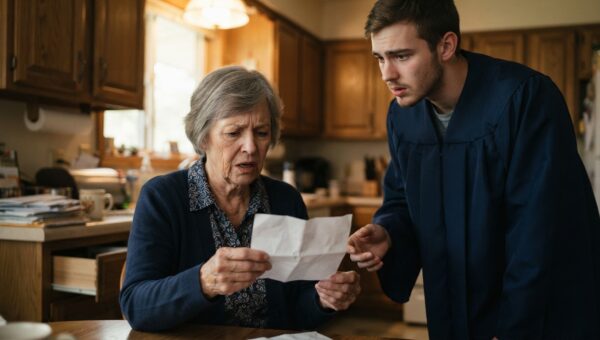
I set a plate of buttered toast down beside her mug. Eat some bread, Paige. We’ll figure out the rest tomorrow morning when the social security office opens.
She took a tiny bite, chewing slowly while the tears finally spilled over her lower lashes and dropped straight into her lap. She didn’t make a sound when she cried, which was worse than if she had wailed. It was the quiet, practiced crying of a kid who had learned early on that making noise only made the adults around her angrier.
That was Reid all over. He always had to have the cleanest house, the straightest lawn, and the most predictable people in his orbit. When he was ten years old, he cried for three days because a neighbor’s dog tracked mud across his freshly chalked baseball baseline. He grew up into a man who measured his own worth by how neatly he could fold his life away from the mess of other human beings.
And God help anyone who stained his reputation. A pregnant seventeen-year-old daughter who wasn’t married and didn’t have a college fund lined up was the kind of catastrophe that Reid felt he couldn’t survive in his little subdivision.
I poured myself another cup of coffee, letting the familiar brown liquid warm my palms.
Does he know about the father? I asked quietly.
Paige shook her head, her bangs falling into her eyes. He’s gone, Grandma. He cleared out his locker at the warehouse last month and went down to Texas. He told me I was making a big deal out of nothing. When I told Dad, he didn’t even ask who the boy was. He just started yelling about his church friends and what the people at the credit union would say on Monday morning.
I remember church friends. I remember how polite they were when my husband cleared out our bank accounts and left me with three kids under eight and an eviction notice taped to the front screen. Not a single one of them offered to watch Reid or his sisters while I worked the double shift at the diner down by the grain elevator. They just looked at me with those tight, pitying smiles that meant I had somehow failed the test of respectable womanhood.
I spent twenty years trying to prove to those people that I was as good as they were. I kept my kids’ shoes polished. I sewed patches on their school trousers so neat you couldn’t see the stitches. I pushed myself until my knees swelled up from standing on hard tile ten hours a day.
And somewhere along that road, when my sister Clara came to my back door with a suitcase and a black eye, begging me for fifty dollars and a couch to sleep on for a week, I looked at my fragile little life and told her no.
I told her I couldn’t risk my job. I told her Reid and the girls needed every cent we had. I watched her walk down the gravel alleyway toward the bus station, her head down, carrying her whole life in a cardboard box from the grocery store. She died six years later in a rooming house in Muncie, and nobody called me until the funeral was already over.
I set my coffee mug down hard enough to make the spoons rattle in the drawer.
He’s going to come over here, I said, looking right at Paige. Your daddy’s going to finish his dinner, and then he’s going to drive his truck right down this street because he needs to have the last word.
Paige stopped chewing. Her eyes went wide and dark in her pale face. Are you going to send me away when he gets here?
I reached across the oilcloth table and put my hand over her small, cold fingers. Her skin felt like tissue paper.
Nobody’s sending you anywhere, Paige, I told her. Your daddy forgets where he came from sometimes. He thinks because he got a desk job and a mortgage with a white fence that he’s immune to bad luck. But I was changing diapers when the bank was threatening to turn off our water, and I didn’t back down then. I’m certainly not going to start now over what the people at the credit union think.
We sat there in the quiet kitchen as the sun dipped down below the neighbor’s garage roof, turning the sky the color of a bruised plum.
Right around 7:30, the heavy rumble of Reid’s diesel engine echoed off the asphalt outside. A pair of high beams swept across our front living room window, painting white bars across the family portraits hanging on the wood paneling.
The truck door slammed shut with a sharp metal bang that I could feel right through the floorboards. Heavy boots crunched on the gravel driveway, moving with that stiff, angry rhythm Reid always used when he was about to lecture someone.
Paige shrank back in her chair, pulling her knees up toward her chest like she wanted to fold herself into nothing.
Go sit in the spare bedroom down the hall, I told her, keeping my voice steady. Close the door and leave the light off. Let me handle your father.
She hesitated for half a second, then grabbed her black trash bag by the knot and scurried down the dark hallway like a frightened rabbit. The bedroom door clicked shut with barely a whisper.
I didn’t move from my chair. I picked up my coffee mug, took a slow sip even though it was stone cold by then, and waited.
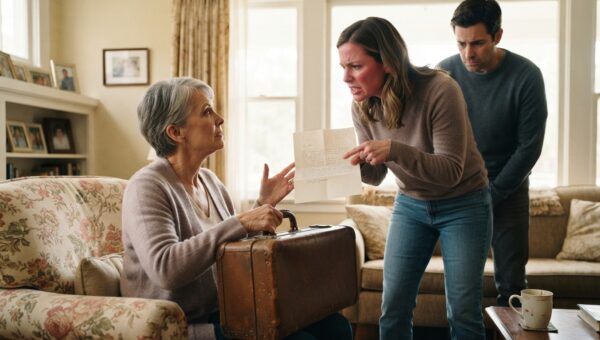
The front doorbell didn’t just ring; it buzzed twice in that sharp, aggressive way Reid used when he was annoyed with a customer service clerk. When I didn’t rush to throw the latch, the knob twisted violently, and then the door banged open against the coat rack in the hall. Reid had kept his spare key all these years for emergencies.
Mother! Reid’s voice boomed through the small house, echoing off the low ceiling. What in the hell is wrong with you? Are you out of your mind?
I stayed sitting at the kitchen table, looking toward the hallway archway as his heavy frame filled the opening. He looked just like his father did twenty years ago when he walked out the door, all squared shoulders and righteous indignation, wearing his flannel shirt and his work jacket, convinced the universe owed him obedience because he paid his bills on time.
He took three long strides into the kitchen, his face flushed red from the cool night air and pure temper. He spotted Paige’s empty mug and the fourteen dollars sitting neatly on the table runner.
Where is she? Reid demanded, pointing a thick finger toward the back of the house. Did you actually let her in? After everything I told you on the phone?
I set my mug down in the center of the table. Sit down, Reid.
I am not sitting down, he snapped, pacing back and forth across my braided rug like a caged animal. Do you have any idea what this does to us? To me? I spent five years building a reputation in this town. My boss is on the board of directors at the bank. If word gets out that my seventeen-year-old unmarried daughter is knocked up and living out of a spare bedroom on public assistance, my career is finished. People talk, Mother. You know how people talk.
Let them talk, I said quietly. They’ve been talking about our family since your daddy left in eighty-four, and I’m still standing here paying my own light bill.
This isn’t about your past, Reid shouted, slamming his palm down on the kitchen counter so hard the salt shaker bounced. This is about accountability! She made her bed. She broke every rule in the house. She lied, she sneaked around, and now she expects everyone else to pick up the pieces while she plays victim. If you coddle her now, you’re just teaching her that she can do whatever she wants with zero consequences.
I looked at him, really looked at him, and wondered at what point my son had turned into a judge in a black robe who forgot how to mercy.
Accountability, I repeated, the word tasting like tin in my mouth. Is that what you call locking your pregnant kid out on the front porch with fourteen dollars and a trash bag?
She brought this on herself! Reid yelled, his face turning a darker shade of crimson. She had a good home. She had rules. All she had to do was follow them until she graduated. Instead, she decided to throw her whole future away on some local nobody who skipped town the second things got complicated. I’m not going to let her drag my name through the mud.
Your name, I said, my voice dropping down to a low, flat whisper that made him stop his pacing. That’s all you’ve cared about since you were twelve years old. What the neighbors think. What the boss thinks at the bank. You were terrified that if you weren’t the most respectable boy in the room, someone would look at you and see your daddy’s ghost.
Reid flinched, just an inch, his jaw tightening until the muscle jumped near his ear. Don’t bring Dad into this.
I brought Clara into this forty years ago, Reid, I said, and the words came out before I could stop them, heavy and raw like dirt being shoveled into a hole. When your aunt Clara stood on my porch asking for a place to lay her head because she was scared and broke, I looked at her the exact same way you looked at Paige today. I told her I had a reputation to protect. I told her my kids needed stability. I turned my back on my own blood because I was too proud and too terrified of what people would say at the grocery store.
The kitchen went dead silent. The old refrigerator in the corner gave a loud, metallic hum, then clicked off, leaving us in a vacuum of sound.
Reid stared at me like I had spoken in a foreign language. That was different, he muttered, though his voice lacked its earlier fire. Clara made her own choices.
We all make choices, Reid, I told him, standing up slowly from the table, my knees popping in the quiet room. And some of us spend the rest of our lives hiding behind them like cowards. I spent forty years regretting that I wasn’t softer when my sister needed me to be. I am not going to spend my last years on this earth doing it again to my granddaughter just so you can sleep better at the country club.
Reid’s chest rose and fell in heavy, angry breaths. He looked at the fourteen dollars on the table, then down the dark hallway toward the spare bedroom where Paige was hiding.
If you keep her here, he said, his voice dropping into a cold, hard ultimatum, you are dead to me, Mother. Don’t call me when you need your leaves raked. Don’t call me when the furnace breaks down in January. I mean it this time. You’re choosing her over your own son.
I walked over to the kitchen counter, picked up my set of brass house keys, and dropped them into my apron pocket.
You always did love a dramatic exit, Reid, I told him, looking him straight in the eye. But you’re wrong about one thing. I’m not choosing between you and Paige. You made that choice for yourself the second you drove down my driveway tonight.
He stood there for three long seconds, waiting for me to blink, waiting for me to cave the way I used to when he threw tantrums over his baseball gear as a boy. But I didn’t blink.
Reid turned on his heel, his heavy boots hitting the linoleum with a hollow sound, and stormed out the front door, leaving it wide open to the night air. The slam that followed shook the house down to its foundations, rattling the teacups in the china cabinet.
A moment later, the diesel engine roared to life in the driveway, tires spitting gravel as he threw the truck into reverse and tore down the asphalt street toward the highway.
I stood in the empty hallway for a long time, listening to the red tail-lights fade away into the dark.
The house felt enormous and terrifyingly quiet.
Slowly, I walked down the hall and pushed open the door to the spare bedroom. Paige was sitting on the edge of the mattress, her knees pulled up to her chin, her small face barely visible in the moonlight coming through the window.
Is he gone? she whispered.
He’s gone, I said.
Is he going to cut you off too, Grandma?
I walked over, sat down on the edge of the lumpy mattress beside her, and pulled her stiff, trembling shoulders into my arms until she finally let go and cried hard against my shoulder.
Let him try, I whispered into her hair. We’ve still got fourteen dollars and a whole lot of room left in this house.
The next morning, the sun came up pale and clear over the rooftops, cutting long gold bars across the worn floorboards of my kitchen.
Two mugs of morning coffee rested on the oilcloth table beside a small, empty black trash bag, and I reached across the wood to squeeze Paige’s steadying hand in the morning light.