The hallway outside our back bedroom had smelled of old paper and peppermint oil for thirty years, ever since Arthur planted the little garden by the side porch. On a Tuesday afternoon in late October, it smelled mostly like masking tape and damp cardboard.
My son Mark had brought three boxes from the hardware store down on 4th Street, the kind with the blue printing on the side that tells you how to fold the bottoms so they do not give out under thirty pounds of canned goods or winter blankets.
Mark is forty-eight now, with the same square jaw his father had before the stroke took the strength out of the left side of his face, and he moves through a room like he is settling an estate before the heirs even get their coats off.
“The intake coordinator said they have a ground-floor unit opening up next month,” Mark told me, not looking up from the stack of photo albums he had pulled off the bottom shelf of the bookcase. “It has the walk-in shower with the built-in seat, Mama. And someone comes in at seven every morning to make sure the bed gets made. You won’t have to worry about the stove anymore.”
Arthur was sitting in his green vinyl armchair by the radiator, his hands folded in his lap the way they have been since the hospital discharged him three winters ago. He didn’t look at the boxes.
He looked at the baseboard heater where the paint has been flaking off since the Reagan administration, his eyes fixed on that one little gray chip that curled up like a dry leaf.
I had been standing by the sink with a dish towel in my hands, folding and refolding the hem until the cotton was warm from my palms. I knew about the thirty thousand dollars because Mark had left the printout from the credit union on the corner of the kitchen table last Thursday, right on top of the grocery receipts.
“It covers the community fee and the first six months,” he had said to me then, his voice flat and careful, the way he uses when he is talking to a client who is behind on their truck payments. “After that, we can look at liquidating the back lot. It is just too much house for you, Mama.
You left the front burner on high for twenty minutes on Saturday. Mrs. Gable smelled it from across the driveway.”
I didn’t tell him that I had been browning butter for the noodles Arthur likes with his pot roast, and the doorbell had rung just as the skillet started to smoke, and by the time I took the package from the UPS man, the dial had slipped half an inch past the notch. I just wiped the counter and let him talk.
People get an idea in their heads once you hit seventy-eight. They start looking at your kitchen floor like it is a courtroom exhibit. If you misplace your reading glasses twice in one morning, you are no longer a person who has lived in the same zip code for half a century; you are a hazard to public safety.
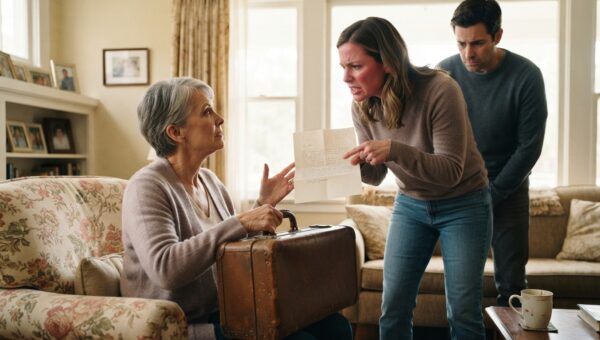
By six o’clock, the living room looked like a bus station. Mark’s wife, Brenda, had brought over casseroles in aluminum pans that she set on the sideboard, and she kept lowering her voice every time she spoke to me, the way people do in hospital waiting rooms when they think the patient is sleeping under heavy sedation.
My great-granddaughter Lily sat at the corner of the table with her knees tucked up against the rungs of her chair, swinging her short legs in her patent-leather shoes that still smelled like new cardboard from the shoe store in the mall. She had a habit of tracing the grain of the oak table with the tip of her plastic spoon, round and round in little concentric circles that never crossed each other.
“Grandpa wants his water,” Lily said suddenly, breaking through the low murmur of Mark and Brenda talking about moving van rentals and utility transfers.
The room went quiet for a second, the kind of stillness where you can hear the pilot light in the furnace clicking on down in the basement.
I reached for the glass on the sideboard, but Mark beat me to it, filling it from the tap and carrying it over to Arthur’s chair with that careful, exaggerated patience he had picked up from the physical therapy brochures.
“Here you go, Pop,” Mark said, setting the glass on the side table. “Just sip it slow.”
Lily watched her uncle with her chin propped in her small hand, her brown eyes too big for her face. She didn’t touch her mashed potatoes.
“Grandma gives Grandpa his shots,” she piped up, her voice ringing clear against the plaster walls. “Every morning, every night. She never forgets that.”
The table went dead still. Brenda stopped buttering her roll, the yellow knife hovering an inch above the bread. Mark turned around slowly from Arthur’s chair, his hand still resting on the back of the green vinyl.
My chest went tight, that familiar squeeze behind the ribs that usually comes right before I have to count out the blue pills into the small plastic tray.
“What did you say, Lily?” Mark asked, his voice dropping into that low, flat register.
“The little needles,” the child said, pointing toward the back bedroom with her spoon. “In the leather case with the zipper. Grandma does them before we have toast.”
Mark looked at me across the room, his eyes scanning my face as if he were trying to find a signature he hadn’t checked in twenty years.
“Mama?” he said. “What is she talking about?”
For three years, since the stroke took most of his words and left his right hand looking like a bird’s claw that could no longer hold a pen or a spoon without dropping it, Arthur had not touched a single needle. Every morning at 6:00 AM, before the sun cleared the top of the water tower down on Lincoln Street, I sat on the edge of the mattress with the small plastic alcohol wipes and the yellow plastic pen. I checked the little gray meter with the cracked screen. I drew up twelve units for the morning, twenty-four for the evening, holding the plunger against the light to make sure there wasn’t a single air bubble big enough to cross a room, let alone a vein.
Nobody had asked. Nobody had stayed long enough to watch the routine start when the house was dark and cold. They only saw the burnt toast on the counter and the name of the grocery store clerk that slipped my mind when Mark asked me who gave me the discount on the celery.
“It’s just part of the morning,” I said, my voice sounding smaller than I meant it to, dry like old paper.
Mark didn’t move. He stood there by his father’s chair, his mouth slightly open, looking down at Arthur as if he were seeing him through the wrong end of a telescope.
“Pop,” Mark said, his voice thickening up a bit. “Who’s been doing your numbers?”
Arthur didn’t say words the way he used to. He could get out three or four at a time if he didn’t rush them, but mostly he just pointed or made a low, rumbling sound in his throat that meant yes or no. He lifted his heavy right hand, the fingers curled and stiff, and pointed one thick finger directly toward the back bedroom, right at the top drawer of the maple dresser where the quilt box sits.
“She,” Arthur said. The word came out rough, like gravel sliding down a chute, but he said it twice. “She did.”
Mark walked past the table without touching another box, his heavy boots heavy on the braided rug. I didn’t follow him, but I heard the drawer slide open, that familiar dry screech of the maple wood that hasn’t been waxed since my husband’s workshop closed down.
When Mark came back into the kitchen, he wasn’t carrying the photo albums. He was holding the small, black vinyl ledger I’ve used since the third month after the stroke, the one with the elastic band that’s lost its stretch and is held together with a piece of blue twine.
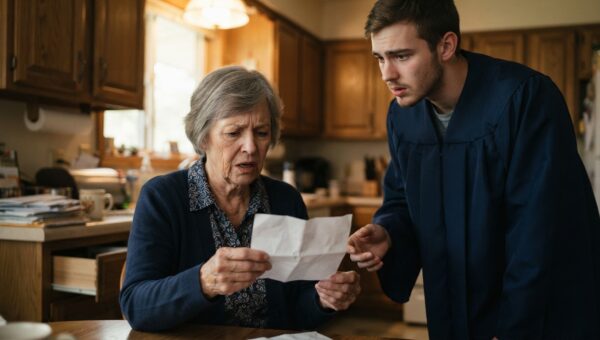
He laid it down right on top of the moving company brochure, right over the line where it said *Assisted Living Deposit: $30,000*.
The pages were soft from being turned six thousand times. Every line was written in my steady, old-fashioned hand, rows of tiny numbers stretching back across three winters and two summers: glucose readings in black ink, insulin units in red ink, weight checks every Sunday morning before breakfast.
Mark turned a page, his thumb smudging a bit of ink from a Tuesday in November two years ago when the weather had turned sudden and Arthur’s sugar had dropped to fifty-four while we were watching the evening news. I had given him four ounces of orange juice and waited twenty minutes, retesting until the needle hit one-ten, then written it down in the margin with a small checkmark.
“Mama,” Mark said, and his voice didn’t sound like the intake coordinator anymore. It sounded like the boy who used to scrape his knees on the gravel driveway and come looking for iodine and a clean rag. “If you missed a dose by two units… if you got the ratio wrong…”
“I didn’t get it wrong,” I said.
I picked up the dish towel again, though it was already dry.
“You forgot the stove last week,” Brenda said from the table, her voice small, trying to find some footing in a room that had suddenly tilted sideways.
“The stove is an electric iron box with numbers I can’t read without my distance glasses,” I told her, looking straight at the salt shaker between us. “The insulin is a life. I haven’t forgotten a life yet.”
Arthur made that low sound again from his corner, shifting his weight in the green chair so the springs groaned under him. He lifted his chin, looking at his son with those pale blue eyes that still missed nothing, even if the words stayed trapped behind his teeth.
Mark stood there for a long time with his hand resting on the black ledger. He looked down at the rows of numbers, every single day accounted for, every fraction of a unit weighed and measured in a quiet room while the rest of the world figured we were already half-gone.
Then he reached out, picked up the brochure for the home with the walk-in showers and the thirty-thousand-dollar deposit, and folded it in half twice until it was small enough to fit into his coat pocket.
“Brenda,” Mark said without turning around. “Put those boxes back in the truck.”
Nobody said anything else for a minute. Lily climbed down from her chair, her patent-leather shoes clicking softly against the linoleum, and walked over to her grandfather’s knee, leaning her head against his shoulder where the gray wool cardigan smelled of pipe tobacco and peppermint.
The living room was quiet again, the way it gets when the sun goes down behind the water tower and the radiators start their steady, rhythmic clank against the wall.
Later that evening, after Mark and Brenda had driven away and the tail-lights of the truck had turned the corner by the mailbox, I went back to the kitchen table.
The worn leather-bound insulin logbook was still resting open right where Mark had left it, the pages flat under the yellow kitchen light, beside two clean syringes waiting for the morning.