PART 1
The probate court copy of my father’s will arrived in a manila envelope with page two entirely missing, leaving a gap where my legally guaranteed fifty percent share of the historic Charleston home should have been secured. I sat at my kitchen table in the quiet historic neighborhood where I had grown up, staring at the blank space in the court numbering sequence, trying to make sense of how an official document could just drop a page.
My sister-in-law Lillian had handled the initial filing three weeks after my father passed away. She was the estate executor, a woman who wore her competence like expensive armor and never missed a chance to remind everyone of my past financial stumbles from my twenties.
According to Lillian, she was stepping in to protect what remained of the family property from my supposed recklessness. She had organized the funeral, gathered the paperwork, and gently told our extended family that she would manage the distribution of the one hundred eighty-four thousand five hundred dollars in real estate equity so I would not make any impulsive choices. At forty-four, as a mid-career professional and resident board treasurer for our neighborhood association, I thought I had moved past the family narrative of being the irresponsible younger relative. Yet sitting there with the incomplete probate filing, I realized Lillian was not just helping. She was building a paper trail that cast me as a beneficiary who had already received his advance, leaving the house entirely under her control.
I called her office that afternoon, my voice tight with a mix of grief and irritation. Lillian picked up on the second ring, her tone instantly adopting that patient, managerial cadence she used whenever she needed to soothe a difficult client.
Marcus, she said, her voice smooth and practiced, you know how overwhelmed you’ve been since Dad passed. I am simply streamlining the title transfer so we don’t trigger unnecessary tax penalties or probate delays. Trust me, it is much cleaner this way.
Clean for whom, I wanted to ask, but I swallowed the question, letting grief and a misplaced sense of family loyalty keep me quiet. I had trusted her too deeply, avoiding direct confrontation because I did not want to dishonor my father’s memory with bickering over paperwork while his urn still sat on the mantel. That silence had been my biggest blind spot. It gave Lillian four months to quietly manipulate property titles and bank distributions without a single word of pushback from me.
Two days later, I drove over to the old house on Legare Street to begin the routine estate appraisal inventory my lawyer had advised me to request formally. The rooms still smelled faintly of my father’s pipe tobacco and old floor wax. The sun cut through the high parlor windows, throwing long, slanted light across the Persian rugs we had walked on as kids. Lillian was supposed to meet me there at ten, but she called at nine-to say an urgent closing at her real estate firm required her presence, telling me to go ahead and start cataloging the downstairs study.
I spent an hour going through the bookshelves and filing cabinets, noting old tax receipts and family photo albums. In the corner sat our father’s heavy mahogany partner desk, its top drawer locked tight. I remembered he kept his spare fountain pens and important duplicate records in there. On a hunch, I tried the small brass key ring I had found in his bedside table drawer. The third key turned with a soft, heavy click.
Inside the top drawer, beneath a stack of old ledger books from his veterinary practice, I found something that made my chest tighten. It was an original duplicate ledger from the local bank, dated just two weeks before his death, tucked inside a manila folder labeled personal directives. Attached to it was an old bank statement from the neighborhood branch. Running my finger down the itemized charges, I stopped at a strange fifteen-dollar notary fee charge dated exactly three days after my father had supposedly signed his final estate instructions with Lillian present.
My father never used outside notaries unless he was confined to his bed. And according to this statement, the fee was processed across town at a shipping center near Lillian’s office, not our local branch.
I pulled out my phone and photographed the page, the digital shutter click sounding unnaturally loud in the empty, high-ceilinged room. Before I could process what the fee meant, the heavy front door clicked open in the hallway. Lillian’s heels clicked against the hardwood floor as she called out my name, her voice carrying an edge of sharp surprise that she was not alone in the house.
PART 2
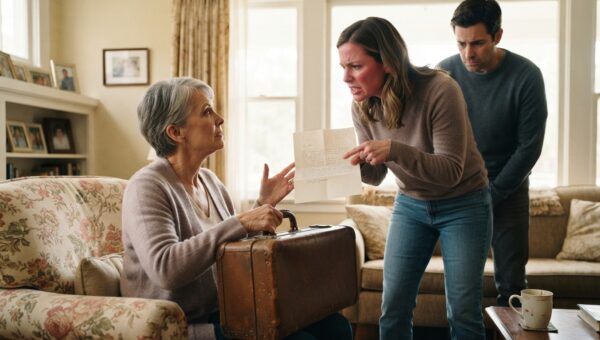
Marcus, what are you doing in here? Lillian asked, stepping into the study with her leather briefcase tucked tightly under her arm. Her eyes darted straight to the open mahogany drawer before flicking back up to my face.
I was just finishing the inventory you asked me to do, I said, keeping my voice level, though my pulse was hammering against my ribs. I found Dad’s old ledger books.
She stepped closer, her expression shifting instantly from surprise to practiced concern. Her shoulders dropped into a posture of wounded patience. You know how disorganized he became toward the end, Marcus. There is no reason to go digging through every old receipt. It only prolongs the grief for both of us. Besides, I already spoke with the probate clerk this morning about expediting your distribution once the final deed transfer clears.
How much is the final distribution slated to be, Lillian? I asked, looking directly into her eyes.
The exact figure we agreed on, she said, her voice hardening just a fraction before she smoothed it back out. Forty thousand for your immediate settlement, to help you clear up whatever personal debts you might still be carrying from your thirties.
The real estate equity share was one hundred eighty-four thousand five hundred dollars, exactly half of the assessed value of the property. Forty thousand was not a settlement; it was a payoff designed to make me disappear from the title forever while she absorbed the rest to fund her daughter’s expensive private university tuition entirely out of liquid estate assets. I didn’t yell. I didn’t accuse her on the spot. I simply closed the desk drawer, locked it with the small brass key, and walked past her without another word.
That afternoon, I took the photographs of the bank statement and the duplicate ledger straight to a probate attorney recommended by a trusted colleague on the neighborhood board. We didn’t waste time filing emotional appeals. My lawyer reviewed the missing page sequence from the court copy alongside my photographic evidence of the unexplained notary fee and the original duplicate ledger. Within forty-eight hours, we filed a formal motion for an independent forensic accounting review through the Charleston County probate court, backed by a subpoena for the original document archive.
When Lillian was formally served with the court notice three days later, her polite facade finally cracked. She called my cell phone four times in a row, her voice dropping the maternal sweetness entirely, demanding to know how I could be so ungrateful after everything she had done to keep the family from falling apart. I didn’t answer her calls. I let the legal process carry the weight I had spent months carrying alone.
PART 3
The forensic audit didn’t take long once the bank records and the original filing archives were placed side by side under a judge’s order. The handwriting expert confirmed what the missing page sequence had hinted at all along. Two weeks before our father passed away, he had executed a formal codicil explicitly leaving the historic Charleston property split directly fifty-fifty between us, with zero conditions regarding my past financial history. Lillian had not misplaced page two of the probate copy. She had detached it from the original instrument at the shipping center across town, paying the exact fifteen-dollar notary fee logged on the old statement to notarize a fraudulent substitution that transferred sole executorship and majority equity control into her own personal holding trust.
The confrontation happened not in a dramatic shouting match on the front lawn, but across a polished conference table during a mandatory legal mediation session ordered by the probate judge.
Lillian sat across from me in a tailored charcoal suit, her expression cold and tight, flanked by a high-priced family attorney who looked increasingly uncomfortable as he reviewed the forensic report. On the center of the table lay the recovered second page of the codicil, bearing our father’s unmistakable signature and the two original witness marks that Lillian’s separate filing had conveniently omitted.
We can settle this quietly by reinstating the correct property division today, or we can let the district attorney review the notary logs from the shipping center, my lawyer said, sliding the certified document forward. The choice is yours, Lillian.
She looked down at the paper, her fingers tightening around the leather strap of her briefcase. For a long moment, the silence in the room was absolute, broken only by the hum of the overhead air conditioner. The superiority that had carried her through months of gaslighting me finally dissolved into a bitter, pinched realization that her elaborate scheme had collapsed under the weight of simple, stubborn documentation. She didn’t offer an apology. People like Lillian rarely do. She simply signed the consent decree relinquishing her executor powers and authorizing the immediate restoration of my full legal share of the estate.
ENDING
Two weeks after the mediation concluded, the revised deeds were officially recorded with the county, restoring my legally guaranteed fifty percent share of the property and sealing Lillian’s permanent removal from any control over my father’s legacy. I drove over to Legare Street just before dusk, holding the newly minted brass key in my palm. The neighborhood was quiet, the evening air carrying the distinct scent of jasmine and salt marsh from the harbor. I unlocked the heavy front door and stepped inside into the warm, familiar quiet of the hallway. The urn still sat on the mantelpiece in the parlor, catching the last amber rays of the Charleston sunset through the high glass panes. I stood there alone for a long time, feeling a quiet, unshakeable peace settle deep into my bones, knowing my father’s true wishes had finally been honored without descending into bitter vengeance. I turned the key twice in the deadbolt, stepped back out onto the porch, and locked the door behind me for the very last time as a visitor who no longer needed anyone’s permission to belong.