I got the math wrong on the grocery bill twice that week, and that was apparently all the proof my son David needed to decide I belonged in a nursing home. He stood by the sideboard with a stack of brown liquor store boxes he had taped up the night before, talking about my future like I was already a piece of furniture he had to clear out of a spare room.
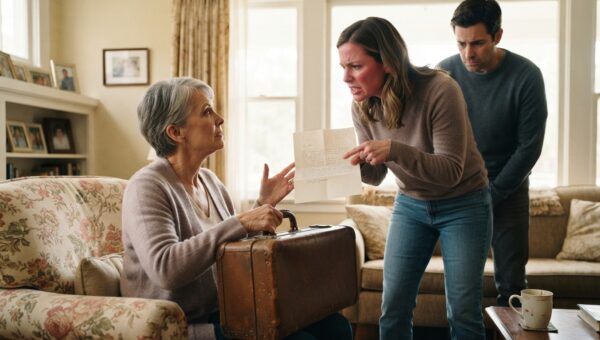
The house smelled like floor wax and the cabbage soup I had made for lunch, ordinary smells that suddenly felt heavy and wrong. David had his clipboard out, the one with the aluminum clip that always squeaked when he turned a page. He tapped the corner of it against his palm while my daughter-in-law, Susan, folded tea towels at the kitchen island as if she were inspecting them for lint.
“It is just not safe anymore, Mama,” David said, using that careful, slow voice he reserved for people who had lost their keys or forgotten what day it was. “You left the front door unlocked on Tuesday. And Dr. Evans agreed that your short-term memory is sliding off a cliff.”
I sat in my usual ladder-back chair with my hands folded in my lap, watching the dust motes drift in the late afternoon sun that cut across the linoleum. Arthur sat across from me in his orthopedic chair, his right hand curled into a stiff claw against his knee, staring down at his patterned socks with that blank, heavy patience he had worn every day since the stroke took his speech three years ago.
Susan didn’t look up from her folding. “We already ran the numbers on your accounts, Helen. The thirty thousand in your separate savings will cover about twelve months at Oakridge Manor. After that, we can look at Medicaid options for the remainder.”
They had it all laid out like a blueprint for a commercial garage. My life, my thirty thousand dollars, my small brick house with the weeping willow out front, all neatly bundled into a twelve-month transition plan that ended with me staring at a pale green wall three miles from the highway. They talked about me in the third person while I was sitting six feet away, weighing my competence on a scale they had bought at a hardware store.
I didn’t argue about the door. I knew I had left it unlocked. I also knew I had done it because the mail carrier, young Jimmy with the red hair, had dropped my heart pills in the screen door crack and I went out in my apron to grab them before the humidity ruined the cardboard.
But nobody asked about Jimmy. They only saw the open latch and the gaps in my memory where names sometimes slipped away like minnows through a net.
Dinner was roast pork and boiled potatoes, cooked on the stove I supposedly couldn’t trust myself to light. We ate in a strained sort of quiet where the only sound was the scrape of forks against stoneware and the heavy ticking of the kitchen clock that Arthur had repaired back when we still had a shop on Main Street.
David was cutting his meat with aggressive, short strokes. “We can get the movers in by Saturday morning, Mama. It is better to rip the bandage off clean. You will make friends there. They have bingo on Tuesdays.”
I looked down at my plate. The gravy had skinned over into a dull grey film. I felt small and thin, like an old dress left out in the rain too long, and I wondered if maybe they were right.
Maybe the fog in my head really was too thick to navigate. Maybe I was just a liability waiting for a disaster.
Then little Chloe, who was seven and mostly spoke only when someone asked her a direct question, dropped her fork against her bread and butter plate with a sharp, ceramic ping.
“But Grandma gives Grandpa his shot,” she said, her voice bright and clear in the middle of David’s speech about bingo. “Every morning and every night. She forgets that.”
The table went dead silent. Susan stopped folding the tea towel mid-motion, her hands freezing against the checkered cotton. David’s fork hovered halfway to his mouth, the roast pork sliding an inch down the tines before stopping.
“Chloe, eat your carrots,” Susan said automatically, her voice tight around the edges.
“No, she does,” the girl insisted, leaning forward so her pigtails swung over her chest. “I saw her this morning before you guys got here. She took the little bottle out of the blue box in the pantry and she rolled the glass between her palms like this. And then she counted the ticks on the clicker.”
David slowly set his fork down on the edge of his plate. The clatter was louder than it should have been. He turned his head toward me, his brow bunching up into three deep creases that made him look suddenly much older than forty-four.
“Mama,” David said, and his voice didn’t have that careful, clinical padding anymore. “What is she talking about?”
Arthur didn’t look up from his socks, but his left hand twitched once against the armrest, a tiny, involuntary jerk that I knew meant he was listening hard.
Nobody had noticed. That was the funny thing about children and stroke victims. Everyone else looked at what was broken, but Chloe and Arthur looked at what was actually happening right in front of them. For three years, since the blood clot hit the left side of Arthur’s brain and left him speaking in half-formed nouns and dragging his right heel across the rug, I had been the one keeping the gears turning.
I didn’t say anything for a long second, letting the silence settle into the room until it felt thick enough to touch. My chest felt tight, not with fear, but with a cold, steady anger that had been building underneath my ribs ever since they brought the first cardboard box through the front door.
“She is talking about his insulin, David,” I said plainly. My voice didn’t shake. It surprised me how steady it sounded.
David leaned forward, planting both palms flat on the laminate table. “Arthur’s insulin is managed by the visiting nurse service. They come out on Tuesdays and Thursdays. That is what we pay seventy dollars an hour for.”
“They come on Tuesdays and Thursdays to check his blood pressure and drop off the boxes,” I said, standing up from my chair. My joints popped once, dry and loud in the quiet kitchen. “They do not live here. They do not wake up at 5:00 a.m. when his sugar drops so low he starts sweating through his pajamas.”
I walked over to the pantry, my slippers whispering against the linoleum. I reached up past the rows of canned peaches and old jelly jars, past the box of tea bags David had bought me because he thought green tea helped with memory, and I pulled down the heavy metal cocoa tin.
I set it down right in the middle of the table, between David’s plate and the gravy boat. The tin made a dull thud against the wood.
“What is that?” Susan asked, her voice small.
“Open it,” I told David.
He hesitated, his fingers hovering over the faded lithograph of Dutch children on the lid before he finally lifted it off. Inside weren’t biscuits or sewing supplies. There was a stack of yellowed graph paper notebooks, bound together with rubber bands that had dried out and turned amber, and a dozen unused plastic syringes packed neatly in their sterile wrappers.
David picked up the top notebook. The cover had my handwriting on it in heavy blue ballpoint ink, neat and slightly slanted: *Arthur’s Numbers – 2021 to Present*.
“Three years,” I said, leaning against the back of Arthur’s chair and resting my hand briefly on his good shoulder. He leaned into my palm, just an inch, his gray head tilting toward my wrist. “Every single morning at 6:00 a.m. and every night at 8:30 p.m. I draw twenty-six units of NPH and six units of regular. I check his blood with the little silver meter that you think I lost behind the toaster last Thanksgiving. It is in the bread box, by the way. Right where I put it so the mice wouldn’t chew the wires.”
David flipped open the notebook. Page after page of columns, dates, numbers, blood glucose readings, carbohydrate counts, and notes about whether Arthur had eaten his oatmeal or pushed it away. One thousand and ninety-five days of math, measured in drops of blood and tiny plastic needles, all recorded while my son spent forty minutes every Sunday afternoon telling me I ought to look into a nice retirement community with an active social calendar.
“You’re eighty-one years old,” David whispered, staring down at the ink as if it were written in Latin. “You could have… if you messed up the dose…”
“I didn’t mess up the dose,” I said. “Not once in three years. Not when my hip was acting up, not when the power went out for two days during the ice storm, and not when you brought those boxes into my kitchen and told me I was useless.”
Susan pushed her chair back, the metal legs screeching against the floor. She looked at David, then at the notebooks, and then at me with something that looked very much like fear. Not fear of me, but fear of how wrong they had been, and how close they had come to throwing away something they didn’t even have the eyes to see.
“We thought…” Susan started, her voice trailing off into nothing.
“I know what you thought,” I said. “You thought old age was a straight line down into the dark. You thought because I forgot the name of the girl at the pharmacy, I forgot how to keep the man I have loved for fifty-four years from slipping away in his sleep.”
David didn’t answer. He sat there with the notebook open in his lap, his thumb tracing the blue lines where I had marked every high reading with a tiny red asterisk. The silence in the kitchen wasn’t heavy anymore; it was sharp and clean, like the air after a hard freeze.
The moving boxes were still by the sideboard, taped up tight with their little paper labels reading *Living Room Sundries* and *Helen’s Linens*. They looked ridiculous now, like luggage left behind by travelers who had missed the only train that mattered.
“Unpack those boxes, David,” I said, pointing toward the door with my chin.
He looked up, blinking hard against the kitchen light.
“Take them out to your car,” I told him, and my voice dropped into that tone my mother used to use when she was done discussing a fence line with the neighbors. “And take your thirty thousand-dollar plan with you. If Arthur needs his sugar checked tomorrow morning at six o’clock, I intend to be right here with the clicker and the tin.”
David didn’t argue. He stood up slowly, his knees popping, and reached for the top box by the sideboard. He didn’t look at Susan, and he didn’t look at me. He just picked it up, turned around, and walked out through the screen door into the darkening yard, the hinges giving that familiar, long squeak that we had never quite gotten around to oiling.
After the car doors slammed shut in the gravel drive and their taillights swept across the kitchen ceiling and vanished down the road, the house settled back into its own skin.
Arthur reached out his good left hand, his fingers trembling just a little, and touched my wrist where I stood beside his chair. He didn’t say anything because he didn’t have the words for it, but he didn’t need them.
The kitchen window caught the last amber smear of dusk across the pasture, turning the glass the color of old cider. I picked up the insulin pen from the table, my hand steady as I checked the dial, while Arthur watched me with those quiet, steady eyes that had seen the whole thing from the very beginning.