The kitchen was quiet in that heavy way it gets right after seven o’clock when the supper dishes are cleared and the refrigerator kicks on with a low, vibrating hum. I had been sitting at the laminate table with a stack of grocery store flyers and a ballpoint pen, trying to figure out how to stretch the remaining grocery money for the next twelve days until my next shift at the clinic.
Noah walked in without making a sound on the linoleum, his gray hooded sweatshirt pulled low over his forehead, his shoulders rounded like he was carrying something invisible and entirely too heavy for a seventeen-year-old boy. He kept his hands stuffed deep into his front pouch.
“Ma,” he said, his voice dropping off before he even finished the word. “Can I use the tablet for a bit? Mr. Henderson assigned that online history module and my phone screen is too cracked to read the source texts.”
I didn’t think twice about it. Why would I? He was my boy, quiet lately, sure, but high school juniors get moody when midterms roll around and the pressure starts piling up. I just reached behind the toaster, picked up the silver tablet, and handed it across the table to him without looking up from my coupon clipping.
“Don’t stay up till three playing those strategy games,” I told him, pointing my pen at his chest. “You’ve got first-period English tomorrow.”
“Yeah, I know,” he muttered, snatched the device from my fingers, and turned on his heel before the screen even fully lit up.
The heavy oak door of his bedroom at the end of the hall clicked shut a second later.
I went back to my coupons, listening to the faint, tinny tap of his fingers on the glass keyboard through the thin drywall. After about an hour, my feet started bothering me from the double shift I had pulled down at the clinic, so I stood up to make a cup of chamomile tea before heading down the basement to fold the laundry. The kettle was slow to heat on the old electric burner, and while I stood there waiting for the whistle, I remembered I needed to check the exact measurements for that slow-cooker pot roast recipe my sister had texted me on Sunday.
I walked into the living room where Noah had left the tablet resting face-down on the arm of the floral sofa. I picked it up, pressed the home button, and tapped the browser icon to pull up my saved recipe site.
The browser didn’t open to the recipe page. Instead, it opened straight to a freshly loaded tab with a bright green checkmark at the top.
My eyes didn’t register the words at first. I just stared at the bold black numbers centered on the white screen.
Confirmation number: 884-2910-X.
One-way economy ticket. Origin: Pittsburgh International. Destination: Dublin, Ireland. Total amount charged: $2,100.00. Departure date: tomorrow morning at 6:45 AM.
My blood didn’t run cold. It just stopped moving altogether. I stood there in the quiet living room, the digital glow reflecting off my glasses, and tried to make my brain connect the numbers on the screen to the boy sitting twenty feet away down the hallway. Two thousand one hundred dollars. Noah didn’t even have a savings account worth two hundred dollars, let alone enough to buy international airfare. We didn’t have passports. We had never even been on a commercial airliner, let alone across the Atlantic Ocean.
I didn’t knock. I didn’t even hesitate. I walked down that hallway with my chest feeling like someone had clamped a vise around my ribs, pushed his bedroom door open wide, and stepped inside.
Noah was standing by his closet with a heavy black duffel bag unzipped across his mattress. He had three pairs of jeans and four hoodies piled in a sloppy heap beside a pair of worn-out sneakers. When the door slammed against the wall, he jumped like he’d been shot, his hands flying up to clutch a dark blue passport cover he had been sliding into his jacket pocket.
“Where did you get the money?” I demanded. My voice didn’t sound like mine. It sounded small, sharp, and cracked at the edges.
He didn’t look up. He just kept his eyes fixed on the zipper of the duffel bag, his jaw working overtime as he shoved the passport against his ribs.
“I don’t owe you an explanation,” he sneered, his voice dropping into that cold, ugly register he had picked up over the last six months whenever I asked him who he was texting late at night. “I am leaving.”
“You are seventeen years old!” I shouted, taking two fast steps across the room until I was standing right in front of him. “You are not going anywhere! Who gave you two thousand dollars? Is this some kind of sick joke?”
“It’s not a joke,” he yelled back, finally lifting his chin to glare at me with eyes so full of bitter, unearned hatred that it made my knees shake. “I’m done here. I’m done with this house, I’m done with the way you look at me like I’m a criminal every time I breathe, and I’m done being stuck in this dead-end town.”
Before he could pull away, I lunged forward and grabbed the edge of the blue passport cover sticking out of his coat pocket. He jerked back, shouting my name, but I pulled harder, my fingers tearing the leather flap free from his grip.
As the passport came away in my hand, something else came sliding out from between the pages. A folded piece of lined notebook paper drifted down through the air and landed face-up on top of the pile of hoodies on the bed.
I dropped the passport, reached down, and picked up the paper.
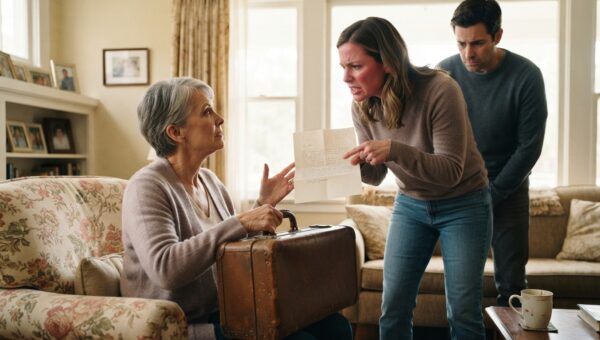
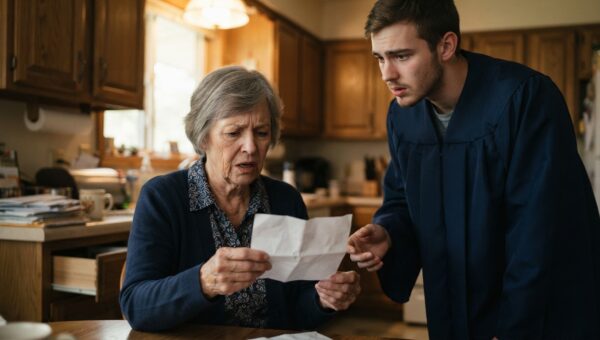
The room seemed to tilt sideways. The handwriting was slanted, heavy, and aggressive, written in black ink that had bled slightly into the cheap paper fibers. I knew that handwriting better than I knew my own face. I had stared at it on legal notices and bank statements ten years ago when my brother packed up a rented truck and emptied our aging mother’s bank account before skipping town for good.
My vision blurred until the words swam in front of my eyes, but I forced myself to read them out loud, the syllables scraping out of my throat like gravel.
“Dear Noah,” I read, my voice trembling so badly I could barely form the sounds. “You did the right thing. Forget her. Forget the rules and the miserable life she’s built for you. Meet me at Terminal B outside baggage claim at 5:00 AM sharp. We’re going to make things right. And don’t worry about your mother finding out until we’re halfway across the Atlantic. Let her sit in that empty house and wonder what she did wrong for once.”
It was signed with a sharp, sweeping slash that formed the letter M. Marcus.
I looked up from the paper. Noah was standing there with his hands clenched into fists at his sides, his chest heaving under the gray sweatshirt. For a second, neither of us breathed.
“You’re running off with Marcus?” I whispered, the absurdity of it tasting like ash in my mouth. “My brother? The man who stole every dime our mother had left for her final years? The man who hasn’t spoken to this family in a decade?”
“He understands me,” Noah shouted, his voice cracking on the edge of tears. “He told me how you drove him out! He told me you always had to control everything and everyone around you! He said he’s got a place for me in Dublin, working with him, earning real money instead of listening to you complain about bills every single night!”
“He is using you, Noah,” I said, and for the first time all evening, my voice went flat and cold. I didn’t yell. I just held the letter out toward him so the ink was inches from his face. “Read the last line. Read what he says about me. Does that sound like an uncle who loves you, or does it sound like a coward who wants to use a seventeen-year-old boy to settle an old score with me?”
Noah didn’t take the paper, but his eyes dropped to the page. He read the lines again, his lower lip starting to tremble despite all his hard work to look tough. I watched the defiance slowly drain out of his face, replaced by that terrible, hollow realization that comes when a kid figures out for the first time that an adult they trusted has been lying to them.
“He said… he said you wouldn’t care if I left,” Noah whispered, the anger completely gone now, leaving only a small, terrified boy standing in the middle of a messy bedroom.
“He doesn’t care about you at all,” I said softly, stepping closer and reaching out to touch his arm. He didn’t pull away this time. “He cares about hurting me. You were just his tool to do it.”
Nobody said anything for a long time, and honestly that felt heavier than any shouting could have. The only sound in the house was the hum of the refrigerator down the hall and the distant hiss of traffic out on the highway.
Noah looked down at the duffel bag on the mattress. Then he looked at the open passport lying on the floor near his sneakers. Slowly, deliberately, his shoulders slumped forward, and he let out a long, ragged breath that sounded like air escaping from a punctured tire.
“Cancel it,” he whispered to the floor. “Please. Just… cancel the ticket.”
I didn’t say I told you so. I didn’t hug him right away either, because my arms were still shaking too hard to hold anything. I just reached down, picked up the folded letter, and tore it straight down the middle into four neat pieces before dropping them into the metal wastebasket beside his desk.
The rest of the night moved in a blur of gray routine. We sat at the kitchen table while I used my phone to call the airline customer service line, fighting through automated menus for twenty minutes until I reached a real person who processed the emergency cancellation and refund dispute for the fraudulent charge. Noah sat across from me in silence, drinking the chamomile tea I had made earlier, watching the dark window pane as the rain finally started tapping against the glass.
By midnight, the house was completely still again. I walked down the hall to check on him one last time. The door was cracked open an inch, casting a thin wedge of yellow light across the hardwood floor.
Inside the dark room, the heavy black duffel bag sat zipped and discarded in the corner near the closet, perfectly still and completely empty, resting right beside a pair of grounded sneakers and the steady, quiet glow of his bedside lamp.