The blue light of the tablet screen stayed on long after Julian had gone back down the hall to his bedroom. I had been looking for that chicken and rice casserole recipe I scribbled down on a napkin somewhere around November, and the easiest way seemed to be just typing it into the browser search bar. The little gray box popped up with recent tabs.
One of them said booking confirmation. I tapped it without thinking, figuring it was just some school project or maybe a tracking number for those heavy-duty art pencils he was always ordering online.
My blood ran cold when the page loaded.
It was a passenger receipt from a major international airline. One passenger. Adult economy. Origin: Dallas-Fort Worth. Destination: London Heathrow. The total came to $2,100, and the departure date listed on the top line was tomorrow morning at 6:15. Julian was seventeen years old. He didn’t have a credit card, let alone two thousand dollars sitting in a savings account. He had been mowing lawns since May and most of that cash went straight into his beat-up Honda Civic’s gas tank.
The silence in our kitchen felt heavy, the kind of stillness that settles right before a bad storm hits the porch. I didn’t even take off my apron.
I just walked down the hallway, past the family photos we had stopped looking at years ago, and pushed his bedroom door open without knocking.
Julian was standing by the closet, shoving gray wool sweaters into a battered green duffel bag. His movements were fast, almost frantic, like he was trying to beat a clock only he could hear.
“Where did you get the money?” I demanded, holding the tablet out so the bright white light hit his face.
He didn’t look up from the zipper. “I don’t owe you an explanation,” he sneered, his voice cracking slightly on the last word. “I am leaving.”
“You are a minor, Julian,” I said, my voice shaking despite myself. “You are not going anywhere.”
“I am seventeen,” he shot back, finally turning around to face me, his jaw set in a hard, stubborn line that looked far too much like his uncle Arthur’s used to look. “In six months I’m out of here anyway.
I’m just getting a head start on a life where people actually want me around.”
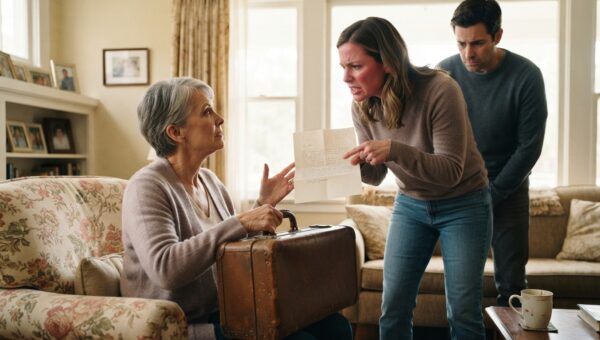
The sting of those words sat right behind my ribs, sharp and sudden. Before I could answer, I noticed his brown leather passport case sitting on the corner of the oak desk, half-unzipped. I moved before I could talk myself out of it, reaching across the stack of sketchbooks and snatching the case up. Julian lunged forward with a sharp curse, his hand catching my wrist, but I jerked away and pulled the passport free.
As I pulled it out, a folded piece of heavy cream-colored paper fluttered down and landed face-up among the charcoal pencils.
I knelt down and picked it up. My vision blurred around the edges, the small, slanted handwriting jumping off the page before my eyes could even focus on the words. It wasn’t from a friend at school. It wasn’t from some college admissions office or a summer art program.
The person who had written those lines, the person who had bought his ticket, was my brother Arthur.
Arthur, who had packed his bags fifteen years ago after a bitter fight over our father’s failing hardware store and swore he would never set foot in Texas again. Arthur, who had spent the last decade living somewhere in Europe, sending postcards that never had a return address.
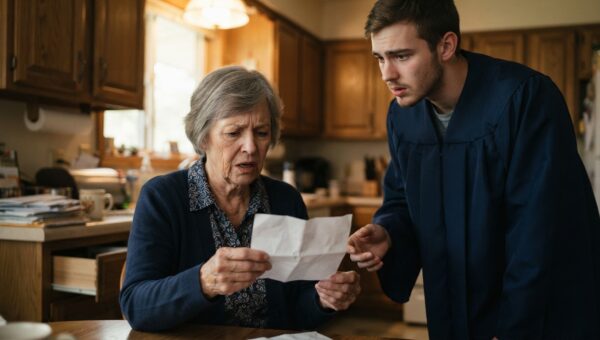
“Julian,” I whispered, the paper trembling between my fingers. “What is this?”
“He’s the only one who actually gets what it’s like here,” Julian said, his voice dropping to a stubborn, defensive murmur as he looked away toward the window. “He told me about the flat in Kensington. He said I could study design without having to listen to everyone tell me I’m wasting my time.”
I read the top line of the letter again under the harsh desk lamp. *The car will be waiting at Gate 4, lad. Pack light and don’t look back.*
It was like watching a ghost reach out of the past and grab my son by the shoulder. I sat down heavily on the edge of Julian’s unmade bed, the springs groaning under the sudden weight. The whole room seemed to tilt slightly as the years of quiet resentment and old family bitterness rushed back into the corners, smelling faintly of cedar and cheap pipe tobacco, the exact scent Arthur used to leave in the hallway when we were kids.
“You think he cares about your art?” I asked, looking up at my boy. The defiance in Julian’s eyes was wavering now, replaced by a sudden, nervous flicker of doubt. “Arthur doesn’t care about anyone except himself, Julian. He used our mother until she had nothing left in her savings account. He walked out on his own wife and daughter without a word. When he ran out of money in London three years ago, he called me begging for five thousand dollars to pay his back rent, and when I said no, he told me I was dead to him.”
Julian swallowed hard, his hands dropping to his sides. “He said you threw him out. He said you and Dad drove him off because you were jealous he had talent.”
“He lied to you,” I said quietly, holding out the letter. “Just like he lied to everyone else. He’s using you to get back at this house, Julian. You’re just a tool in his old grudge.”
For a long moment, nobody said anything. The only sound in the house was the old refrigerator clicking on in the kitchen, humming through the floorboards. Julian stared at the folded paper in my hand, his shoulders slowly sagging under the weight of a realization he wasn’t quite ready for. The grand, romantic rescue he had spent the last three weeks dreaming about over late-night text messages was suddenly looking a lot more like a trap laid by a stranger who happened to share our blood.
He walked over to the desk and picked up his phone, which was resting face-down next to a coffee mug. The screen lit up with a notification from a banking app showing a recent wire transfer of $2,100 from an account in London with Arthur’s initials on the memo line. Julian stared at it for a long second, then pressed the power button until the screen went black.
“I thought…” Julian started, his voice cracking for real this time, the tough-guy act completely gone. He sat down on the floor by the desk, pulling his knees up to his chest just like he used to do when he was ten years old and scared of a thunderstorm. “I thought he was just being an uncle.”
“I know you did,” I said softly, getting up from the bed and kneeling down beside him on the braided rug. I didn’t yell. There was no room left for anger, only a heavy, protective ache that felt like it had been waiting for this exact Tuesday night for years. “He knows how to make people feel chosen, Julian. That was always his gift. But he doesn’t stay.”
Julian didn’t pull away when I put my hand on his shoulder. He just let out a long, ragged breath that sounded like years of teenage frustration leaving all at once.
“What do we do?” he whispered.
“We cancel the flight,” I said. “And tomorrow morning, we’re going to sit down at the kitchen table and talk about what’s actually making you want to run halfway across the world, because it sure as hell isn’t just about art school.”
We stayed like that on the floor for a long time, the green duffel bag sitting zipped and forgotten by the closet, the airline receipt glowing faintly on the tablet screen down the hall.
By sunrise, the house was completely quiet. The sky outside the kitchen window turned a pale, bruised gray as the first morning light began to hit the gravel driveway. I didn’t make coffee right away. Instead, I took the printed flight confirmation, the passport letter, and the bank notification printout, walked them over to the old ceramic soup tureen on the counter, and struck a match. We watched them curl into black ash together while the kettle slowly started to whistle on the stove. Julian sat across from me at the scarred laminate table, wrapping both hands around a warm mug of tea without saying a word, staring down at the steam rising into the early light as the heavy silence finally began to lift.