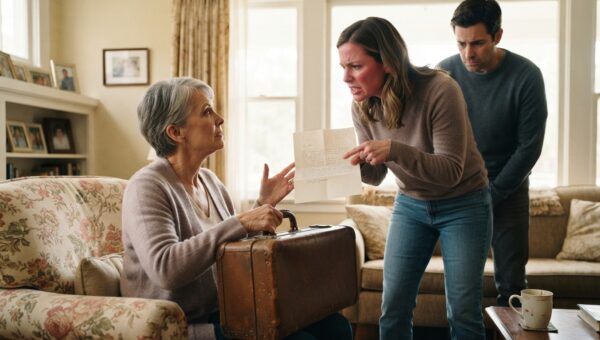
The cold linoleum under the fellowship hall tables always smelled of lemon wax and stale ham. October had come in wet that year, rattling the dry oak leaves against the church windows while people in black coats murmured condolences I couldn’t quite anchor to my brain. Garland was gone. Just like that, after seventy-three years of a life that felt as steady and predictable as the grandfather clock in our front hallway.
I had spent forty-two of those years pouring his coffee, mending his work shirts, and listening to the steady scrape of his boots on the back porch every evening at five o’clock.
People kept patting my shoulder, handing me casserole dishes wrapped in foil, and saying things like he lived a full life. I nodded because that was what you did when your husband of four decades was laid out in a polished oak box three rooms away. I didn’t cry much during the service. My eyes felt dry, like old parchment left out in the sun, and my fingers kept twisting the hem of my cardigan until the wool went fuzzy.
Then came the repast, which is just a church word for eating dry turkey sandwiches while pretending you aren’t all waiting to go home. An old man with a heavy tweed jacket and watery blue eyes that looked like cracked marbles drifted over to the folding chair where I sat alone.
He didn’t introduce himself right away. He just reached down and took my hand in his, and his palm felt like dry sandpaper against my skin. He held on a little too long, the way old people do when they forget social distance, and stared right into my face.
“He never missed a single month,” the old man said, his voice rattling like gravel in a tin can. “You raised a fine boy.”
My hand stayed in his because my muscles forgot how to pull away. We never had children. That was the first heavy truth of our marriage, settled back in the autumn of 1961 when the hospital room still smelled of ether and bleach and the young doctor in the white coat told us our baby hadn’t survived the night. I thought grief had muddled the poor man’s head, maybe confused me with someone else from his Sunday school class or some cousin from downstate.
“I think you have the wrong person,” I said, and my voice sounded thin even to me. “Garland and I didn’t have any children.”
The old man went pale. Not movie pale, but that gray, sickly color old skin turns when the blood suddenly drains right out of it. He let go of my hand as if I’d burned him, and his mouth twitched once before he found his footing.
“For forty years,” the old man said, and each word dropped like a lead sinker into muddy water. “Every single first Saturday of the month. Rain or snow or sleet. He drove out to the state home on the county line. He sat with our son. Our son, the baby the doctors took in 1961, swearing he wouldn’t reach five. He lived to forty-seven.”
My knees buckled right there by the folding table where the plastic coffee urn was dripping onto a paper napkin.
The old man steadied me by my elbow, his grip surprisingly strong for someone who looked like a strong gust of wind might blow him over. He leaned down close to my ear, his breath smelling of peppermint and old wool.
“He always brought two cups,” Arthur whispered, because that was his name, Arthur who lived down the hall from my boy for thirty years. “He’d tell the boy, your mama… The bad part is when he…”
The sentence drifted off into the hum of the church hall refrigerator, leaving me hanging over a void so deep my chest went hollow. I didn’t hear the rest of what Arthur said because the room tilted sideways, and suddenly I was staring at the linoleum floor, wondering how a person could live forty years inside a house with a man and never once know what he carried in his pockets.
The drive home from the cemetery later that week felt entirely wrong. Garland’s old Dodge truck sat in the driveway with the passenger door unlocked because he always forgot to push the button down, and the house inside was suffocatingly quiet. I didn’t turn on the television. I walked straight past the kitchen where the yellow sponge sat by the sink and went into Garland’s small back study.
It was a room I rarely disturbed. He kept his ledgers there, old blue-lined notebooks where he tallied up the farm equipment repairs, the seed prices from nineteen-seventy-five, and the odd jobs he did for the county road department. I pulled open the top drawer of his oak desk. There were rubber bands, a box of yellowed paper clips, and a stack of small, leather-bound appointment books going back decades.
My hands were shaking as I flipped open the book for the current year. March fourth. June third. September second. Every single entry on the first Saturday of every month had a single, neat capital letter written in black ink: S.
Just an S. For Saturday, I used to think if I ever glanced at it. Or maybe supplies. But now, turning back the pages through yellowed paper and ink that faded from dark black to a dusty gray-brown as the years rolled backward, I saw the pattern. Forty years of first Saturdays marked with that one letter. Always the morning. Always blocked out from nine until noon, right when Garland told me he was driving twenty miles out to the hardware store in town or helping old man Henderson clear fence rows.
I sat there in that small, stuffy room until the light through the lace curtains turned the color of ditch water. The silence in the house wasn’t peaceful anymore. It felt heavy, packed tight with forty years of closed doors I didn’t even know were there.
Three days later, I drove out to the county line.
The old state home wasn’t a hospital anymore. Most of it had been abandoned years ago, the brick wings boarded up with sheets of gray plywood and ivy choking the iron fire escapes, though one single-story building at the back still functioned as a group home. The gravel drive was full of potholes filled with stagnant rainwater that reflected the gray October sky.
I parked the Dodge right by a rusted sign that said *Authorized Personnel Only*, but my boots kept moving across the crushed stone anyway. A young woman with tired eyes and a green cardigan let me into the office when I told her my name and showed her Garland’s driver’s license, which I still carried in my purse.
“You’re Mr. Garland’s wife?” she asked, looking down at a heavy gray ledger bound in buckram. “He came here a long time. Everyone knew Mr. Garland.”
“I need to see where he went,” I said. My voice didn’t sound like mine. It sounded like an old record playing at the wrong speed.
She didn’t ask questions. People who work in places like that learn pretty quickly not to poke too hard at other people’s grief. She led me down a linoleum-floored corridor that smelled of floor polish and institutional cabbage, past a sunny dayroom where three elderly men were staring blankly at a television set with the sound turned down.
At the end of the hall, she pointed to a small wooden door with a brass plate that had long since lost its shine. Room 14.
“Arthur is still here,” she said softly, her hand lingering on the doorframe. “He was with him at the end. Your boy went peacefully, Mrs. Garland. In his sleep. Back in August, right before your husband took sick.”
I stood in that doorway for a long time without stepping inside. The room was tiny, just a narrow metal bed with a faded plaid quilt, a wooden nightstand, and a small chest of drawers. On top of the dresser sat a plastic tumbler and a stack of small, curling photographs held together with a rubber band.
Arthur was sitting in a green vinyl armchair by the window, watching a squirrel scramble up the trunk of a dying maple tree outside. When the floorboards creaked under my shoes, he turned his head slowly, and recognition flickered behind those watery blue eyes.
“You came,” he said. It wasn’t a question.
I walked in and sat down on the edge of the metal bed. The mattress sagged in the middle. “You were saying something at the repast,” I told him, keeping my voice as flat and steady as I could manage. “About the bad part.”
Arthur looked down at his slippers, his gnarled thumbs rubbing against the fabric of his trousers. For a long time, the only sound in the room was the hum of the wall heater overhead.
“Garland loved you,” Arthur said finally, and he didn’t look up when he said it. “That was the first thing he told the boy on every one of those visits. He’d sit right where you’re sitting, pull two paper cups out of his jacket pocket, and set one on that nightstand. He’d talk about the farm, or how the corn was coming in, or how you’d just bought a new set of curtains for the front room.”
“Why didn’t he tell me?” I asked, and the question came out tighter than I meant it to, a little sharp around the edges. “Why would he carry that alone for forty years?”
Arthur let out a dry, rattling cough that might have been a laugh if there was any humor left in it. “Because back in sixty-one, Mrs. Garland, you were half out of your mind with the fever and the grief. The doctors told you both that the baby was gone, that his brain wasn’t right, that keeping him would sink you both before you even had a chance to start. Garland took the papers and signed them because he thought that’s what kept you breathing.”
He paused, shifting his weight in the chair until the springs groaned.
“Then he came out here that very first Saturday just to sign the final transfer forms for the county,” Arthur continued, his voice dropping an octave. “And he walked into the nursery and saw the baby lying there in the crib, blinking his little eyes and moving his hands. He wasn’t vegetable-gardening like the doctors said. He was just small. Just quiet.”
I stared at the wall above the dresser, where a square of lighter paint showed where a picture used to hang.
“Garland couldn’t bring him home because he’d already told you the baby didn’t make it,” Arthur whispered. “And he couldn’t tell you the truth because he was terrified the shock would finish breaking whatever was left inside you. So he built a wall right down the middle of his own life. Every month, he drove out here, sat with a boy who grew up into a man with no words, and played the part of a father in secret.”
My throat felt tight, burning like I’d swallowed hot coal dust. “And the bad part?” I asked. “What was the bad part?”
Arthur finally looked me square in the eye, and the kindness in his face was almost harder to bear than the silence had been.
“The bad part wasn’t the visits, Mrs. Garland,” he said softly. “The bad part was watching him leave at noon every single Saturday. He’d stand up right here, put on his heavy canvas jacket, and look back at the door like he was tearing himself in half. He’d walk out to that truck, and he wouldn’t say a word to nobody for three days straight. He carried that boy out of this room every time he left, and he carried him all the way back to a house where he wasn’t allowed to exist.”
I didn’t cry. Not then. My eyes stayed dry while Arthur told me about the time my boy, our boy, whose name was Thomas, though I hadn’t known it until Arthur spoke it aloud, managed to wrap his fingers around Garland’s thumb and hold on for twenty solid minutes. He told me about how Garland used to bring him a peppermint drop every month, even though Thomas couldn’t chew them, just because they smelled sweet.
I stayed in that room for an hour. When I left, the young woman in the green cardigan handed me a small brown envelope that Arthur had fished out from the bottom of the dresser drawer. Inside were four polaroids taken sometime in the eighties, a grown man with soft, round eyes and dark hair just like Garland’s, sitting in a wheelchair by the window, holding a paper cup in his lap while a man whose back was to the camera leaned down to whisper something in his ear.
I drove back out toward the farm as the sun was dipping below the tree line, turning the sky the color of a bruised plum.
The house was dark when I pulled into the gravel drive. I didn’t turn on the porch light. I walked around to the back shed, found the old folding lawn chair in the corner, and carried it out past the pump house to the edge of the old orchard where the ground sloped down toward the creek.
The air smelled of damp earth and rotting apples, that heavy, rich scent of things finishing their season. I set the chair down in the dry grass, sat back, and pulled the two paper cups I’d bought at the gas station in town out of my coat pocket.
I set them side by side on the flat top of an old cedar stump beside me. One for Garland. One for Thomas.
The wind picked up through the apple boughs, shaking a few last dried leaves down into the grass. I looked out over the dark fields where the fence posts were disappearing into the dusk, and for the first time since the repast, I said our son’s name out loud to the empty trees.