The cardboard boxes were sitting right by the front hall closet when I came back from checking the mail last Tuesday. There were six of them, flat brown things from the liquor store down on 4th Street that Keith had taped up with packing tape so wide it looked like armor.
My son Keith had been talking about my memory for six months.
He would bring it up while he was standing by the refrigerator, drinking my milk straight from the carton, looking at me like I was a broken appliance he needed to figure out how to haul to the curb.
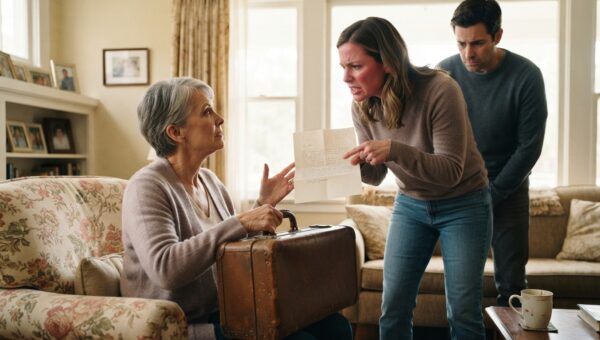
“It is just getting unsafe, Mama,” Keith had said to me that very afternoon while Sarah, his wife, nodded along from the kitchen island. “You forgot the name of the plumber last month. And yesterday you left the burner on low under the kettle for twenty minutes. You are seventy-eight years old. You cannot live alone in this house anymore.”
They had already priced out the Windsor Oaks facility off Route 9. It cost $4,800 a month, which sounded like a fortune for a room that smelled like floor wax and boiled cabbage. But Keith had my bank statements spread out on the dining table right next to my good silver.
He had my $30,949 in hard-earned savings mapped out to the penny, telling me it would cover a year and a half of care before we had to figure out what to do with the house.
Arthur was sitting in his usual armchair by the radiator, his hands folded in his lap the way they had been ever since the stroke took his left side and half his words three years ago. He looked small in that chair, his flannel shirt hanging off his shoulders because he had lost weight over the winter. Arthur did not look at the boxes. He just stared at the braided rug near his boots, his jaw working slowly on nothing at all.
“We found a nice ground-floor unit,” Sarah said, her voice dropping into that sweet, terrible tone people use when they are talking to someone who has lost the plot entirely. “They have bingo on Thursdays, and someone comes in to handle all the medication management so you do not have to worry about a thing.”
That was the word they kept using. Worry. As if my life was just a collection of anxieties they needed to sweep into a dustpan.
I had lived in this house for forty-two years. I planted the lilac bush by the back porch when Keith was nine years old and still lost his teeth down the register. I knew every drafty floorboard, every crooked door frame, every squeak the stairs made when the frost got into the timber.
“I am not going to Windsor Oaks,” I told them, keeping my voice level, though my throat felt dry as cedar. “Arthur and I are staying right here.”
“Mama, please,” Keith sighed, rubbing the back of his neck the way his father used to when the truck transmission dropped its gears out on the highway. “You are being stubborn. You cannot even remember where you put your car keys half the time.”
“My keys are in the butter crock on the counter because the cat likes to bat at them when they are on the hook,” I said. “And I know exactly where they are.”
Sarah just gave a little tight-lipped smile and picked up a roll of packing tape, letting it tear with a loud, sticky zip that made Arthur flinch in his chair.
That was when Leo, our seven-year-old great-grandson who had been sitting quietly under the table playing with a plastic dinosaur, crawled out and stood up against my knee.
Leo looked right up at his uncle Keith with those big, clear eyes that missed nothing at all. “But Grandma gives Grandpa his shots,” Leo piped up, his small voice cutting cleanly through the hum of the refrigerator. “Every morning and every night. She never forgets that.”
The dining room went dead silent. The sticky zip of Sarah’s tape roll stopped halfway across the roll.
My chest went tight, not with fear, but with that cold, sudden rush of blood that comes when you realize someone has finally opened a door you had been guarding alone in the dark for three years.
Keith froze, his hand still hovering over my bank statements. “What did you say, Leo?”
“Grandma does the needles,” the boy repeated, leaning his small shoulder against my apron strings. “She does it before we have pancakes and she does it before we watch the news. Grandpa needs them so he does not fall down.”
Nobody moved for three full seconds. The only sound in the whole house was the old grandfather clock in the hallway ticking away its heavy seconds, steady as a heartbeat.
Keith slowly turned his head from the boy to look at Arthur. Then he looked at me, his eyes wide and blinking behind his wire-rimmed glasses, as if he were trying to read a sign written in a language he had forgotten how to speak.
“Mama?” Keith said, his voice dropping an octave. “What is he talking about?”
I didn’t answer right away. I reached down and patted Leo’s head, feeling the fine, soft hair under my palm. Then I looked at my son, really looked at him, seeing the exact moment the math finally caught up with his clever plans.
“You think I forgot how to run my own house because I misplace a name now and then,” I said, and my voice didn’t shake at all. “You come over here three times a week for forty minutes at a time, usually right after lunch when the television is on. You bring a casserole or some fruit, you check the mail, and you leave before dark. You have never stayed through an evening in five years.”
Sarah set the tape down on the table with a sharp clatter. “That has nothing to do with, “
“It has everything to do with it,” I said, stepping past them toward the kitchen counter. “Arthur’s pancreas stopped doing its job the same week his brain forgot how to tell his left leg to step over the threshold. The doctor told us right here in this kitchen that if the numbers go twenty points too high, he goes into a coma and does not come back out.”
I pulled open the top drawer under the silverware tray, right past the rubber bands and the old coupons for the hardware store, and lifted out the black vinyl ledger. It was worn white at the corners where my thumbs had held it morning and night for 1,095 days.
I laid the ledger down right on top of Keith’s neat piles of bank statements and nursing home brochures. The contrast was enough to make anyone look twice. His papers were crisp and white, printed off a laser printer downtown. My book was swollen with loose slips of paper, doctor’s notes taped into the margins with yellowed Scotch tape, and columns of tiny, precise numbers written out in black ballpoint pen.
“Read it, Keith,” I said, tapping the cover with my fingernail. “Go on. Look at the dates.”
Keith reached out slowly, his fingers hesitating for a second before he flipped the cover back. The pages were a dense grid of blood sugar readings: 114 before breakfast, 128 before bed, 109, 116, 122. Every single day accounted for, down to the half-unit of Humulin R drawn up through an orange-capped syringe under the light of the over-the-sink fluorescent fixture.
“Three years,” I said, standing right beside him while he stared down at the columns. “Every single morning at 7:00 a.m. Every single night at 8:30 p.m. I draw the dose, I tap the bubble out of the barrel, I pinch the skin on his arm, and I check the disposal box under the sink. Not once has he had to go to the emergency room for a spike or a drop. Not once.”
Sarah came around the table, her footsteps making a sharp tapping sound on the linoleum, and leaned over Keith’s shoulder. Her eyes scanned the page, moving down column after column of my neat, old-fashioned handwriting. She didn’t say anything, but I watched her mouth part just a fraction as she realized what those numbers actually represented.
“If I go to Windsor Oaks,” I whispered, leaning over the table so they could hear every word, “who is going to wake up at six in the morning to test his blood before his hands even stop shaking? Are they going to sit with him for twenty minutes while he tries to explain where the pain is? Or are they just going to hand him a pill tray and let him slip away while nobody is looking?”
Keith swallowed hard. His Adam’s apple bobbed once, twice, in his throat. He looked from the open ledger up to Arthur, who was still staring quietly at the braided rug, unaware of the storm happening around his chair.
“Mama, I didn’t know,” Keith muttered, his voice sounding small and thin in the large kitchen. “You never told us how bad the medical part was getting. You just seemed… well, you get confused about things sometimes.”
“I get confused about who played the lead in that movie from 1968,” I snapped back, my temper finally flaring through the fatigue. “I forget where I put the garden shears. But my hands don’t forget how to keep your father alive. There is a big difference between losing your keys and losing your mind, Keith, and you didn’t bother to look close enough to tell the two apart.”
The silence in the room came back, but this time it wasn’t comfortable for them. It had teeth in it. Sarah reached out and slowly pushed the nursing home brochure away from the center of the table, sliding it under her palm as if trying to hide something embarrassing she had dropped on a clean floor.
“We thought we were helping,” Sarah said, and for the first time since they walked through the front door, her voice sounded genuinely small. “We really thought we were doing the right thing.”
“You wanted to solve a problem without having to look at it,” I said. “You wanted my savings to pay for your peace of mind so you wouldn’t have to drive out here on rainy nights when Arthur has a fever.”
Keith closed the black ledger with a soft, dull thud. He didn’t look at me when he spoke. He just kept his hand flat on the worn vinyl cover.
“Leave the boxes,” Keith said quietly after a long moment. “We’ll take them out to the truck on our way down the steps.”
“Take them now,” I said.
Keith looked up, surprised.
“Take them now,” I repeated, pointing toward the hallway. “And take your brochures with you. My money stays in the drawer where it belongs, and Arthur and I stay right here.”
Neither of them argued. Keith stood up, his chair scraping loudly against the floorboards, and picked up two of the brown liquor store boxes from by the closet. Sarah grabbed the others, her face flushed red, keeping her eyes fixed on the front door. They didn’t say goodbye to their father, and they didn’t look at me again before the heavy oak door swung shut behind them.
The latch clicked into place with a solid, familiar sound that I had heard ten thousand times before.
I stood in the middle of the kitchen for a long minute, listening to the refrigerator hum and the wind starting to rattle the screens out on the back porch. My knees felt a little weak, and my hands had a slight tremor in them now that the anger was starting to drain away.
Arthur looked up from his chair, turning his head slowly toward me. He didn’t have many words left, but he knew how to look at me when the house was ours again.
“All right?” he asked, his voice thick and uneven around the edges.
I walked over to his chair, rested my hand on his good shoulder, and smiled down at him. “All right, old man,” I said. “We’re right where we’re supposed to be.”
I went back to the counter, picked up the black ledger, and slid it neatly back into the top drawer beside the silverware, right where it had always lived. The kitchen clock ticked on the wall, steady and slow, measuring out the evening hours in a house that still belonged to us.