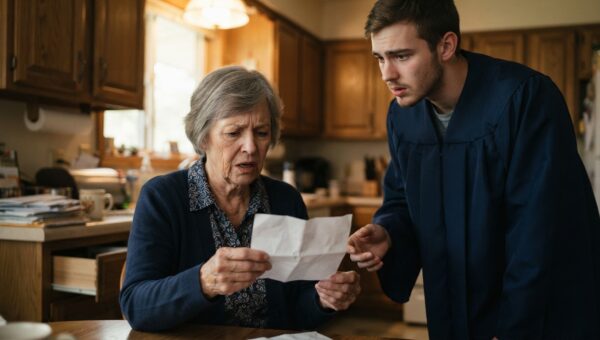
I wasn’t snooping. I was looking for the dishwasher warranty.
The basement was cool that Tuesday morning, smelling faintly of damp concrete and old cardboard boxes that had sat untouched since we moved into the rancher back in nineteen ninety-six. I had my knees on the cold floor, pulling out the second drawer of the old gray metal filing cabinet because Arthur always swore he filed every single appliance manual right where we could find them.
Behind a stack of yellowed Sears appliance folders, my hand brushed against something stiff and plastic-coated. It didn’t belong with the blenders and the refrigerators.
I pulled it out into the dim light of the overhead bulb. A mortgage document. Second lien. One hundred and eighty-five thousand dollars. Our house, listed right there at the top with our address and the property tax map numbers.
My signature was right there on page fourteen. Except I didn’t sign it.
I held it up to the bare bulb, squinting against the yellow glare. The little tail on the y in my maiden name always curls left, out of habit, ever since grade school when Sister Mary told us to keep our loops tight. This one curls right, sharp and unfamiliar, like someone trying to copy a signature off a Christmas card. My brother, Russell, is a notary public down at the county title office.
His official stamp was right there on the document, dark purple ink pressed into the margin, along with his signature as the official witness.
The lender was a place called Pacific Ridge Financial. I had never heard of them in my life.
I sat back on my heels, the paper rustling in my hands, and felt the blood drain right out of my head. Arthur had always handled the bills, every single month, taking the mail off the porch and sorting it in his little corner of the den while I worked the morning shift down at the clinic. He always told me not to worry my head over the banking, that he had everything locked down tight and the interest rates were steady.
I didn’t wait to go upstairs. I pulled my cell phone out of my apron pocket and dialed the number printed at the bottom of page fourteen before my hands could start shaking any worse than they already were.
A woman with a flat, professional voice answered on the third ring. I gave her the loan number from the top of the page and my home address, my voice sounding thin and small against the concrete walls of the basement.
“Account is active,” she told me, her fingers clicking against a keyboard on the other end of the line. “One hundred and forty-one thousand remaining. Monthly payment is one thousand, three hundred and forty dollars. Paid on time for three years straight.”
Three years.
“Who authorized this?” I asked, and my voice cracked right in the middle of the kitchen word.
“The file shows both homeowners present with a registered notary,” she said, her tone never shifting an inch. “Is there a problem with the servicing, ma’am?”
I hung up without answering her.
One thousand, three hundred and forty dollars a month. That was why we couldn’t afford to go down to visit my sister in Savannah for Thanksgiving three years running.
That was why Arthur had sold my daddy’s old aluminum fishing boat behind the barn, swearing up and down that the motor had seized and it wasn’t worth the cost of hauling to the mechanic. That was why he sat at the kitchen table every November when the property taxes came due, rubbing his temples and talking about how hard the economy was hitting small contractors, looking so miserable I used to make him extra peach cobbler just to cheer him up.
I climbed the basement stairs slowly, each step feeling heavier than the last, clutching the mortgage papers against my chest like a shield.
The kitchen was quiet, the little wall clock ticking away the seconds while the coffee maker sat cold on the counter. I opened the walnut secretary desk in the dining room where Arthur kept our green ledger binders. I didn’t have to look hard. The bank statements from our joint checking account showed the automatic withdrawals hitting on the first of every single month. One thousand, three hundred and forty dollars, gone like clockwork to Pacific Ridge Financial.
But as I flipped back through the older statements from three years ago, right around the time my father passed away and left us the truck, I found something else tucked into the margins of the February ledger. An additional transfer. Forty-seven thousand dollars, moved in one lump sum from our savings account directly to an account held by a company called Devlin Holdings.
I sat there at the kitchen table for a long time, staring at the numbers until the ink seemed to blur together into gray smudges.
Russell’s office was down on Court Street, right next to the hardware store with the faded green awning. I didn’t call him first. I just got into my old sedan, laid the mortgage papers on the passenger seat under my coat, and drove straight down town with my jaw set so hard my teeth ached.
The bell above the door of Russell’s office jingled cheerfully when I walked in, smelling of stale cigarette smoke and cheap carpet cleaner. Russell was sitting behind his big laminate desk with a stack of property deeds, wearing his reading glasses down on the bridge of his nose. When he looked up and saw me standing there with my purse clutched in both hands, the color drained right out of his cheeks. He didn’t even try to smile.
“Well, hello, Martha,” he said, his voice dropping an octave as he took off his glasses and laid them on the desk. “You look like you’ve seen a ghost.”
I didn’t say a word. I walked right across the brown linoleum floor, pulled the folded mortgage document out from under my coat, and laid it flat on top of his property deeds.
“Look at page fourteen, Russell,” I said, and my voice didn’t shake at all, which surprised me. “Look at the y.”
Russell stared down at the purple ink of his notary stamp. He didn’t touch the paper. He just sat there with his hands flat on the blotter, his fingers twitching against the corners of the leather pad.
“Arthur came to me,” Russell whispered after a minute, his eyes fixed on the grain of the wood desk. “He was in so deep with that partnership down in Meridian. They had men coming to the house, Martha. Loan sharks. Real bad people. He said if he didn’t raise forty-seven thousand that very week, they were going to put a lien on the truck and come after the house while you were sleeping.”
“So you signed my name,” I said.
“He said you’d never agree to it,” Russell muttered, his voice dropping so low I had to lean in to hear him over the hum of the wall heater. “He said it was just temporary. Just a bridge loan until the county contract cleared. He swore he’d pay it off before you ever noticed a dime missing.”
“And the forty-seven thousand?” I asked. “Where did that go?”
“Devlin Holdings,” Russell said, and he finally looked up at me, his eyes watery and small behind his wire-rimmed glasses. “That was the partner’s shell company. That’s who Arthur owed the gambling debts to. The mortgage was the only way to clear the books before the bank foreclosed on the whole farm.”
I looked at my little brother, a man who had sat at our mother’s Sunday table every week of our lives, and I didn’t feel angry anymore. I just felt cold, the same way I felt standing in the basement ten minutes before I found the file.
“You’re a notary, Russell,” I said softly. “You swore an oath.”
“I know it,” he whispered, looking down at his desk again. “I know it, Martha.”
I picked the papers up off his desk, squared the edges against my palm, and slid them back into my coat.
“Don’t call me,” I told him as I turned toward the glass door. “Don’t come to Sunday dinner. And don’t expect me to lie for you when the bank investigators start asking questions about whose seal was on that page.”
The bell jingled again behind me as I walked out into the bright afternoon sun, but I didn’t look back.
Arthur was already home when I pulled into the gravel drive at five o’clock. His truck was parked crooked by the back porch, the tailgate down the way he always left it when he was tired from hauling lumber. When I walked through the screen door, he was standing at the kitchen counter opening a package of sliced ham, whistling some tuneless little tune through his teeth like nothing in the world was wrong.
“Hey, hon,” he said, turning around with a half-smile on his face. “How was your day? You look a little pale. Did you find that dishwasher warranty in the basement?”
I laid the thick stack of bank statements and the Pacific Ridge mortgage document right in the middle of the laminate kitchen table, right on top of the mail he hadn’t sorted yet.
Arthur stopped whistling. His hand stayed frozen on the edge of the ham package, the plastic crinkling under his thumb.
“What’s this?” he asked, though his voice had already lost its cheerful ring.
“Page fourteen, Arthur,” I said, pulling out a chair and sitting down right across from him. “Russell told me all about Devlin Holdings. He told me about the loan sharks in Meridian, too. He told me how you forged my signature three years ago and used my brother’s stamp to steal our home out from under us.”
Arthur didn’t yell. He didn’t try to pound his fist on the table or tell me I was imagining things. He just sank slowly into the chair opposite mine, his shoulders sagging down like someone had cut the strings on an old puppet.
“We almost lost everything, Martha,” he said, his voice cracking into a dry, pathetic little plea. “I was trying to protect you. I didn’t want you to have to worry about the business failing. I handled it. We’ve been making the payments every single month. The house is still ours.”
“It was never yours to mortgage,” I said.
I reached into my handbag, pulled out the small leather key ring with the brass key to the filing cabinet, and slid it across the shiny laminate surface until it hit the edge of his coffee mug with a tiny, metallic click.
Arthur stared at the key like it was a live snake.
“What are you doing?” he asked, his voice finally rising into that familiar panic I used to try so hard to soothe. “Martha, where are you going? We can talk about this. We can call the bank together, “
“There’s nothing left to talk about,” I told him, standing up from the table and smoothing down the front of my apron. “You can call a lawyer in the morning, or you can call the sheriff. Either way, I’m going over to my sister’s place in Savannah tonight, and I’m taking the truck.”
I didn’t pack a suitcase because I knew I’d be back with the deputies and a real attorney before the week was out to sort through every last piece of paper in that house.
I walked out the front door, pulling it shut behind me with a solid, satisfying click, and stepped off the porch into the crisp evening air. The sun was just dipping below the treeline out back of the barn, turning the sky the color of old copper. My car keys felt cool and heavy in my hand, and for the first time in three years, the road ahead of me was entirely my own.