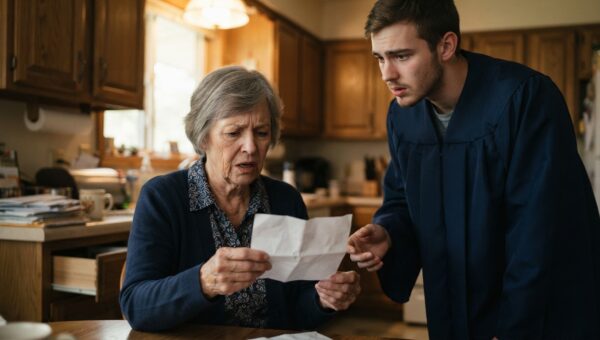
The rain in southern Illinois has a way of turning the gravel in our driveway into gray porridge by late October. I was standing at the kitchen sink rinsing out a coffee mug when the front screen door rattled. It was not a polite knock. It was that three-beat stutter my mother always used when she wanted everyone inside to know she was displeased before her boots even touched the welcome mat.
When I pulled the door open, Martha did not look like the woman who used to run the altar guild and make me wear itchy wool skirts to church every Sunday. She looked small. Her gray hair was pinned up crooked, and she was wearing a navy windbreaker that smelled faintly of damp wool and stale peppermints. She didn’t wait for me to invite her in. She just stepped past my shoulder, her canvas travel bag scraping against the doorframe with a dull thud.
“The roof at the Maple Street house finally caved in,” she said, her voice dry as corn husks. “The town condemned the block. I need the small bedroom upstairs for a couple of months until things settle down.”
I didn’t move from the threshold. My hand stayed flat against the white wood of the door. Ten years earlier, when Claire died at nineteen after three solid years of surgeries and experimental treatments that drained every bank account within fifty miles, Martha had looked at me with eyes like hard river stones and told me that survival required sacrifice.
She had taken every last cent of the $180,000 grandfather left me in trust, liquidating it down to the copper wire to pay for hospital bills that didn’t save my sister anyway. She had left me out in the cold with a high school diploma and a stack of rejection letters from community colleges, telling me I was selfish for even asking about my own future while her youngest child was fading away.
“You can’t stay here, Martha,” I said. My voice didn’t shake. I had practiced that sentence for nearly twenty years while working the registers at the hardware store and putting myself through night classes one module at a time.
She stopped halfway to the stairs, her canvas bag sagging in her grip. “I am your mother. I gave you life.”
“I don’t owe you anything,” I told her.
I reached out, caught the brass handle of the screen door, and pulled it shut.
I watched through the wire mesh as she stood there for three long seconds, waiting for me to blink, waiting for the old guilt to kick in like it always did. When I didn’t move, she turned around and walked back down the gravel drive toward her rusted Buick, her shoulders hunched against the drizzle.
My husband, Lyle, came down the stairs five minutes later, wiping his hands on a blue shop towel. He had heard the whole thing from the landing. He didn’t say anything smart, just poured himself a fresh cup of coffee from the pot on the counter and looked out the window where Martha’s taillights were disappearing down the county road.
“You okay?” he asked.
“I’m fine,” I said, though my chest felt tight and hollow, like an old silo with the grain hauled off. “Just tired.”
We went to bed around ten. The house was quiet except for the furnace kicking on in the basement with a dull metallic clunk.
I fell into that heavy, dreamless sleep that comes after a long argument, the kind where your limbs feel like lead.
Then the phone on the nightstand buzzed.
It wasn’t a call. It was a single text message lighting up the dark room with a harsh blue square. Lyle rolled over, muttered something into his pillow, and reached blindly for the screen. He tapped it once to clear the notification, but then his thumb stopped moving. He didn’t scroll. He just stared at the small rectangle of light for so long that my own eyes started to burn from the glare.
“Who is it?” I asked, my voice thick with sleep.
Lyle didn’t answer right away. He turned the phone toward me so the light hit the gray wallpaper above the headboard. “Your mother sent this at four-forty in the morning.”
I squinted at the small black letters against the white background. It wasn’t a plea for gas money or a complaint about the weather. It was a single address in the county records office down in Murphysboro, followed by three lines of text that made the room tilt slightly on its axis.
“She says the trust was never yours to begin with,” Lyle read aloud, his voice flat and careful. “She says grandfather didn’t leave it to you in the will. She says she had to use it because the title on the Maple Street house was in default before Claire even got sick.”
I sat up straight, pulling the quilt around my shoulders. “She’s lying. Grandfather told me himself when I was fourteen. He brought out the leather folder and showed me the blue seal.”
“Then why is she sending us probate file numbers at dawn?” Lyle asked. He reached for his glasses on the floor. “People don’t give away maps to their own graveyard unless they’re trying to drag you down with them.”
By eight o’clock we were sitting in the fluorescent-lit basement of the Jackson County courthouse, breathing in that heavy smell of old paper and radiator rust that hasn’t changed since the Truman administration. The clerk on duty was a woman named Brenda who had gone to school with my older cousin and knew every family feud within forty miles. She didn’t even ask why we wanted the file for the 2004 estate settlement of Arthur Vance. She just disappeared into the back stacks and came back with a green cardboard box tied with faded red cotton string.
The documents inside weren’t grand legal treatises. They were carbon-copy forms with ink that had faded to the color of weak tea. I opened the folder, my fingers catching on the rough edges of the cheap paper.
There it was on page four. The asset schedule.
The $180,000 wasn’t a discretionary trust fund that Martha was legally allowed to raid for medical emergencies. It was an escrowed land buyout from an old timber lease on the river bottom acreage, designated explicitly in my name as a minor by a third-party rider that grandfather had filed back in ninety-eight. But right beneath my name, in Martha’s sharp, sloping cursive, was an amendment dated three weeks after grandfather’s funeral. She had signed her own name as legal guardian and administrator, transferring the entire balance into her personal checking account to cover a tax lien on the Maple Street property.
Claire’s illness hadn’t drained the trust. The medical bills were real enough toward the end, God knows, but the bulk of that money had vanished six months before my sister ever coughed up her first speck of blood. It had gone to pay off back taxes on a house Martha had mortgaged twice to keep up appearances at the country club after my father walked out.
I sat there on the wooden bench with the green folder open on my knees. The fluorescent tube above us gave a high, thin whine that sounded like a trapped wasp. Lyle didn’t touch me or try to offer some comforting line about how everything happens for a reason. He just laid his hand flat on the wood beside the file, waiting for me to lead.
“She didn’t spend it on the chemo,” I whispered. My throat felt like I’d swallowed sand. “She spent it before any of that even started. She used Claire as the story so nobody would ever ask to look at the books.”
“You want to go see her?” Lyle asked quietly.
“No,” I said. “I want to go home.”
We didn’t call her. We didn’t drive out to the temporary shelter where the county housing board had put her up for the week. There was nothing left to argue about, and there was no apology coming that would fix thirty years of small, calculated lies told over Sunday pot roast.
When we pulled back into our driveway, the gravel crunched under the tires with a clean, familiar sound. The sky over the pasture was clearing up, letting a thin, pale streak of sunlight cut across the weathered boards of the old machinery shed. I walked up the porch steps, turned the heavy brass key in the deadbolt until it clicked twice, and pushed the door open to the smell of coffee and pine cleaner.
Lyle went straight to the kitchen to put the kettle on, leaving my coat on the hook by the door. I walked into the kitchen, pulled out the wooden chair at the table, and sat down to watch the light move across the floorboards. The room was quiet, completely and finally quiet, without a single ghost left standing in the corners.