The blue linoleum on my kitchen floor has always had a stubborn scuff right by the pantry door, a legacy from when my husband tried to fix the hinges back in nineteen-ninety-four. I stared at that scuff while the front door clicked open and Etta walked in with her canvas bag slung over her shoulder. She was the third person my daughter-in-law Sarah had sent over in a month, and I had my defense mechanisms polished to a high shine.
I am seventy-four years old, I told myself, and I do not need a stranger coming into my house three days a week to watch me breathe. Sarah meant well, I knew that. Sarah always meant well, organizing schedules and checking boxes on her phone like a general planning maneuvers. But ninety dollars a visit was ninety dollars my boy David didn’t have to spare, no matter how hard he worked down at the county water department. Every time Etta set her keys on the counter, it felt like a visible tally mark of my own uselessness.
The first three visits had been a quiet war of attrition. Etta would wipe the counters, check my blood pressure with that cold Velcro cuff, and ask me if I needed anything from the grocery store. I always said no. I told her I had my routine, thanked her for her trouble, and waited for the clock to tick down so she could leave.
But Etta didn’t chatter the way the others did. She moved with a slow, deliberate grace that made me feel entirely transparent. She noticed things. By the fourth visit, the air in the kitchen felt heavier, weighted down by the unspoken truth I had been dragging around like a sack of wet salt for eight solid months.
Back in June, when the difficulty started, I thought it was just a stubborn throat tickle from the summer ragweed. I poured myself a mug of chicken broth thinking it would coat the scratchiness, but the warm liquid seemed to hit an invisible wall somewhere behind my collarbone. It did not go down smoothly. It sat there, burning and tight, until I had to force a cough just to clear the passage. I told myself it would pass by morning. It did not pass by morning. Within a week, any solid food felt like swallowing gravel.
Bread turned to paste that refused to move, and meat was entirely out of the question. I spent hours sitting at this very table, pushing a single forkful of mashed potatoes around a porcelain plate until it went cold, then scraping it into the trash can before David came home from his shift.
I learned to live on clear liquids and thin, watery soups. I became an expert at stirring spoonfuls of broth around my bowl to make it look like I was eating when David or Sarah dropped by with groceries. I bought oversized cable-knit sweaters from the thrift store down on Main Street, layering them so nobody would notice how quickly my ribs were beginning to show beneath my skin. Whenever David kissed the top of my head and told me I looked tired, I blamed my arthritis or the damp autumn air. I lied to my own son because the alternative was worse.
I could not bear the thought of him sitting across from me at the hospital billing counter, looking at numbers we couldn’t pay, worrying himself sick over a mother who was slowly falling apart.
Etta knew the signs long before she said a word. She had spent twenty years working the night shift in a hospital ward before she took up home care to save her knees. She had seen bodies give out in a hundred quiet ways. On that fourth visit, she had prepared a bowl of vegetable soup for me, setting it right in front of my usual chair with a small handful of crackers on the side. I looked down at the orange carrots floating in the pale broth and felt the familiar knot tighten in my throat. I picked up my spoon, dipped it into the liquid, and brought it toward my mouth. I paused, letting my hand hover just an inch above the porcelain, pretending to adjust my glasses so she wouldn’t see the tiny tremor in my fingers.
Etta didn’t pick up her clipboard. She didn’t pretend to check her phone or look out the window. She just sat there in the chair across from me, her hands folded neatly over her blue denim skirt, watching the way my jaw locked tight every time I tried to swallow air. The silence stretched between us until it felt louder than the old refrigerator humming in the corner. Then she reached out, picked up her ballpoint pen, and set it down with a soft click against the laminate table.
“Ma’am, how long have you been hiding that you can’t swallow?”
The question dropped into the room with the force of a falling beam. My breath caught, and for a terrifying second, my chest seized up entirely. I opened my mouth to give her the usual excuse, to talk about heartburn or a passing summer cold, but the words died before they reached my teeth. I had practiced the lie so many times in front of the bathroom mirror, but looking at Etta’s steady, unblinking eyes, the machinery of deception simply seized up. I couldn’t do it anymore. My shoulders slumped, and the heavy cardigan felt suddenly like a lead weight pressing me down into the wooden chair.
I didn’t answer right away. I just stared down at the untouched soup, feeling hot tears prick the corners of my eyes. Etta reached across the narrow table and took my hand in hers. Her skin was warm and calloused, anchored in a reality I had been trying to outrun for two hundred and forty days. She didn’t let go when I tried to pull back out of sheer embarrassment.
“This isn’t picky eating,” Etta said, her voice dropping into that low, steady register she must have used a thousand times with frightened patients. “Something is closing, and the longer we wait, the harder it’s going to be to fix.”
The words hung in the air, stripping away every excuse I had built. She didn’t wait for my permission. With her other hand, she reached into the pocket of her scrub top, pulled out her black smartphone, and tapped the screen with her thumb. She punched in a ten-digit number from memory, pressed the speaker button, and laid the phone right beside my bowl of cold soup. Three rings went by. Four. Then David picked up on the other end, his voice muffled by the background roar of the water plant’s turbine room.
“Hey, Etta. Everything okay with Mom?” David asked, shouting slightly over the industrial din.
Etta pushed the phone an inch closer to my hand and kept her warm fingers locked firmly around mine. She didn’t speak into the mic; she just looked at me with an expression that brooked no argument. She made me say the words myself. She tilted her head toward the phone and whispered, “Tell him.”
I swallowed hard, my throat protesting every microscopic muscle movement, and leaned down toward the small speaker. “David,” I said, my voice cracking thin and old in the quiet kitchen. “David, I haven’t been eating real food for eight months because I can’t swallow, and I need you to come home and take me to the doctor.”
The silence on the other end of the line was absolute. The background noise of the water plant vanished as if someone had flicked a heavy master switch. For three long seconds, there was only the faint static of the cellular connection and the sound of my own shallow breathing. When David spoke again, all the color and authority had drained entirely out of his voice.
“What did you say?” he whispered. “Mom, what did you just say?”
“I’m right here,” I managed, a tear finally breaking free and tracking down the side of my nose. “I’m so sorry, David. I didn’t want to be a burden.”
“Don’t you move,” David said, his voice suddenly sharp with a panic I hadn’t heard since he was a little boy scraping his knees on the concrete. “Don’t you touch anything. I’m leaving right now. Sarah is meeting me there.”
The line went dead with a soft click. Etta picked up her phone, slipped it back into her pocket, and calmly reached for a clean paper towel to wipe a stray drop of soup off the edge of the table. She didn’t offer any false comfort or tell me everything would be fine. She just stayed right there beside me, holding my hand until the gravel in our driveway crunched under the tires of Sarah’s sedan less than twenty minutes later.
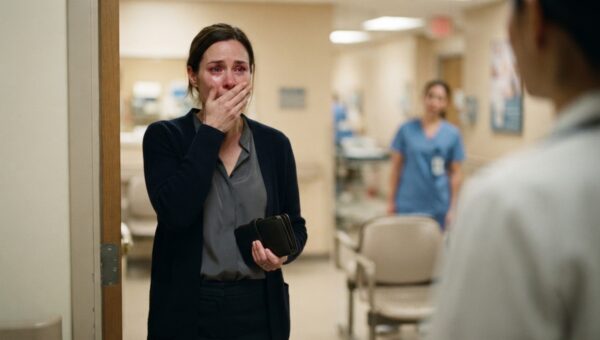
When David burst through the front door, his face was pale and his hard hat was still clutched in his fist like a weapon. Sarah came right behind him, her keys slipping from her fingers and clattering against the linoleum before she dropped to her knees beside my chair. They didn’t yell at me. They didn’t ask how I could be so foolish. Sarah just pulled my head against her shoulder and cried, her hands trembling as she stroked my hair, while David stood over us with his jaw clenched so tight the muscle twitched beneath his ear.
The specialist we saw two days later at the county hospital used a tiny camera on a flexible tube to look down into my throat. He called it an esophageal stricture, a narrowing caused by years of silent acid reflux that had finally scarred the tissue shut. He told us that another month of living on thin broth would have left me too weak to survive the simple outpatient procedure needed to stretch the passage back open. Sitting in that sterile examination room with the fluorescent lights buzzing overhead, I realized how close I had come to trading my life for the sake of a stubborn pride.
We are home now. The procedure went well, and though I still have to eat my food slow and soft, the burning tightness is gone. Etta still comes three days a week, but the ninety dollars doesn’t feel like a tally mark anymore. It feels like the price of admission back to the land of the living. This afternoon, the sun is cutting a warm yellow square across the kitchen table where the old scuff mark still sits by the pantry door. A white ceramic mug of nutrient-rich broth sits beside me, steaming softly in the afternoon light. Etta is sitting quietly across from me with her notebook open, doing her paperwork, while David stands nearby with his hand resting gently on my shoulder. He isn’t holding me up because I’m broken. He’s just standing there because he loves me, and for the first time in eight months, I finally have the courage to let him.