I got a lot of things wrong about my family, but the biggest mistake I made was thinking $82,219 of my own personal savings would finally buy me a quiet seat at their table.
For three years, I told myself that distance was the only problem. I lived six hundred miles away in an old farmhouse outside Tucson, running my design business from a scarred oak desk while my mother, Arlene, hosted garden club luncheons and charity galas that my father, Richard, quietly funded with money he claimed came from old investments.
I thought if I just showed up, if I paid my own way and brought enough olive branches, they might look at me as something more than an inconvenient financial footnote.
So when Arlene mentioned their golden anniversary trip to Maui, I foolishly offered to cover the whole thing. I didn’t send a lump sum through some digital app. I routed $82,219 directly through corporate channels to secure the premier oceanfront villas at the Coral Sands, the crown jewel of the island. I wanted them to have the best. I wanted, God help me, to hear Arlene say I’d done something right for once.
The humidity in the open-air lobby hit me like a wet wool blanket the afternoon I arrived. I had flown coach, hauling my own garment bag while the rest of them flew first class on my dime, touching down three hours earlier to get settled. I found them gathered around a teak table near the koi pond, a bright patch of resort linen and gold jewelry against the dark green ferns.
Julian sat right beside my sister, Cassie, leaning in close while his mother, a woman named Suzanne who wore too many diamonds for a Tuesday afternoon, laughed at something my father said. Arlene was holding a tall glass of sparkling water with a lime wedge, her silver hair pinned into the immaculate French twist she wore to every funeral and fundraiser.
“Well, look who finally decided to drag herself out of the cab,” Arlene said before I could even set my bag down on the flagstone. She didn’t stand up. She didn’t offer a cheek to kiss. She just looked me up and down with that familiar, heavy disappointment that always made me feel like I was twelve years old and standing in the mud with the wrong shoes on.
I tried to smile, pulling the strap of my tote bag higher up my shoulder. “Traffic out of the airport was a little messy, Mom. But I made it. Room 412, right?”
My father didn’t look up from his drink. He was turning a heavy silver coaster over and over between his fingers, the way he always did when he was dodging a conversation about money.
Cassie stood up, smoothing the linen hem of her sundress, and stepped right into my path. She reached down to the tray where a waiter had left a silver bucket of ice and two fresh flutes, picking up an empty silver tray with a sharp clink.
“About that,” Cassie said, her smile entirely empty. “We had to shuffle the rooms around. Julian’s mother needed the ocean view for her migraines, and you were taking up space we actually needed for people who matter.”
My stomach didn’t drop. It didn’t flutter. It just went cold and hard, like a lead weight sinking into ice water. I looked from Cassie to Arlene, waiting for the punchline, waiting for someone to laugh and tell me my keycard was waiting at the front desk.
“What do you mean, you shuffled the rooms?” I asked, my voice flat. “I booked those villas six months ago. Every single dollar for this entire stay came out of my account.”
Arlene took a slow sip of her water, setting the glass down on the teak table with a tiny, deliberate click. “Your father and I decided it was inappropriate for you to stay here on our dime when you haven’t even bothered to attend a single family gathering since Christmas. We paid for your flight, didn’t we? Be grateful for that.”
“You didn’t pay for my flight, Mom. I paid for my flight. I paid for all of this,” I said, and for a second, the courtyard went completely quiet except for the heavy splash of the koi pond.
Suzanne let out a delicate little gasp, pressing three fingers against her chest as if she had just heard something obscene. Julian just smirked, leaning back in his chair with his hands locked behind his head.
Cassie stepped closer, shoving the cold silver serving tray right into my hands. The metal hit my palms with a sharp sting.
“If you want to stay, go bring Julian’s mother more champagne,” Cassie said, her voice dripping with venom. “She’s thirsty, and you’re clearly not doing anything else useful.”
Arlene smirked, her eyes cold and bright. “Maybe next time you’ll learn not to embarrass this family.”
They thought I was stranded. They thought I was just the obedient, desperate daughter who would swallow her pride, take the tray, and find some damp closet to sleep in because I wanted their approval so badly. They had no idea who owned the land beneath their expensive sandals.
I didn’t yell. I didn’t throw the tray. I just let go of it, letting the silver plate clatter loudly against the flagstone floor between Cassie’s feet.
“Keep the champagne,” I said, turning my back on them before they could process the sound.
I walked out of the open-air lobby, past the towering palms and the manicured hedges, stepping out into the blinding Hawaiian heat until I reached the row of private phone booths near the service entrance. My hands were shaking, not from fear, but from the sudden, terrifying clarity of a lock clicking open in my mind.
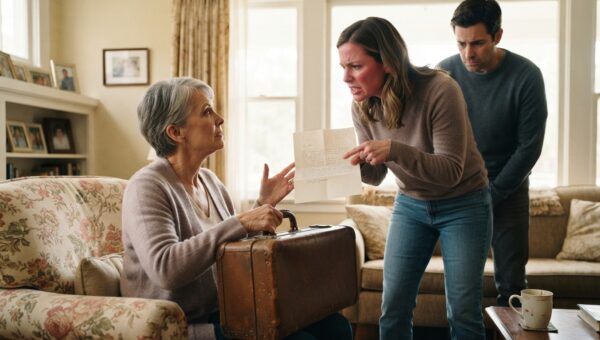
For three years, ever since grandmother passed away in that drafty house in Tucson, the old cedar chest had sat untouched in my spare bedroom. Grandmother had left it to me with a strict instruction written in her shaky, blue-ink cursive: *Open this only when you finally understand why your father is always running from the tax man.*
I had unlocked it six months ago, expecting sentimental trinkets or old photo albums. Instead, I found a dense, perfectly organized archive of bank statements, property titles, and notarized transfer logs spanning thirty years. Dad hadn’t made his fortune through brilliant investments. He had systematically drained Grandmother’s entire manufacturing estate, forging her signature on power-of-attorney documents while Arlene looked on and smiled, bleeding her dry to fund their country club memberships and high-society fantasies.
And more than that: Grandmother, who had never trusted Richard as far as she could throw an anvil, had quietly restructured the family corporation before she died. She hadn’t left a single brick or share to my parents. She had placed the entire Coral Sands resort portfolio, lock, stock, and barrel, into a private trust bearing my name.
I pulled my phone from my pocket, my thumb hovering over the contact I had saved two years ago but never had the heart to use.
I pressed call.
The phone didn’t even ring twice before a crisp, professional voice answered on the other end. “Coral Sands Executive Office. This is Eleanor Vance.”
“Eleanor,” I said, my voice steady now. “It’s Clara.”
There was a tiny hitch of breath on the line, and then Eleanor’s tone shifted instantly from polite management to warm, fierce recognition. “Miss Clara. We were wondering when you’d check in on your property. Your parents arrived earlier this week, but their registration folio listed them as guests of the ownership trust. Is everything alright?”
“Not quite,” I said, looking back through the glass doors toward the teak table where my family was laughing again. “I need you to pull up reservation number 884-210. The oceanfront villas.”
“I have it right here on my screen,” Eleanor said, the sound of her keyboard clicking softly in the background. “Party of five. Arlene and Richard Sinclair, plus guests.”
“Cancel the entire folio,” I said quietly. “Revoke all corporate credit access, disable their keycards immediately, and have security ready to escort them off the property for administrative fraud and guest misconduct.”
Eleanor didn’t hesitate for a single second. “Consider it done, Miss Clara. Shall I have their luggage brought down to the service entrance?”
“No,” I said. “Leave it in the rooms. Let them figure it out.”
Twenty minutes later, I walked back through the lobby. The air conditioning was crisp, smelling faintly of forced orchids and expensive floor wax. I didn’t hide. I walked right past the koi pond, my sneakers clicking softly against the marble tiles.
Arlene was still sitting at the teak table, laughing at something Julian said, when the front desk manager, a tall man in a sharp navy blazer named Mr. Henderson, walked briskly across the lobby with a clipboard in his hand. He didn’t go to the front desk. He walked straight up to their table.
“Mr. and Mrs. Sinclair?” Henderson’s voice carried clearly across the open space.
Arlene looked up, her smile slipping just a fraction as she adjusted her sunglasses. “Yes? We’re a bit busy right now. Can this wait?”
“I’m afraid not,” Henderson said, his tone entirely polite but utterly immovable. “We’ve just received notice from corporate oversight. Your reservation and all associated credit profiles have been revoked effective immediately. You’ll need to settle your incidental charges and vacate the villas within the hour.”
The silence that followed was absolute.
Julian sat up straight, his face flushing a bright, furious red. “Are you out of your mind? Do you know who we are? We’re friends with the owners of this entire resort.”
“I am well aware of who owns this resort, sir,” Henderson said smoothly. “And the trust has instructed us to terminate your stay for severe guest misconduct and unauthorized reservation tampering.”
Arlene stood up so fast her chair screeched against the flagstone. Her face went tight, her mouth opening and closing like a fish out of water as she looked around the lobby in mounting panic. “There’s been a mistake. Richard, tell him. Call our accountant. Call our daughter!”
Cassie stood beside her mother, her eyes wide with sudden, sickening realization as she saw me standing ten feet away by the pillar, watching them with my arms crossed over my chest.
Cassie grabbed Arlene’s arm, her voice shaking. “Mom… Mom, look.”
Arlene turned her head, her gaze locking onto mine. For the first time in my entire life, the iron mask of absolute superiority cracked completely. She saw the calm, flat look in my eyes, and she understood.
She took two shaky steps toward me, her voice dropping to a desperate, trembling hiss. “What did you do?”
I reached into my tote bag and pulled out a heavy, leather-bound ledger with brass corners, setting it down on the nearest marble-topped table with a dull, heavy thud. The old cedar chest was back in Arizona, locked safely in my spare room, but I didn’t need it here. The weight of it was in my voice.
“You always said I didn’t belong in this family, Mom,” I said softly, letting every word hang in the humid air between us. “You were right. I don’t.”
I turned my back on them, walking toward the private elevator that led up to the penthouse suite, leaving them standing in the middle of the expensive lobby with nowhere to go and no one left to pay their way.
The private oceanfront balcony was quiet, the sound of the evening waves rolling in against the reef below erasing the last ragged echoes of their shouting far beneath my feet. I set my bag down on the polished mahogany table, walked out to the glass railing, and watched the sun drop below the Pacific horizon, feeling the cold, heavy iron of the past finally lift away for good.