The smell of cold coffee and stale toast always hung in the hallway of my father’s house by the time Saturday rolled around, a heavy, quiet sort of smell that I never used to notice back when Mama was still here to keep the windows cracked and the sun moving across the linoleum. I drove out every weekend like clockwork, turning my little sedan down his gravel lane at precisely ten in the morning, expecting the usual routine of checking his gutters or listening to him complain about the county commissioners.
But lately, the silence coming off that old house felt different, heavy as a wet wool blanket left out in the yard overnight.
My father, Clifford, was a man built out of old iron and stubborn pride. He had spent forty-two years running the bandsaw at the lumber mill down by the river, never missing a shift, never taking a handout, and raising two girls without ever raising his voice above a firm murmur. He was the kind of man who would gnaw his own arm off before he would ask a neighbor for a cup of sugar, let alone ask his daughter for help with anything heavier than a stuck storm window. He had always taken care of everything, fixing the truck in the driveway with a wrench and a string of muttered curses, keeping the property line neat down to the last inch of fescue.
Then Mama passed away after that long, cruel winter, and the house shrank around him until he was rattling around inside it like a dry seed in a gourd.
I tried to visit more, tried to bring casseroles he barely touched, but he kept pushing me back with that polite, rigid smile that meant he was closing the door. For the past few months, though, the retreat had turned into something much darker and faster. It was the little things that first set my teeth on edge, like finding his heavy-duty lawn mower missing from the garage bay where it had sat since I was in middle school. When I asked him where it went, he just waved a calloused hand and muttered something about the carburetor giving out, though I knew damn well he could have fixed a carburetor in his sleep.
The real shift came when he started giving the family heirlooms away piece by piece. He had pressed Grandpa’s heavy gold pocket watch into my palm two weeks ago, looking right past my shoulder with those faded blue eyes and saying, “Take it, honey, what do I need it for.” That sentence had stayed rattling around in my head like a loose stone in a tin can ever since.
A proud man doesn’t just hand over his father’s watch because he’s feeling sentimental. A proud man gives things away because he thinks he won’t be around to keep them, or because he’s clearing the decks for something he’s too ashamed to name out loud.
I pulled my car up by the old cedar tree, cutting the engine and sitting there for a minute while the ticking cooling metal pinged in the quiet afternoon air. The front room windows were pitch black because he had drawn the heavy velvet drapes all the way across, blocking out the October sun like he was hiding from a county tax man. I didn’t knock because the screen door had a loose latch that always rattled anyway, so I just let myself in with the spare brass key he kept hanging on a rusted nail behind the porch post. The air inside hit me right in the chest, smelling of damp dust and old paper that hadn’t seen fresh air in weeks.
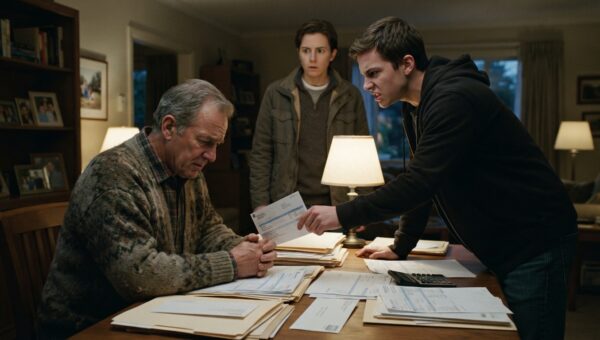
He was sitting at the laminate kitchen table in his gray cardigan, staring straight down at the oilcloth with his hands flat between his elbows. A half-empty box of saltines sat near his right hand, and the house was so quiet I could hear the old refrigerator compressor humming in the corner like an irritated beetle. He didn’t even look up when the floorboard groaned under my sneakers, which scared me worse than if he had jumped out of his chair with a shout. I walked over and set my purse on the counter, my eyes scanning the room out of sheer nervous habit until they caught on the edge of the kitchen table near the bread box.
There was a thick stack of blue window envelopes sticking out from under a crumpled sports section of the county gazette. They were bright, glaring white against the dark wood, and I could see the bold red lettering through the cheap paper margins warning about final disconnects and past-due balances. He must have heard my breath catch because his hand twitched, sliding the newspaper over the pile with a quick, jerky motion that looked entirely unlike the steady man who used to guide heavy oak planks through a screaming saw blade. My heart did a hard, ugly thud against my ribs, but I kept my voice level as I pulled out the chair across from him and sat down.
“Daddy,” I said, leaning forward until my forearms rested on the oilcloth. “Look at me for a second.”
He kept his chin tucked down toward his chest, his knuckles swollen with arthritis looking stark white against the dark grain of the table. “I’m fine, Clara,” he muttered, his voice dry as corn husks. “Just got a bit of a head cold is all. You don’t need to be driving out here every Saturday wasting your gas.”
“I have a full tank of gas, and I’m right where I want to be,” I answered, reaching across the table to cover his big, shaking hand with my own. His skin felt dry and papery, burning with some secret fever that had nothing to do with the weather outside. “We can handle anything together, whatever it is. Just tell me the truth.”
He stayed frozen like that for a long, terrible minute, his chest rising and falling in shallow, hitching breaths while the clock on the wall ticked off the seconds with cruel indifference. Then his shoulders caved in all at once, the last thirty years of unbreakable pride snapping like dry pine under a heavy load, and he put both hands over his face, his lips trembling violently as he finally broke the silence he had built around himself.
“I messed it all up, Clara,” he whispered into his palms, the sound cracking right down the middle until it hardly sounded like my father at all. “I lost everything Mama left me, and now they’re threatening to put a lien on the house.”
The words sat in the space between us like broken glass, sharp and heavy and impossible to sweep away. I didn’t pull my hand back, and I didn’t gasp, because sitting there in the dim kitchen, the whole miserable picture clicked together with a terrible, sickening clarity that made my stomach turn over. It wasn’t cancer, and it wasn’t old age catching up to him the way I had feared during those sleepless nights; it was something much more modern and much more vicious that had preyed on a lonely old man sitting in an empty house with an open internet line and a grieving heart.
He looked up then, his eyes red-rimmed and leaking thin tears down his hollow cheeks, looking smaller and older than I had ever seen him in my entire life. “It started back in April, right after we buried your mother,” he told me, his voice barely carrying over the hum of the refrigerator. “Some feller called on the landline talking about government-backed recovery funds for seniors who lost pensions in the crash. Sounded smart, sounded like he knew the county commissioners by their first names. He called every Tuesday morning right after the mail came. And I… I thought I was being clever, Clara. I thought I was building a little cushion so I wouldn’t have to be a burden on you and your sister when my knees finally gave out for good.”
He pulled a folded letter out of his cardigan pocket and laid it flat on the table between us, his finger tracing the corporate letterhead with a look of pure disgust. It was from a company registered in the Cayman Islands, promising high-yield asset protection through digital currency exchanges that didn’t exist outside of a server room in another hemisphere. He had poured every cent of Mama’s life insurance payout into wire transfers at the local credit union before the tellers even knew to ask questions, believing he was securing our family’s future while sitting alone in the dark kitchen.
“I didn’t want to tell you,” he choked out, staring down at the table like he expected the wood to open up and swallow him whole. “After all these years of me being the one who took care of the bills, I let some smooth-talking stranger clean out our accounts in three months. By the time I realized they weren’t sending returns, the phone numbers were dead and the website was gone. I started selling the tools because the collection calls wouldn’t stop coming, ringing twenty times a day until I couldn’t even stand to look at the instrument on the wall.”
That explained the missing lawn mower, the socket set given to the neighbor, and the heavy velvet drapes drawn tight against the afternoon light. He had been liquidating his entire life to pay off private debt consolidators who bought up the fraudulent paper for pennies on the dollar and started calling him day and night with automated threats of foreclosure and legal ruin. His terror of the telephone wasn’t old age paranoia; it was a daily siege by automated predators who knew exactly how to squeeze a terrified widower until he handed over whatever was left of his dignity.
I felt a cold rage settle into my bones, but none of it was directed at him. I stood up from the table, my chair scraping loudly against the linoleum, and walked straight over to the wall where the black landline phone sat plugged into the baseboard jack. The little red light on the answering machine was blinking furiously with three new messages stored up since noon. Without waiting for him to object, I reached down, grabbed the cord, and yanked it straight out of the wall with a sharp snap that left the plastic clip dangling uselessly against the baseboard.
My father flinched at the sound, half-rising from his chair with a frightened look in his eyes. “Clara, don’t do that,” he stammered, his hands hovering over the table. “They’ll just call back on the mobile, or send another certified letter from the court.”
“Let them try,” I said, walking back to the table and scooping up the entire stack of unopened bills and final notices, squaring the edges against my palm with firm, deliberate movements. “They aren’t getting another red cent from you, Daddy. Not for the mortgage, not for the fake loans, and certainly not for their trouble. We’re going to take all of this down to the state attorney general’s elder fraud division on Monday morning, and let them explain their paperwork to a federal investigator.”
He sank back down into his chair, the fight completely gone out of him, leaving behind only a profound, exhausted quiet that felt like the first honest breath the house had taken in months. “You aren’t mad at me?” he whispered, his voice trembling as he looked up through his bifocals. “I threw away everything your mother and I saved up over forty years of working the floor.”
“I’m mad as hell,” I said, my voice softening as I walked around the table and put my arms around his narrow, shaking shoulders, pulling him back against me until I could feel the hard knobs of his spine through the wool cardigan. “I’m mad at those thieves, and I’m mad you tried to carry this whole mountain by yourself like an idiot. But I’m not mad at you.”
We sat like that for a long time while the shadows lengthened across the linoleum floor and the afternoon sun finally found a gap between the heavy velvet drapes, casting a narrow golden beam right across the saltine box and Grandpa’s watch resting beside it. He didn’t say anything else, and neither did I, because there wasn’t anything left that needed explaining between us.
The next few weeks were a grind of bank statements, police reports, and certified letters to credit bureaus, but the house started changing back the very next Saturday when I walked in through the front door and pulled those heavy drapes all the way open to let the daylight flood every corner of the room. We sat side by side on the front porch swing in the warm afternoon sunlight while the neighborhood dogs barked down the lane and the gravel crunched under the tires of passing cars. The phone inside stayed unplugged and silent, and Grandpa’s watch ticked steadily on my wrist, keeping time for both of us.