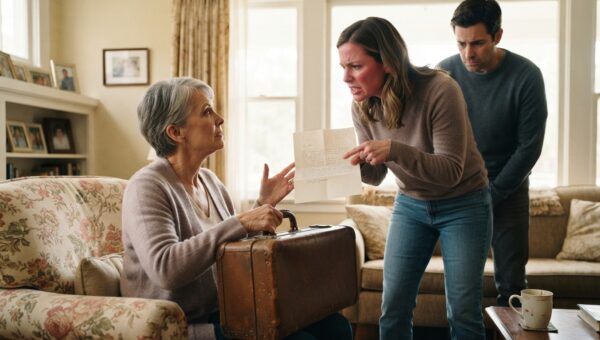
The hip joint itself felt like a sack of dry gravel being ground down every time the physical therapist made me bend the knee, but that wasn’t what kept me awake when the rehab center turned off the overhead fluorescent lights. It was the four o’clock hour. For forty-two days straight, right down to the minute when the wall clock above the double doors clicked over to sixteen hundred hours, Emory would fold his crossword magazine, cap his pen, and stand up from that green vinyl chair like someone had signaled him from the hallway.
He would lean over the metal bed rail, give my good shoulder a dry pat that felt more like he was dusting off a sack of feed, and say the exact same thing he had said every afternoon since they wheeled me out of the operating room. I’m heading out now, Clara. You get some rest and eat that gelatin before it melts. Then he would walk out through the heavy fire doors without looking back once.
I used to lie there in the dark after he left, staring at the empty green chair and listening to the old ladies down the hall arguing with the aides about their call buttons. Fifty-one years we had lived in that house out past the rail spur, sharing a bed with a spring that poked my hip and a breakfast table where we didn’t even need to speak to know who wanted the heel of the loaf.
And yet, six weeks in this brick building across town had turned him into a visitor who couldn’t wait for the visiting bell to ring. I figured hospitals just got to him. Emory was never a man for sickness or doctors or the smell of institutional floor wax. He’d rather grease a tractor axle in January bare-handed than sit in a waiting room with plastic chairs.
On the forty-second night, my leg throbbed so hard the pain felt hot, like someone had jammed a red-hot iron skewer right through the meat of my thigh. The nurse had given me a small paper cup of pills around ten, but they hadn’t touched the ache by midnight. I sat up, pushed the scratchy wool blanket off my shins, and swung my good leg over the edge of the mattress. My toes found the cold linoleum. I didn’t bother with the call button because the night staff was always rushed thin, and besides, I just wanted the window.
The window looked out over the staff parking lot toward the old gravel overflow strip where the delivery vans parked during the week. At that hour, the lot was black except for one mercury-vapor lamp by the dumpster that buzzed like a trapped beetle. I didn’t expect to see anything. I just wanted to feel the glass, which was usually cold enough to draw the heat right out of a person’s forehead if you pressed hard enough.
Then I saw the blue tailgate.
It was an old Ford, two-tone gray and faded blue along the rusted bed panels where Emory had hauled bags of lime and firewood for three decades. It sat alone in the third row, right beneath the shadow of a bare oak tree that dropped its dry leaves onto the hood. There was no frost on the windshield, which meant the engine hadn’t been running long enough to clear it, but the back window was fogged white from the inside.
I squinted against the glare of my own room reflecting in the glass. A dark shape was tilted back in the driver’s seat. A man’s shoulder, broad and familiar even under the bulk of a garment, was wedged against the door pillar. He had his heavy canvas hunting coat pulled up over his ears, the one with the corduroy collar I had patched with denim patches back when Reagan was still in office.
The door behind me clicked open with that soft, oiled squeak the night nurses could manage when they were trying not to wake an old woman. It was Sandra, the young girl with the heavy silver earrings who always checked my blood pressure without looking at the dial because she already knew my numbers by heart. She stopped when she saw me standing by the sill in my faded cotton gown, leaning all my weight onto the metal frame of the walker.
You’re going to pull that incision right open, Clara, she said, her voice dropping down to that low, tired register they use at three in the morning. You ought to be asleep.
I didn’t turn around. I just pointed one finger through the glass toward the third row, right where the old Ford sat swallowed up by the dark. My finger was shaking, not from the cold, but from the way my stomach had suddenly dropped right down into my slippers.
He went home, Sandra, I said, and my voice sounded thin and papery even to me. He told me he was driving back to the house because the chores needed tending. He said the dog wouldn’t settle unless someone was there to let her out at five.
Sandra didn’t look at the truck right away. She walked over slowly, her rubber-soled shoes squeaking once on a stray bit of spilled water, and laid her warm hand right over mine where it gripped the aluminum frame. Her skin smelled like lavender soap and cheap hospital coffee.
He hasn’t gone home once, Mrs. Miller, she whispered, and she didn’t look at me when she said it. She kept her eyes fixed on the asphalt down below.
I turned my head then, my neck stiff as a rusted gate hinge. What do you mean he hasn’t gone home? He leaves every day at four. I watch him go down the corridor.
He walks out the front doors, she said softly, and then she looked at me with those big, sad brown eyes that had seen too many old people dying or running out of money in rooms like this one. He walks out, gets into that truck, and drives it around to the back row by the loading dock. He stays out there all night. Every single night since you came in from surgery.
The silence in the room suddenly felt heavy, like the air right before a summer thunderstorm breaks over the dry hay fields. I could hear the wall clock ticking behind my head, and every tick sounded like someone dropping a pebble into a tin bucket.
The motel down on the highway is eighty dollars a night now with the tax, Sandra added, like she was explaining something simple to a child who had missed a day of school. He asked me on the third day about rates. When I told him, he just stood there by the nurses’ station and rubbed the back of his neck until his skin was red. Next morning, that truck was parked by the fence. He told me he’d rather stay close in case you took a turn. Said eighty dollars was enough to buy a half-ton of winter coal and he wasn’t about to spend it on a bed with a Gideon Bible and a Gideon lamp when he had four wool blankets and his old coat in the cab.
My hand stayed flat against the cold pane. The glass had turned my palm white where the skin pressed against it. Fifty-one years of sharing a mattress that dipped in the middle, fifty-one years of him grumbling about the price of spark plugs or whether we needed to patch the pump house before the first freeze, and here he was, seventy-four years old with a bad ticker of his own, sleeping doubled up in the cab of an eighty-model Ford because eighty dollars was too much of our retirement to throw at a stranger’s motel room while I lay in a clean white bed with my leg propped up on foam wedges.
He comes in at eight every morning with that crossword puzzle from the paper, I said, and my throat felt like I’d swallowed a mouthful of road dust. He always smells like shaving soap. How does he smell like soap if he’s sleeping in a truck?
He uses the family washroom down in the basement, Mrs. Miller, Sandra said gently. The one by physical therapy with the old shower stall. He keeps a spare shirt and a bar of Ivory in his tackle box under the seat. He washes up at six every morning before they unlock the front doors so you won’t ever guess. He’s proud as an old rooster, that husband of yours. He wouldn’t let you spend a dime on him if his ribs were cracking.
I didn’t cry then. People think old women cry at the drop of a hat, but when things get that heavy, your eyes just dry up like old leather left out in the sun. I just stood there until my hip started to burn so bad I couldn’t keep my weight on it any longer, and Sandra had to help me shuffle back to the mattress without turning on the overhead light.
The rest of that night went by in chunks, dark hours where I listened for the sound of an engine starting up down in the lot, though the Ford’s muffler was so rusted out I would have heard it if he’d cranked it even an inch. I thought about all the things we hadn’t said to each other over the last twenty years. We were good at the quiet parts of marriage, the parts where you just hand someone the salt without being asked or check the oil in their car before they drive into town for supplies. We weren’t the kind to hold hands while walking down to the post office, not even back when we were twenty, but we knew the weight of each other’s absence the way you know the weight of a heavy winter coat hanging by the door.
When the morning shift came on around six-thirty, the light through the high window turned that dirty gray color that comes off the desert before the sun gets high enough to burn the haze away. A different nurse brought in my breakfast tray, a paper carton of apple juice and a bowl of oatmeal that looked like wallpaper paste, but I didn’t touch it. I sat propped up against the pillows with my hair brushed out and my flannel bed jacket buttoned all the way to the top button.
At seven-fifty-five, the heavy fire doors at the end of the hall swung open with their usual rubber-bumper thud.
Emory came down the linoleum floor with his short, rolling gait, the one he’d had ever since he took a kick from a yearling mule back when we were first farming out near Wasco. He was wearing his gray wool sweater with the leather buttons, the one I had mended at the elbow last November, and he carried a crumpled brown paper sack in one hand and yesterday’s folded newspaper tucked under his arm. He looked just like he always did: face shaved clean, white hair combed back wet from the basement tap, eyes a little red around the corners from the wind.
He walked into the room, dropped the paper on the bedside table, and reached out to set the brown sack down next to the plastic water pitcher.
Morning, Clara, he said, and his voice was as steady as a fence post. How’s that leg holding up? Did the nurse give you anything for the grinding?
I didn’t answer him right away. I just watched him pull the green vinyl chair out from the corner, right where it always sat, and hitch it an inch closer to the mattress so he wouldn’t have to raise his voice over the hum of the ice machine down the hall.
Emory, I said.
He stopped with one hand on the back of the chair, his fingers hooked over the top rail. Yeah? You feeling weaker today? I can go find the doctor if that hip’s acting up again.
You didn’t go home yesterday, I said.
The room got very quiet then. You could hear the pneumatic door at the end of the hall closing with a soft hiss, and somewhere down in the courtyard a diesel delivery truck was trying to turn around. Emory didn’t drop his eyes, but his jaw tightened just a little bit, right where the old scar from the barbwire cut ran down toward his collar.
Who told you that? he asked, and his voice dropped down so low I had to lean forward to catch it.
Sandra was on duty last night, I told him. I couldn’t sleep, so I got up to look at the stars. I saw that old blue truck of yours sitting right down there under the oak tree with your hunting coat pulled up over your ears like an old hobo sleeping in a boxcar.
Emory let go of the chair. He walked over to the window, turned his back to me, and looked out at the parking lot where his truck was probably sitting right then with the steering wheel turned hard to the left so the tires wouldn’t catch the gravel curb. His shoulders looked narrower under that wool sweater than they used to, or maybe I was just noticing for the first time how much bone was left under the cloth.
The motel’s eighty dollars, Clara, he said to the glass. It’s highway robbery. They charge twenty dollars just to park a car in the back, and the sheets smell like bleach and old carpet. We ain’t made of money. We got that property tax coming due in November, and you know as well as I do what the seed corn cost us this spring.
I looked at the back of his head, at the little bald spot right on the crown where the hair was starting to thin out white as sheep’s wool. Fifty-one years. Fifty-one years of him trying to carry every load by himself because he was scared to death I’d look at him sideways if things got tight.
You think I care about eighty dollars for a motel when you’re sleeping on a coil spring in the back of a Ford at seventy-four years old? I said, and my voice didn’t shake the way I thought it would. It felt hard, like dry oak. You think I want to sit here in these clean sheets knowing you’re out there freezing your kidneys just so we can save enough to buy a few extra pounds of fertilizer we don’t even need?
He turned around slowly, his face looking tired, the skin around his eyes mapped with fine little lines from forty years of squinting into the valley sun.
I ain’t freezing, he muttered. I had the sheepskin quilt from the tack room. And I’m fifty yards away if you need me in the night. You was hollering for water three nights ago and nobody came for twenty minutes because they was down the hall with that woman from the hardware store. I heard you. I was sitting right out by the fence with the window cracked two inches.
I stared at him, and for a second I didn’t know whether I wanted to throw my plastic water pitcher at his head or reach out and pull him down onto the edge of the bed so I could feel the cold of that truck still coming off his wool sweater.
You go down to that front desk right now, I said, and I pointed my finger toward the door just like I used to do when he tracked cow manure across the clean kitchen linoleum. You tell that girl with the silver earrings that you’re staying here. You tell her to bring one of those folding cots they keep in the linen closet up to this room before noon.
He opened his mouth like he was going to argue, like he was going to tell me about the fire codes or what the administrator would say about a man sleeping in the women’s wing, but then he looked at my face. He looked at me the way he used to look at the sky over the north forty when the clouds started turning that greenish-black color that meant the hail was coming. He knew there wasn’t no use talking back once I used that particular tone.
They charge ten dollars a day for the cot, he mumbled, looking down at his boots. I checked when I first brought you in.
Then we’ll eat oatmeal for a month when I get back, I said. Now get on down there before they give that cot to somebody else’s husband.
Emory didn’t move for a long second. Then the corners of his mouth twitched just a tiny bit, that dry, stubborn little grin he used whenever he knew he’d been caught dead to rights but didn’t want to admit he was glad of it. He reached out, took my hand in his rough, grease-grained palm, the thumb all scarred from where the corn binder had taken the tip off back in seventy-two, and squeezed it hard enough to make my knuckles pop.
All right, Clara, he said, and his voice was thick as porridge. I’ll go talk to her. But I’m keeping the truck where it is just in case we need to haul something.
He walked out then, but he didn’t rush the door this time. He took his time down the hall, his boots hitting the floor with a steady, heavy rhythm that I could hear long after the double doors swung shut.
They brought the folding cot up around ten. It had a thin green mattress that smelled like old wool and Lysol, and Emory set it up right between the window and the metal wardrobe, close enough that I could reach out and touch the frame with my fingertips without even leaning off the edge of my own bed. He didn’t sleep in his hunting coat that night. He took it off, hung it over the back of the green vinyl chair, and lay down in his flannel shirt with his hands folded across his chest, staring up at the white acoustic tiles of the ceiling while the old highway traffic hummed out on the bypass.
Around three in the morning, my leg gave that same hot, grinding wrench, and I let out a little breath through my teeth before I could stop myself.
Instantly, the springs on the cot groaned. A heavy pair of bare feet hit the floor, and a second later a warm, dry hand reached out from the dark and found my wrist.
You want some water, Clara? he whispered in the pitch black.
I didn’t want water. I just wanted to know he was right there where I could touch him, fifty-one years and forty-two nights of parking lot cold behind us both. I squeezed his fingers, and he squeezed back, right there in the narrow space between the window and the wall, while the hospital lights hummed on through the dark.