My father always ran our family like he was tallying inventory at his scrap yard, keeping a ledger in his head of who brought a profit and who was just taking up floor space.
I knew the rules better than anyone. I married a woman who didn’t come from money, took a job that paid an honest wage instead of a corporate bonus, and chose to live in a modest house on the edge of town where the furnace always rattled when the wind came down off the ridge.
That made me the lean season in my father’s ledger. It made my eight-year-old daughter, Josephine, a liability he didn’t care to account for.
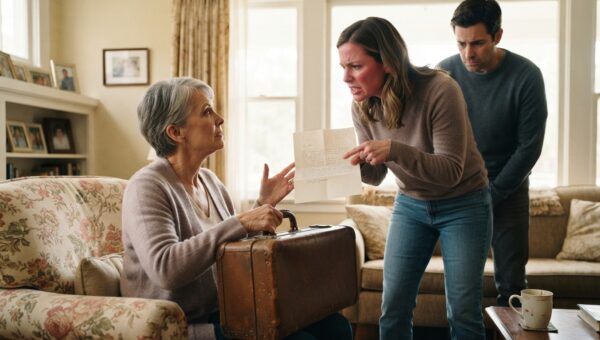
New Year’s Day started like every other holiday we spent under his roof, with the gravel crunching under the tires of our battered Dodge and the smell of pine and boiled ham drifting through the front door. Clara and her husband had already parked their shiny new SUV right in the middle of the drive, blocking us in as usual. Inside, the living room looked like a toy store after a liquidation sale. Clara’s twin boys, both eight just like Josephine, sat knee-deep in discarded wrapping paper, surrounded by brand-new tablets, designer sneakers, and sprawling art kits that probably cost more than my monthly grocery bill.
Josephine didn’t say a word. She just smoothed down the front of her hand-me-down corduroy skirt and walked over to the corner where my sister had tossed a crumpled grocery bag.
My father sat in his leather recliner, nursing a cup of black coffee, watching her with that flat, heavy stare he used on suppliers who tried to short him on a load of scrap iron. Clara hovered nearby, holding a glass of ginger ale and smiling that thin, knowing smile she’d perfected since high school.
At eight years old, Josephine stood beside that mountain of plastic and paper, clutching a cheap plastic horse with one leg snapped off clean at the knee and black marker scribbled all over its flank. The wrinkled brown paper crackled in her trembling hands as she turned it over once, twice, looking for a tag or a card that wasn’t there.
Then my father laughed. It was a dry, ugly sound that didn’t reach his eyes. “The good presents are for the grandchildren who actually matter.”
Nobody in that room moved. Clara looked down at her fingernails, pretending she hadn’t heard.
My mother gave a nervous little cough and looked away toward the kitchen. My father just took another sip of his coffee, waiting to see if I would swallow it the way I always did.
Josephine didn’t cry. She just pressed her face into my shirt, right where the cotton was worn thin at the chest, and whispered, “Daddy… maybe my real present is hidden somewhere else?”
Those ten words hit me harder than a fist. I felt something inside my chest snap, a cable that had been stretched too tight for thirty years finally parting under the strain. I didn’t yell. I didn’t make a scene right then. I just knelt down, kissed the top of Josephine’s head, and told her to wait for me by the front door.
I walked back into that living room twenty minutes later, my boots making a slow, heavy sound on the hardwood floor.
My father didn’t even look up from his paper. Clara was showing one of the twins how to log into a new tablet.
I walked straight to the mahogany side table where I had placed the gifts I brought for my parents. I picked up the heavy Italian leather handbag I bought for my mother after saving for three months of overtime, and the Swiss-movement watch I got for my father, both sitting in their shiny festive bags with silver tissue paper spilling out the top.
I didn’t say a word as I reached inside, pulled the watch box and the handbag out by their handles, and dropped them back onto the table. I left the empty bags sitting there like hollow shells.
My father finally lowered his paper, his eyebrows drawing together as he narrowed his eyes. “What are you doing?”
I turned toward him, my hands steady for the first time all day. I opened my mouth, and the words came out flat and cold, stripping away thirty years of trying to earn an approval that was never real.
“You wanted an accurate count, Arthur, so here it is,” I said, my voice barely carrying over the hum of the refrigerator in the kitchen. “You made sure everyone in this room knew my daughter doesn’t count in your ledger. Well, congratulations. You finally got your math right. Because as of right now, neither do you.”
Clara dropped her ginger ale glass. It didn’t break on the thick carpet, but the ice cubes scattered across the floor with a sharp clatter that made everyone jump.
“Are you out of your mind?” Clara hissed, her face flushing a bright, angry red. “Dad was just joking around. It’s a joke, for heaven’s sake. Why do you always have to make everything so miserable?”
My father slowly stood up out of his recliner, his jaw working as he tried to find his footing, trying to summon the authority that had kept our whole family dancing to his tune for decades. But the look in his eyes wasn’t anger anymore. It was confusion. He didn’t know how to handle a debtor who simply refused to pay the tribute.
“You bought those with my name in mind,” my father said, his voice dropping into that low, dangerous register he used when he wanted people to back down. “You put those gifts on that table to show respect.”
“Respect is something you earn, Arthur, not something you bill me for,” I said, turning my back on him before he could answer.
I walked over to the front door where Josephine was waiting, her small hand resting quietly on the brass knob. I didn’t look back at Clara sputtering excuses or my mother staring at the empty gift bags in horror. I opened the heavy oak door and let the cold January air sweep into the hallway, fresh and clean and sharp.
We walked out to the Dodge without looking back once. The gravel crunched under our boots, loud and final, like stones falling into place.
An hour later, we were sitting in a warm booth at the twenty-four-hour diner down by the interstate, where the waitress knew us by our first names and the coffee always tasted a little too much of chicory. Josephine had a plate of pancakes dusted so heavily with powdered sugar it looked like a snowdrift had landed on them. In her lap, sitting right beside her juice glass, was a brand-new stuffed puppy we’d picked up at the corner pharmacy with the last twenty-dollar bill in my wallet. It didn’t have a brand name, and nobody had wrapped it in fancy paper, but its ears were soft and it didn’t have a single mark on it.
Josephine took a bite of her pancake, leaned her head against my shoulder, and smiled up at me with her mouth full of sugar. We didn’t talk about the house on the ridge or the ledger my father kept in his head. For the first time in her life, the count came out even, and we were the only ones who needed to know the sum.