The Sears dishwasher manual was supposed to be in the red accordion folder behind the tax returns from two thousand and nineteen. I was on my knees on the damp basement concrete because my back had been acting up since the morning shift at the clinic, and the cold was coming straight up through my jeans. I pulled out the old folders, the ones labeled with Arthur’s careful, block-lettered handwriting from back when we first moved into the Dutch colonial on Elm Street, and reached all the way to the back where the appliance warranties lived in yellowed paper sleeves.
My fingers brushed against something thick and plastic-coated that didn’t belong with the Kenmore manuals. It was a blue binder clip holding together twenty pages of heavy cream legal paper with red margin lines. I pulled it out into the dim light of the single bulb hanging from the floor joist above my head. The cover page had a typed header from Pacific Ridge Financial, a name I had never heard in twenty-four years of paying bills together.
Arthur always handled the big accounts because he liked the numbers and I liked the patients. That was the division of labor we settled into when we bought the place back when our hair still had some natural dark in it and the mortgage rate was something we talked about over cheap beer on the back porch. He paid the electric, he paid the water, he handled the insurance drafts that came out like clockwork on the fifteenth of every month.
I bought the groceries and paid the gas bill with the money from my shifts at the physical therapy clinic on Fourth.
I flipped straight to the signature page because my eyes caught the bold font near the bottom where it said Borrower. There was my name, printed in Arthur’s neat spacing, and right next to it was a signature scrawled in black ink that looked almost like mine until you held it up to the yellow light bulb. My real lowercase y always curls back to the left like a fishhook. This one straightened out and hooked hard to the right, stiff and sharp.
“What is this,” I whispered to the empty basement wall, my voice sounding thin against the low hum of the furnace.
Right below my fake name was another stamp that made my stomach drop lower than the concrete floor. It was my brother Wayne’s notary public stamp, square and purple with the state seal in the middle, alongside his signature as the official witness to my signing.
Wayne lived twenty minutes north in that split-level with the gravel driveway where he fixed lawnmower engines on the weekends when he wasn’t doing real estate paperwork down at the county annex.
I didn’t call Wayne right away. I sat there on the cold floor with my knees aching and dialed the number printed at the top of the Pacific Ridge statement while the basement air smelled faintly of damp cardboard and old furnace oil. A woman with a flat, computerized voice answered on the second ring, asking for an account number I didn’t have until I read her the loan number off the top of page two.
“Account is active,” she said after a long, quiet pause on her end. “Second lien mortgage. Original principal one hundred and eighty-five thousand dollars. Balance remaining is one hundred and forty-one thousand.”
“Who authorized that,” I asked, and my voice didn’t even sound like mine.
It sounded like an old lady shouting across a windy parking lot.
“The borrower on file is Arthur Vance, with co-borrower Margaret Vance,” she said, reciting it like she was reading off a grocery list. “Monthly payment is one thousand three hundred and forty dollars. Paid on time for thirty-six months.”
Thirty-six months. Three years. That was three full years of Arthur sitting at the kitchen table across from me at six in the morning, blowing on his black coffee and telling me we had to watch the water bill because the city rates were killing us. Three years of him shaking his head over the Sunday paper and muttering about how the inflation on lumber and heating oil was going to eat our retirement alive.
I remembered Thanksgiving two years ago when my sister brought that extra pie and Arthur stood by the stove staring out the window, his shoulders hunched inside his old wool sweater, telling us the economy was a runaway train and we had to cut back on every little thing. He looked so tired that day. I reached out and rubbed the back of his neck and told him we’d get through it because we were smart with our money.
“I’ve got it handled,” he had told me then, his hand covering mine on the counter. “Just let me worry about the books.”
I hung up the phone and stared at the dark concrete wall until my eyes watered. Then I climbed the basement stairs one at a time, holding onto the wooden handrail that Arthur had sanded and painted white the summer our oldest girl went off to community college. My legs felt hollow, like somebody had scooped out the bones and left just skin and wool pants.
The kitchen was quiet when I got up top. The digital clock on the microwave blinked twelve-fifteen, the exact time I usually came home from my Tuesday shift to eat a turkey sandwich and check the mail. On the oak table, right where Arthur always left his leather key tray, sat his iPad and a stack of junk flyers for gutter cleaning.
I didn’t wait for him to get home from his office supply warehouse downtown. I opened his laptop, which he never locked because he said he had nothing to hide from his wife, and pulled up our primary checking account through the credit union. I didn’t need his password because the browser remembered it from the last time he paid the electric bill on Sunday night.
The search bar at the top of the statement history took three seconds to pull up what I was looking for. Every single month on the first, right around midnight when the rest of the street was asleep, one thousand three hundred and forty dollars left our joint account and went straight to Pacific Ridge Financial. But that wasn’t the only thing moving out of our savings.
Further down the ledger, buried between a grocery store charge and a utility draft, was a lump-sum transfer for forty-seven thousand dollars dated eighteen months ago. The money hadn’t gone to a bank or a medical bill or a car loan. It went to an outfit called Devlin Holdings, registered at a post office box in a town forty miles down the river where my brother Wayne used to rent a storage unit for his old outboard motors.
I sat there in the quiet kitchen with the afternoon sun cutting across the linoleum floor and typed Devlin Holdings into the state business registry search on my phone. The corporate filing came up in four seconds flat. The managing member listed on the state records wasn’t a bank and it wasn’t a corporation with an office building downtown. It was Wayne’s wife, Susan, and the alternate contact address was an LLC tied right back to the commercial plumbing supply business that Wayne’s eldest boy had run into the ground back during the winter of twenty-twenty.
My brother Wayne had helped Arthur forge a second mortgage on our home to bail out a failed family parts shop that had been bleeding money since before the pandemic, and they had kept it secret by making me believe we were two steps away from the poorhouse.
The front door clicked open at five past five. Arthur dropped his leather briefcase on the entryway bench with the familiar heavy thud that usually meant he was tired and ready for the pork chops I took out of the freezer that morning.
“Margie?” he called out, his voice echoing a little off the hallway walls. “You home early?”
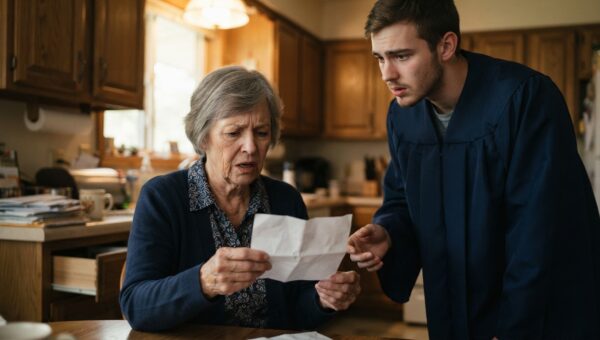
I didn’t answer from the kitchen. I just stayed sitting at the table with the twenty pages of the Pacific Ridge mortgage spread out under the reading lamp, along with the printed bank statement showing the forty-seven thousand dollar wire transfer to Devlin Holdings.
He walked into the kitchen rolling up his shirtsleeves, his tie slung over his shoulder the way he always did when he finished the inventory reports at the warehouse. He stopped dead by the refrigerator when he saw the papers spread across the wood where we used to sit and help the girls with their fractions.
“What’s all that?” he asked, his voice dropping an octave into that flat, careful tone he used when he was trying to figure out how bad a plumbing leak was before he looked under the sink.
“I was looking for the dishwasher warranty,” I said, and my voice didn’t shake at all. That surprised me more than the mortgage did. “In the basement filing cabinet. Behind the tax returns.”
Arthur didn’t run. He didn’t turn white like they do in the movies. He just let out one long, slow breath through his nose and pulled out the wooden chair opposite me, the one with the squeaky leg we never got around to gluing. He sat down and put his hands flat on the table, palms down, staring right at the purple notary stamp with Wayne’s name on it.
“You shouldn’t have been looking in that drawer,” he said softly.
“Wayne stamped it,” I said. “Wayne sat there and watched you sign my name while I was at the clinic cleaning out my room between patients.”
“Wayne didn’t want to do it,” Arthur said, and that was the first lie he dropped, or maybe the first truth he let slip. “I told him you knew about the shortfall. I told him we talked it over and you agreed it was the only way to keep the parts business from taking my sister’s house down with it. Wayne just trusted me.”
“My brother is a notary,” I said, leaning forward until the light hit the gray in my hair. “He knows the law better than that. And you knew damn well I wouldn’t mortgage our roof to pay off my nephew’s bad truck leases.”
“It wasn’t truck leases, Margie,” Arthur said, and for a second he looked small in his gray shirt, his shoulders rounding out like he was carrying forty bags of gravel instead of a piece of paper. “It was the tax liens. They were going to take the warehouse where Wayne works. If Wayne lost his job, he and Susan would have lost the kids’ health insurance before the youngest got his braces off. What was I supposed to do? Tell them no while we sit here with a paid-off deed and three rooms we don’t even use?”
“You were supposed to ask me,” I said. “You were supposed to tell me the truth instead of telling me we couldn’t afford to go visit my mother in Buffalo for her birthday. You made me feel like every time I bought a bag of groceries I was stealing from our retirement.”
“I handled it,” he said, and his voice cracked just a little on the edge, that old familiar phrase he used whenever the furnace broke or the roof leaked and he wanted me to feel safe while he fixed it. “Every month I made the payment. We never missed one. Not once.”
“We’re paying one thousand three hundred and forty dollars a month for a ghost, Arthur,” I said, standing up so fast the wooden chair scraped hard against the floorboards. “And there’s one hundred and forty-one thousand left to go. On a house we built together before Wayne even graduated high school.”
He didn’t reach for my hand this time. He just looked down at his palms, the skin red and rough from forty years of handling boxes and paperwork in a drafty warehouse.
“I already talked to an attorney down at the county seat on my lunch break,” I told him, looking down at the top of his thinning hair. “The mortgage is fraudulent. Wayne’s notary license is going up for review by the state board before the end of the month because I already called them from my car before I came inside. And you are going to call Pacific Ridge and tell them the primary borrower didn’t sign a single page of that binder.”
Arthur looked up then, his eyes small and tired behind his wire-rimmed glasses, the way they looked every time he realized the math didn’t balance at the end of the quarter. “That’ll put the business under, Margie. It’ll take Wayne down too.”
“Then Wayne should have thought about that before he borrowed my signature,” I said. “Get your bag. You can stay at his place tonight while I call the locks Smith.”
He didn’t argue. He got up slow, his knees popping the way mine had in the basement, and walked down the hall toward the front closet where his winter coat hung next to my old gardening jacket. I didn’t watch him leave. I stayed right there at the kitchen table until I heard the front door latch shut behind him with that dry, final click.
The kitchen was quiet again, the way it used to be before we bought the house, before we had a mortgage or a savings account or a family to hide things from. The afternoon light had moved off the linoleum and left the room in gray shadow, the kind of light that doesn’t promise anything except that tomorrow will be Tuesday and the bills will still be waiting in the box by the door. I reached out and picked up the single certified property deed from the center of the table, folding it once down the middle and sliding it into my purse where it belonged.