Why did Arthur wait until the ink on his own death certificate was barely dry to lock me into a thirty-day house arrest? That was the question rattling around my skull while I sat in Mr. Vance’s leather armchair, listening to the heavy tick of a grandfather clock that sounded entirely too much like a countdown.
We had buried Arthur three days before on a Tuesday that smelled of wet mulch and cheap chrysanthemums.
The funeral was a sparse affair because Arthur had spent the last seven years of his life systematically alienating anyone who wouldn’t let him finish a sentence in peace. My mother had stopped visiting after the great argument over his garden shed in 2018. My cousin Wesley hadn’t even flown in from Denver, choosing instead to send a text message that basically asked if the truck was part of the estate.
When Mr. Vance cleared his throat across the mahogany desk and laid out the terms of the trust, I expected the usual division of worn-out furniture and whatever meager savings remained after the nursing home took its bite. Arthur had lived in that single-story brick ranch on Elm Street for forty-two years. It was a modest place with yellowed wallpaper and carpets that remembered every Thanksgiving since Jimmy Carter was in office.
Then Mr. Vance adjusted his spectacles, looked over the top of the document, and said the words that changed the gravity in the room.
Two hundred and fifty thousand dollars in liquid accounts, plus the unencumbered deed to the entire property on Elm Street, transferred outright to me.
“There is a provision,” Mr. Vance said, his voice dropping into that flat, professional register lawyers use when they are about to ruin someone’s afternoon. “Article Twelve, Section Four. You are required to reside in the dwelling continuously for thirty days following the probate filing. No commercial visitors, no estate liquidators, and absolutely no listing of the property until the thirtieth day concludes at midnight. If you vacate the premises prior to that timestamp, the entire bequest reverts to the county historical society.”
I remember blinking at him, wondering if I had misheard the figure or the timeline. Arthur wasn’t a sentimental man. He measured his affection in cans of soup left on my porch during my rough patch after the divorce and quiet nods when I finally fixed the alternator on his Buick.
The idea that he cared whether I slept in his old bedroom for a month felt like a strange, posthumous prank.
Three days later, I moved a single duffel bag into the guest room on Elm Street.
The house felt hollow in a way that empty buildings usually don’t. It smelled of old dust, stale peppermint, and the specific brand of pipe tobacco Arthur had smoked out on the back patio long after his doctor told him his lungs were like old parchment. The silence was heavy, pressing down through the ceiling boards whenever the refrigerator compressor kicked on. I spent the first three evenings walking from room to room, touching the edges of his scarred end tables and wondering what I was supposed to do with a quarter million dollars and a mortgage-free house that felt more like a museum of a life I only half-remembered.
On the fourth night, the wind picked up outside, rattling the loose aluminum flashing over the carport.
I couldn’t sleep. My mind kept looping back to the way Mr. Vance had emphasized that thirty-day clause, as if he were warning me about a dog left off its leash.
I went down to Arthur’s study to look for his tax returns. I needed to know what utilities were outstanding before the monthly auto-drafts cleared out my own modest checking account. The room was dominated by an oversized oak roll-top desk that Arthur had salvaged from an abandoned freight depot back in the seventies. It was cluttered with old catalogues, expired insurance policies, and stacks of unopened mail from charities he never gave to.
I pulled out the bottom drawer of the desk to clear out a pile of paper clips that had jammed the wooden runner. The drawer came all the way out, tipping slightly in my hands.
That was when I felt it.
Taped to the underside of the cabinet frame with thick, yellowed strips of packaging tape was a small, brass Yale key. It wasn’t labeled. It didn’t fit any door in the main hallway or the front deadbolt.
I stood there in the dim light of the desk lamp, turning the cold metal over in my palm. The house creaked above me, the old timber settling against the wind.
I started checking every baseboard in the hallway, pressing my fingers against the paneling just past the linen closet where the drywall looked slightly thicker than it should have been. About halfway down the passage, my knuckle hit something that didn’t sound like lath and plaster. It sounded hollow. A vertical seam ran down the wallpaper right through a faded print of a mallard duck taking flight off a misty lake.
I pushed the framed picture aside. There was a small, waist-high wooden latch disguised as part of the decorative wainscoting.
When I turned the brass key in the hidden lock, the panel gave way with a heavy, oiled click that echoed down the quiet hall. I pulled it open and reached blindly along the wall until my fingers found a toggle switch.
The fluorescent tube overhead flickered twice, buzzing like an angry hornet, before bathing the tiny, windowless space in a harsh, clinical white light.
There was almost nothing in the room. No bed, no dresser, no rugs. Just a metal folding chair facing a small, black-and-white television monitor sitting on a cinderblock shelf, and a calendar that covered the entire length of the far wall.
I stepped inside, the door swinging shut softly behind me with a sound like a vault closing.
The calendar wasn’t one of those free promotional ones from the local hardware store. It was made of heavy draftsman’s paper, pinned to the drywall with thousands of tiny steel tacks. Every single square, stretching back fourteen years, had been meticulously filled in with black ink. Dates, small codes, initials, and short notes crowded the margins in Arthur’s sharp, sloping handwriting.
I traced my finger along the columns, watching the dates recede into the past. 2012. 2015. 2020. The sheer volume of the record-keeping made my throat tighten. Why would an old man sitting alone in a suburban ranch spend over a decade tracking every single day on a wall that nobody else was ever supposed to see?
Then I reached the current month.
The most recent entries stopped three days before Arthur died. But down at the bottom, near the corner where the current week’s date sat, something else caught my eye.
The final date had been marked twice. Once in standard black ink, and then over top of it with a heavy, frantic red grease pencil that had torn slightly through the paper.
Right beneath the calendar, resting on the seat of the metal folding chair, was a legal pad with a single sheet of paper torn from the middle. Arthur’s handwriting was unmistakable, even if the hand had been shaking when he wrote it.
I picked it up, leaning closer to the harsh light of the ceiling tube.
The first line read: If you are reading this, Vance did his job, and the fools downstairs are already reaching for the doorknob.
I had to sit down on the edge of the metal chair because my knees simply decided they were done holding me up. The small television monitor sat right in front of me, its screen dark and reflective.
Arthur hadn’t made me wait thirty days because he was feeling nostalgic about the living room furniture. He had made me wait because he knew exactly what my aunt Brenda and my uncle Gary were going to do the moment they thought the coast was clear.
According to the handwritten note, the fourteen-year calendar was the index to a storage drive plugged into the back of the television monitor. For over a decade, Arthur had maintained a closed-circuit camera and audio recording network routed through the house, capturing every single visit, every clandestine conversation, and every illegal attempt by his extended family to pry open his locks, search his desk, and pre-sell his assets before his heart finally gave out. They had been draining his minor accounts through coerced signatures for years, convincing him he was losing his mind while quietly plotting to liquidate Elm Street the minute he drew his last breath.
The double-marked date on the calendar wasn’t a typo. It was today. Day thirty.
The note ended with a sentence that didn’t sound like a warning so much as an invitation: They think the house is empty, and they brought the quitclaim deed they want you to sign at gunpoint or worse. Let them in. Vance is waiting in the driveway with the sheriff.
Three weeks later. The phrase felt like something carved into stone.
The days between finding the room and the final morning were the longest of my life. I didn’t leave the property once. I spent my time sitting in the study with the television logs running, watching the small, crisp black-and-white feeds of the perimeter cameras. I watched my uncle Gary drive by in his silver pickup three different times, slowing down to stare at the front porch as if he were measuring the square footage for a flip. I listened to voicemails from Brenda asking why I wasn’t answering my phone, her voice dripping with that oily, false sweetness she only used when she wanted someone to sign a paper without reading it.
I didn’t call them back. I just sat at Arthur’s desk, drinking bitter black coffee from his chipped mug, watching the calendar on the wall until the numbers started to blur together.
On the thirtieth morning, the weather broke. A heavy autumn fog rolled in off the river, burying the cul-de-sac in a thick, gray wool that muffled the sound of approaching tires.
I was standing in the hallway when I heard the crunch of gravel in the drive.
It was 8:52 in the morning. Exactly the time Arthur had marked in red pencil on the wall.
Two car doors slammed shut in rapid succession. Heavy footsteps came up the wooden steps of the front porch, followed by the sharp, impatient rattle of the brass door handle.
I didn’t rush. I walked slowly through the living room, past the framed pictures of people I barely knew, and unlocked the front deadbolt with a steady hand.
Brenda and Gary were standing on the porch, their breath pluming white in the cold air. Gary looked older than I remembered, his face flushed red from the cold or the adrenaline of the moment. Brenda had a brown leather portfolio tucked under her arm like a shield.
“Well,” Brenda said, pushing past me into the entryway before I could even open my mouth. “It’s about time you answered. We’ve been calling for hours.”
She stopped dead in the middle of the hallway when she saw I wasn’t packing boxes. I was just standing there with my hands in my pockets, looking at them the way Arthur must have looked at them for fourteen years, not with anger, but with the weary clarity of a man watching something inevitable play out.
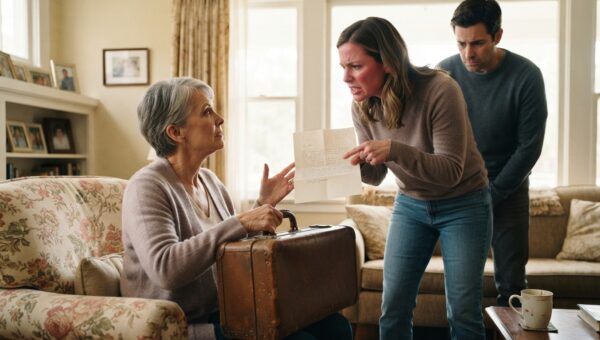
“Where is the paperwork?” Gary demanded, stepping inside behind her and closing the door with a sharp click. “Vance told us you were staying here. We brought the release forms for the probate court. You sign over your share of the house today, we give you twenty thousand cash, and we all walk away happy. Otherwise, things are going to get very difficult for you legally.”
He reached into Brenda’s portfolio, pulling out a sheaf of papers with pre-printed signature lines at the bottom.
I didn’t look at the paper. I looked past them, out through the glass of the front door.
A black Ford sedan was idling quietly at the curb behind Gary’s truck. The driver’s side door opened, and Mr. Vance stepped out into the mist, followed by two uniformed deputies from the county sheriff’s department.
Gary turned around, his face going slack as the front gate clicked open.
“What is this?” Gary muttered, his voice suddenly losing its sharp edge. “What are they doing here?”
I finally spoke, my voice sounding quieter than I expected in the narrow hall.
“Arthur left a very detailed record,” I said, stepping back toward the study door. “Turns out he didn’t like people coming into his house without asking. And he especially didn’t like people trying to steal his home while he was still breathing.”
Brenda let out a small, sharp sound, her hands flying to her mouth as Mr. Vance walked up the steps with a thick manila folder tucked under his arm, the deputies right behind him.
The front door stood wide open to the morning fog.
I walked back into the study, reached out, and pressed the small power button on the front of the television monitor. The little green light flickered, and the screen went completely dark, the blue glow fading away until there was nothing left on the glass except the reflection of the calendar on the wall behind me.
I left the study, walked out onto the front porch, and watched the sun finally burn through the mist over Elm Street.