We packed the last cardboard box into the bed of my brother-in-law’s rusted Ford on a Tuesday morning in October, and honestly, the only thing I felt was tired. Moving thirty miles north out of the county wasn’t some grand adventure. It was just arithmetic. Rent had gone up two hundred dollars a month, the roof over the back porch was leaking pine needles into the gutter, and Clara had outgrown her little twin mattress.
Clara was eight then, and she spent the whole two-hour drive with her nose pressed against the cold passenger window, watching the corn stubble blur past like dirty carpet. She had a little patch of dry, flaky skin right beside her left eyebrow that never quite cleared up, no matter how much Eucerin I rubbed on it after supper. I figured it was just the well water at the old rental place or the dry autumn air blowing off the river.
By the following Thursday, we were sitting in the examining room at the Maple Grove Family Practice. The room smelled faintly of lemon disinfectant and warm paper. Dr. Okafor was a tall woman with steel-gray hair pulled back into a neat braid and wire-rimmed glasses that kept sliding down the bridge of her nose whenever she leaned over a chart.
She had Clara’s forty-seven page medical file spread out across her lap like a Sunday crossword puzzle.
“So you’re moving from the south side,” Dr. Okafor said, not looking up from a green paper divider. “Dr. Linden was your primary before this?”
“For four years,” I said, smoothing the knees of my faded jeans. “Ever since she was four. He was right down by the Methodist church.”
Dr. Okafor turned another page. She didn’t rush. She read the tiny, cramped handwriting in the margins with the slow, deliberate care of a woman counting seed corn by hand. Then she stopped. Her finger rested on a white continuation sheet near the middle of the stack.
She looked up over her glasses, and her eyes were flat and quiet.
“Who ordered the original EEG?” she asked.
“Dr. Linden,” I said. “Children’s Medical Center. Right after her first little dizzy spell at the kitchen table.”
Dr. Okafor tapped the page twice with her thumbnail. “There’s no EEG in this file.”
“Well, he kept the records at the main clinic,” I said, feeling a little defensive heat prickle the back of my neck. “He said she had one.”
“There’s no record,” she repeated, her voice dropping an octave. “The diagnosis is based on a single office visit four years ago.
No EEG. No MRI. No second opinion. Just a handwritten note prescribing twice-daily Tegretol.”
The small paper roll beneath Clara crinkled as my daughter shifted her feet. I remember staring at the metal hinge of the examination door because looking at Dr. Okafor made my chest feel suddenly too tight for my ribs.
“She has epilepsy,” I said, though it sounded thin even to me. “She takes her pills every morning and night. If she misses one, she gets shaky.”
“That’s withdrawal, Mrs. Miller,” Dr. Okafor said softly. “Tegretol is a heavy anticonvulsant. If you take a healthy child off it cold turkey, anyone would shake.”
Dr. Okafor didn’t argue or raise her voice. She simply picked up her desk phone, dialed three digits without looking at a directory, and told someone in scheduling to set up an immediate outpatient scan at the county hospital. Two EEGs and a full brain MRI, scheduled for Friday morning at eight o’clock sharp.
“We are going to find out what we are actually dealing with,” she told me, handing me a neon pink appointment slip. “And we are going to do it right.”
The waiting room on Friday smelled like damp wool and floor wax. Clara sat between us with a coloring book, her crayons scattered across her lap like spilled candy. Every time a nurse in green scrubs walked past the door, my stomach knotted a little tighter.
The technician who ran the EEG machine was a young man with ink stains on his thumbs and a quiet way of speaking that didn’t help my nerves at all. He pasted twenty little copper electrodes to Clara’s scalp with cold white paste, wrapping her head in white gauze until she looked like she had been in a mild tractor accident.
“Just close your eyes, sweetheart,” he told her, adjusting the dials on the heavy grey box by the wall.
I sat in the metal folding chair in the corner for forty-five minutes, watching the green jagged lines dance across the monitor screen in rhythmic, predictable waves. I didn’t know much about medicine, but I knew what a storm looked like on a weather radar. This wasn’t a storm. It was just a flat, steady horizon.
When the radiologist called us back for the MRI, Clara had to wear giant yellow foam earplugs while they slid her into the big white tube that sounded like a woodpecker working on a cedar post. She cried just a little bit right before the plastic cage closed over her face, and I had to hold her bare ankle through the narrow opening, rubbing my thumb over her heel until the buzzing started.
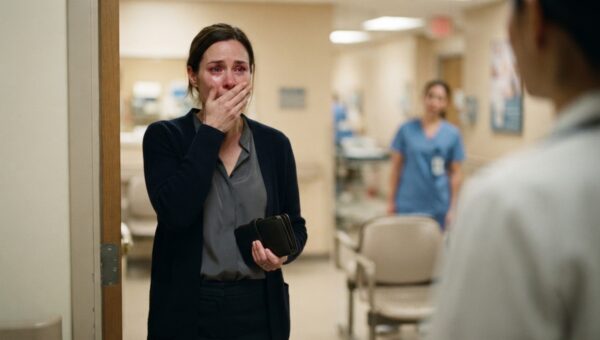
By Monday afternoon, Dr. Okafor had the results printed out on heavy cardstock. She didn’t make us wait in the outer lobby. She met us right at the door and led us back into the same examining room with the lemon smell.
She laid two black-and-white film plates across the light box on the wall.
“Normal,” Dr. Okafor said, pointing to the symmetrical grey folds of brain tissue on the screen. “Completely normal. No scarring, no electrical misfires, no structural anomalies. Your daughter has never had epilepsy, Mrs. Miller.”
Nobody said anything for a second, and honestly, that felt worse than shouting. Clara was coloring a blue duck at the small laminate table in the corner, her yellow crayon scratching against the paper.
“Four years,” I whispered. My throat felt like I’d swallowed a mouthful of road dust. “She’s been taking four hundred milligrams of Tegretol every single day for four years.”
“I know,” Dr. Okafor said.
“I wanted to call Dr. Linden’s office to get the original charts transferred over,” I said, my voice shaking on the vowels. “The number just rang and rang.”
Dr. Okafor leaned back in her stool, her face tight. “Dr. Linden’s license was revoked by the state medical board six months ago, back in the spring of twenty-four. Fourteen different families have come forward with identical charts. Same diagnosis. Same unverified prescriptions. And every single one of them was told to fill their scripts at the little corner pharmacy three blocks from his old office.”
I just stood there because my brain kind of stopped working for a second. I thought about the quarterly blood draws at the lab across from the grain elevator. I thought about the persistent rash on Clara’s eyebrow that never cleared up. I thought about the way she always slumped over the kitchen table around three in the afternoon, so drowsy I figured she was just hitting a growth spurt.
“He had a kickback arrangement,” Dr. Okafor said quietly, filling out a yellow referral slip. “He wrote the volume, and the pharmacy moved the stock. They took healthy children and turned them into patients.”
The anger didn’t hit me all at once. It came in cold, hard waves, starting at the back of my neck and working down to my hands. I thought about every morning I forced my little girl to swallow those bitter white tablets with a glass of tap water while she made a face and tried to hide behind her cereal bowl.
“What do we do now?” I asked.
“We taper,” Dr. Okafor said, handing me a typed schedule with precise, descending dosages marked out in red ink over the next six weeks. “And we get her to a pediatric dermatologist to clear up the metabolic stress on her skin, and we report every single page of this file to the state attorney general’s investigator. My office will handle the paperwork.”
That evening, the sun went down behind the ridge early, throwing long blue shadows across the gravel driveway. Clara was out in the side yard with a stick, poking at a pile of damp maple leaves while the wind carried the smell of woodsmoke from the neighbor’s chimney.
I stood on the back porch with the morning pill bottle in my hand. It was an amber plastic cylinder with my own handwriting taped over the pharmacy label, reminding me of the twice-daily routine we had lived by since she was knee-high to a plow.
I unscrewed the white cap. The smell of the medicine hit me first, chalky and slightly sweet, like old plaster. I didn’t throw the bottle out right away. I set it down on the top step of the porch, right beside an empty tomato basket and a pair of garden shears, before I walked out across the grass to help Clara rake the rest of the yard before dark.