We packed the last cardboard box into the bed of my brother-in-law’s rusted Ford on a Tuesday morning in October, and honestly, the only thing I felt was tired. Moving four towns over wasn’t some grand adventure for us. It was just a way to put some distance between our old life and the rent hikes that finally caught up to us.
Maya was eight years old by then, clutching her favorite stuffed rabbit in the passenger seat while the boxes shifted in the back. She was a quiet kid, mostly because she was almost always tired. I just figured some kids are low-energy. Some kids need extra sleep after school.
Her morning routine was as fixed as the sunrise. At 7:00 AM sharp, before she even touched her cereal, I measured out the small white pill and handed her the tiny paper cup of water. Tegretol. Twice daily, morning and night, without fail, for half her entire life.
We had been doing the quarterly blood draws and routine check-ins since she was four years old. Four years of labs, four years of watching her gain a little too much weight around her middle no matter how much she ran outside, four years of that stubborn red rash across her cheeks that doctors kept telling us was just a mild heat sensitivity or a detergent reaction.
I trusted the system because you have to trust the system when it comes to your kid.
When you sit in a pediatric neurologist’s office and a man in a crisp white coat tells you your four-year-old has a seizure disorder, your brain kind of shortcuts past all the questions you should be asking. Dr. Linden had been the golden boy at Children’s Medical Center back then. He had silver hair, a soft voice, and a diploma framed in heavy mahogany that looked like it cost more than my first car.
“She’s going to need baseline stability,” he had told me during that first twenty-minute consultation, tapping a gold pen against a pristine manila folder. “We start the Tegretol immediately. No gaps.”
And we never missed a gap. Not once in fourteen hundred and sixty days. I kept a little digital timer on the kitchen counter so I never botched the twelve-hour window.
The trouble started on a rainy Thursday afternoon last month, our third week in the new town. We went to see our new pediatrician, Dr. Okafor, just to establish primary care and get Maya’s school immunization records transferred over. Dr. Okafor was younger than Dr. Linden, with sharp, kind eyes behind wire-rim glasses and an untidy bun of dark hair that looked like she actually worked for a living instead of posing for hospital brochures.
She sat at her rolling stool, flipping through the thick, navy-colored binder holding Maya’s forty-seven-page medical history from Children’s Medical Center. She didn’t say much at first. She just hummed under her breath, turning pages back and forth, comparing a lab sheet from two years ago with a prescription refill log from last spring.
The office was quiet except for the hum of the hallway fluorescent lights. I watched her finger trace a line down a summary sheet.
“Who ordered the original EEG?” Dr. Okafor asked without looking up.
“Dr. Linden,” I said, shifting my purse on my lap. “At Children’s Medical Center. When she was four.”
Dr. Okafor stopped turning pages. She looked up over her glasses, her face entirely still. “There’s no EEG in this file.”
I frowned, leaning forward. “No, it’s in there. He told us she had one done right before the diagnosis. That’s why he prescribed the Tegretol.”
“There’s no record, Mrs. Miller,” she said softly, turning the binder toward me so I could see the blank white continuation sheet. “There’s no tracing, no radiologist report, no waveform data. There’s just a billing code typed onto a summary sheet after a routine office visit.”
My stomach did a slow, heavy drop. “That can’t be right. He said she had focal spikes. He explained it to my husband and me in the consultation room.”
“I’m sure he talked to you,” Dr. Okafor said, her voice dropping into something sharper and colder. “But a diagnosis of pediatric epilepsy requires objective diagnostic proof. A physical exam and a conversation don’t cut it. Especially not a lifelong medication protocol.”
She closed the binder with a dull thud that made Maya jump slightly where she was coloring in the corner.
“We are going to run a proper EEG and a full-brain MRI this week,” Dr. Okafor said, standing up and pulling a prescription pad toward her. “I want baseline imaging done at our facility. Today.”
The next three days were a blur of strobe lights, buzzing metallic tunnel machines, and holding my breath while technicians strapped tiny electrodes to my daughter’s scalp with sticky white paste. Maya was brave, but she was scared of the loud clicking noises inside the MRI tube. I held her hand through the small circular opening, whispering that it would all be over soon, while my chest felt like it was wrapped in barbed wire.
On Monday morning, Dr. Okafor called me directly on my cell phone before I even finished the breakfast dishes.
“Can you and Maya come into the office at 11:00 AM?” she asked. Her voice didn’t have the warm professional cadence from our first visit. It sounded tight, guarded, like she was holding back a scream.
“Is it bad?” I asked, dropping the dish towel onto the counter. “Did the scans show something?”
“Just come in, Mrs. Miller,” she said. “Bring the medication bottles with you.”
When we sat in the exam room twenty minutes later, Dr. Okafor didn’t even open a chart. She laid two printed imaging reports flat on the examination table between us.
“The EEG is completely normal,” she said, tapping her finger against the top paper. “Clean background rhythms. No epileptiform discharges, no slowing, no abnormalities whatsoever. And the MRI is pristine. Normal ventricular structure, normal myelination, zero evidence of structural lesions or past neurological trauma.”
I stared at the glossy grayscale images of my daughter’s brain. They looked like gray clouds against a black night sky.
“So… what does that mean?” I whispered. “Is it in remission?”
Dr. Okafor looked me straight in the eye. “It means your daughter has never had epilepsy. Not when she was four, and not now.”
The silence in that small room felt heavier than lead. Maya was sitting on the exam table, swinging her legs back and forth, humming a little tune to herself while she played with the zipper on her hoodie. She had no idea what those words meant. She just knew the doctor was talking about her medicine.
“That’s impossible,” I managed to say, my voice shaking. “She’s been on Tegretol for four years. Dr. Linden monitored her labs every three months. He said if we stopped, she could have a grand mal seizure.”
“Dr. Linden lost his medical license in 2024,” Dr. Okafor said quietly.
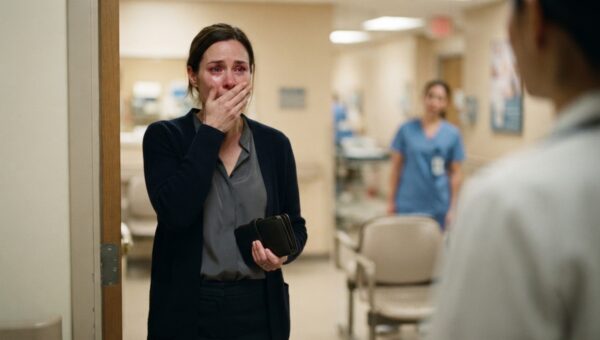
I blinked at her, feeling like I had stepped off a curb that wasn’t there. “What?”
“The state medical board revoked his license six months ago,” she said, leaning against the counter. “An investigation uncovered fourteen pediatric patients at Children’s Medical Center with identical profiles. Vague symptoms, no baseline diagnostics, immediate long-term anticonvulsant prescriptions, and exclusive refill arrangements with a single independent pharmacy three blocks from his old office.”
The pieces didn’t just fall into place; they slammed together with a force that left me gasping. The corner pharmacy with the yellow sign. The way the pharmacist always greeted us by name before we even handed him the slip. The quarterly lab orders that always came back ‘stable’ without ever changing dosage, no matter how much Maya grew.
“He made up a diagnosis,” I said, the words tasting like copper in my mouth. “For four years.”
“For the kickbacks,” Dr. Okafor said bitterly. “High-volume specialty drug contracts with regional distribution tiers. He used healthy children as guaranteed monthly revenue streams.”
I looked over at Maya. She was still swinging her legs, her cheeks carrying that stubborn, medication-induced flush that we had spent four years blaming on the summer heat.
“And the Tegretol?” I asked, my voice barely a breath. “What did four years of unnecessary anti-seizure medication do to her?”
Dr. Okafor pulled a secondary lab printout from beneath the folder. “Anticonvulsants are heavy metabolic loads on a developing liver and central nervous system. Her liver enzymes are currently running slightly elevated, which explains the persistent fatigue and the chronic rash. We need to begin an immediate, supervised step-down taper. We cannot stop cold turkey, or the rebound effect could trigger actual neurological distress.”
I felt the room tilt. I had been the one administering the poison. Every single morning at 7:00 AM, I had measured out the white pills, praised her for swallowing them without a fuss, and watched her drift off into that heavy, drugged afternoon sleep, thinking I was keeping her safe.
“I trusted him,” I whispered, my fingernails digging deep into the palms of my hands. “He had the frame on the wall. He had the white coat.”
“I know,” Dr. Okafor said, reaching out to place her hand over mine. Her fingers were warm and steady. “The legal team at the hospital network is already cooperating with the state attorney general’s office. Your file is part of an active criminal referral against Dr. Linden and the pharmacy partnership.”
We didn’t go home right after the appointment. We drove out to the state park near the edge of town, where the woods opened up into a wide, rolling field of late-summer goldenrod.
I sat on a wooden park bench while Maya ran ahead through the tall grass, her bright yellow jacket bobbing against the green and gold landscape. She didn’t have her pill organizer in my pocket. She didn’t have a digital timer buzzing for her noon dose. For the first time in four years, her body was her own, moving without the chemical fog that had weighed her down since she was a toddler.
Dr. Linden was gone, hiding behind revoked credentials and a closed practice, but he couldn’t take back the afternoon sun or the way my daughter was finally able to run across an open field without stopping to catch her breath every twenty feet.
Maya stopped by a patch of bright yellow dandelions, knelt down in the dirt, and picked one by the very base of the stem. She turned around and held it up toward me, her face bright and completely unburdened, shouting something over the wind that I couldn’t quite hear, but for the first time in four years, I didn’t need translation to know she was going to be all right.