Arthur always said my mother could smell a probate filing from three counties away, and he wasn’t joking. I reckon I should have listened to him closer before his heart gave out on that cold Tuesday morning, leaving me with a stack of legal papers and an awful lot of silence in our old house.
The funeral itself was a sorry affair. Only four people stood by the open plot in the drizzling rain, mostly because my mother made sure nobody else knew the time. “A spectacle,” she called it later that afternoon, shaking her head as she tossed her wet umbrella into my hallway bin. “Just a miserable little gathering, honey. Better off done quietly.”
She wasn’t talking about Arthur. She was talking about how embarrassing it was for her social circle that my husband had died without a grand public viewing. But she changed her tune real quick once Julian Vance, Arthur’s longtime corporate attorney, showed up on my front porch thirty minutes later with a heavy leather briefcase.
Julian didn’t even take off his overcoat. He just set the portfolio on the oak dining table, flipped the brass latches, and laid out the facts in that dry, lawyer voice of his. “The primary residential assets and the six commercial loft properties in downtown Manhattan are fully unencumbered, Abigail,” he told me, sliding a certified ledger across the wood. “Eight point five million in total equity, transferred directly into your sole name before his passing. No probate delays. It’s all yours.”
My mother was standing right by the kitchen archway, and I watched her eyes dilate in the dim light.
She didn’t look at the paperwork for the grief of it; she looked at it like a hawk eyeing a field mouse. Julian didn’t stay long. He gave my hand a brief, professional squeeze, told me to call him if anything felt fishy, and slipped back out into the rain.
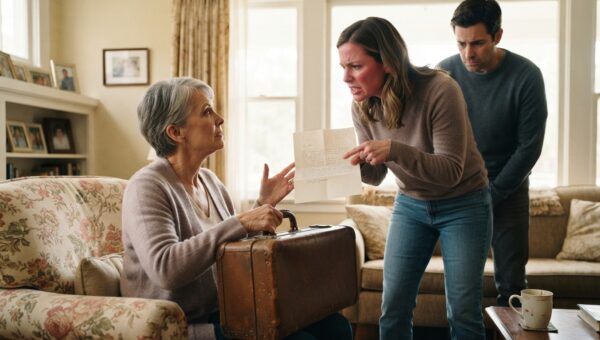
The house felt entirely too big with just the two of us inside. My mother immediately took over the kitchen, bustling around like she owned the deed, talking about how a grieving widow shouldn’t have to look at financial statements or worry about property management. “You’re beside yourself, Abbie,” she kept saying, pouring hot water from the electric kettle into a stoneware mug. “You’re seeing double. Just let me take care of everything for a few days.”
I watched her drop three small white pills into the steaming chamomile tea when she thought my back was turned. I didn’t say a word.
I just took the mug, muttered something about heading up to lie down, and walked straight to my bedroom. But I didn’t drink a single drop of that tea. I poured it down the bathroom sink, rinsed the ceramic clean, and slipped my pocket voice recorder onto the antique sideboard near the hallway stairs.
By eleven o’clock, the house was dead quiet except for the hum of the refrigerator. I sat on the edge of the guest bed in the dark, listening through the floorboards as floorboards creaked downstairs. My mother thought she was whispering, but the old Victorian vents carried every single word straight up to my ears.
“The doctor already signed the temporary conservatorship forms,” my mother told her accomplice, her voice low and sharp. “Once she drinks the second dose in the morning, we’ll have her admitted for acute nervous exhaustion. By the time she wakes up in a clinic, the asset transfers will look like voluntary management handovers.”
“Are you sure she didn’t read the Manhattan deeds yet?” a man’s voice muttered back, and I recognized Dr. Holloway’s sluggish drawl.
“She doesn’t even know what an equity line is,” my mother scoffed. “She’s just like her daddy. Soft. We’ll have the lofts rented out by next month, and her name won’t even be on the bank routing numbers.”
I sat there in the dark for a long time, feeling the grief over Arthur harden into something cold and jagged. I didn’t cry. My brain just clicked into place like a well-oiled machine, exactly the way it used to back when I worked as a sound engineer before I ever met Arthur. I checked my phone, dialed the non-emergency line for the local precinct, and whispered my address to the dispatcher on duty.
“They’re coming at midnight,” I told myself softly in the empty room. “Let’s see how they like the sound of their own voices.”
Around twelve-fifteen, I heard heavy boots on the gravel driveway outside. Two unmarked cruisers pulled up right beside the hydrangeas without turning on their sirens, their blue dashboard lights painting slow, rotating streaks across the living room ceiling.
I walked down the stairs slowly, making sure my steps sounded heavy and uncertain, playing the part of the daughter they thought they had cornered. My mother was waiting at the bottom of the steps with a fresh mug of tea in her hand, smiling that thin, practiced smile she used whenever she wanted something from somebody.
“Drink this, sweetheart,” she whispered, holding out the steaming ceramic. “It’ll help you sleep off the shock.”
Before she could push it into my hands, heavy knocking rattled the front door. My mother froze, her smile slipping off her face like a wet mask. “Who on earth could that be at this hour?” she snapped.
The front door wasn’t even locked properly, so Officer Miller simply pushed it open, stepping into the foyer with his partner right behind him. “Police department,” he called out, his voice echoing off the high ceilings. “We received a call regarding an attempted poisoning and conspiracy to commit fraud at this residence.”
My mother went rigid, turning on me with eyes wide and furious. “Abigail, have you lost your absolute mind? Tell these men you’re just grieving!”
I didn’t answer her. I reached into the pocket of my cardigan, pulled out the small digital voice recorder, and laid my thumb right over the playback button. I didn’t say a single word as I pressed play.
The kitchen instantly filled with the sharp, clear recording of my mother’s voice plotting the conservatorship scam word for word, right down to the dosage of the sedative she had just tried to hand me. Dr. Holloway’s voice followed right after it, agreeing to falsify the psychiatric intake forms for a cut of the Manhattan rental income.
The room went dead silent except for the tinny audio playing from the small speaker in my palm. Officer Miller stepped forward, his eyes flicking from the recorder to my mother’s ashen face.
“I think you both need to come down to the station for questioning,” the officer said, his hand resting on his belt.
My mother tried to stammer something about family matters and medical misunderstandings, but the words just tangled up in her throat. The second officer stepped past her into the kitchen, picking up the untouched stoneware mug from the counter to bag it as physical evidence.
I stood right by the bottom of the stairs, watching them lead her out the front door and into the cool dawn air. The front door clicked shut with a solid, final thud, leaving me alone in the quiet hallway with the morning light just starting to streak across the floorboards.