The ground along Route 9 froze hard enough by mid-December that you could hear the gravel crunching under tires half a mile off before the headlights even swept across our chain-link fence. I spent forty winters standing at that front desk with Cecil, watching the trucks haul freight down toward the state line while the oil heater in the corner clanked and smelled like scorched dust.
Cecil passed in nineteen-nineteen, right before everything started sliding sideways, and after that it was just me and the drafty hallways. The bank sent the letter on a Tuesday. We were fourteen thousand dollars behind on the commercial note, and the man from the regional branch wrote that foreclosure proceedings would begin the first week of March.
I was out by the office post on a gray Thursday afternoon, pulling the plug on the red neon vacancy sign because the letter ‘C’ had burned out two weeks prior and I couldn’t afford the ballast anyway. My fingers were stiff in my old wool gloves, and the wind was coming straight off the flats, smelling of wet asphalt and coming snow. A black sedan with out-of-state plates turned off the highway and rolled slow into the empty gravel lot, kicking up frozen slush. My hand stayed on the thick rubber cord.
I didn’t expect travelers in January, not since the interstate bypassed us back when George Bush was in office.
The car stopped right beside the concrete bumper of room 6. The engine died, and for a long moment the only sound was the wind rattling the metal tin roof over the ice machine. A woman in a dark tailored wool coat stepped out, her boots hitting the frozen gravel with a clean, sharp tap. She didn’t look like a wrong-turn traveler or a repo man looking to inventory the mattresses. She looked steady and deliberate, holding the edge of the room 6 door like she was checking to make sure the latch still caught the same way it used to. Then she turned around and walked straight toward the office with her chin up against the wind.
“I’ve looked for you for thirty-one years,” she said. Her breath plumed white in the freezing air, and her eyes were fixed on my face with an intensity that made my chest tighten up. “The baby you kept warm that week is…”
She stopped right there on the frozen mat outside the screen door, letting the rest of the sentence hang between us while the highway hummed in the distance. I just stared at her coat, which was a good wool blend, the kind they sell in department stores up in Boston, not the cheap acrylic stuff I bought down at the mercantile. Her hair was pulled back into a neat knot, graying at the temples, but the shape of her jaw and the set of her mouth belonged to someone I had tried very hard not to forget. Thirty-one years is a long time to keep track of strangers, but January storms leave marks on you.
“Come inside before you freeze your ears off,” I managed to say, my voice sounding older and thinner than I liked.
The office hadn’t changed much since Cecil put up the knotty pine paneling in seventy-two.
The same rotary phone sat on the scarred laminate counter beside a yellowed blotter pad and a plastic cup full of wooden pencils that had lost their erasers years ago. I reached for the glass percolator on the hot plate, but my hands were shaking worse than they usually did after carrying firewood. She stepped inside, letting the screen door shut with a familiar double-click, and stood by the small propane heater while it ticked and warmed up.
“It smells exactly the same,” she said softly, looking past the counter toward the narrow hallway that led to our old apartment in the back. “Pine oil and stale tobacco. My mother always said this place smelled like a church basement after a funeral dinner.”
“Cecil smoked those cheap Dutch cigars,” I told her, wiping my palms on my apron. “Took me three years after he died to get the smell out of the upholstery, and even now I catch it when the humidity gets high.”
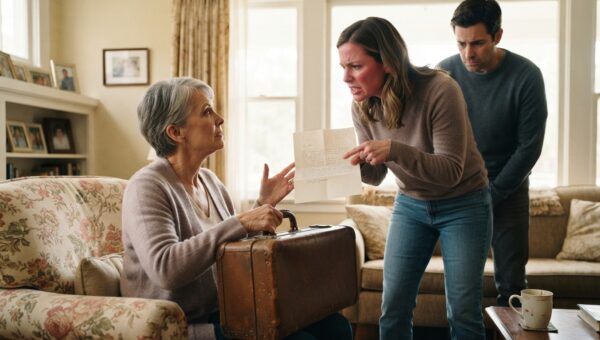
She reached into her leather bag and pulled out a small, folded piece of lined paper, yellowed at the edges like old parchment and creased four ways into a square. She laid it flat on the counter between us, smoothing it out with a thumb that wore a heavy silver ring. It was a page torn out of an old motel notepad with the Starlite logo printed across the top in faded blue ink. Cecil’s handwriting was right there in the middle, blocky and stubborn, listing out measurements for mixing powdered milk and warm water in a sterilized medicine cup.
“He wrote this down on the kitchen table while you were boiling water on that hot plate,” she said, her voice dropping down until it barely carried over the hum of the heater. “My mother told me the story every year on my birthday. Eleven dollars in her pocket, a rusted-out Ford that kept blowing head gaskets, and two feet of wet snow blocking every turnpike from here to Albany.”
“She was half-frozen when she carried that basket through the snow,” I said, remembering the blue quilt with the frayed satin binding. “And you didn’t weigh nine pounds soaking wet. Cecil told me to put you in room 6 because the radiator in there held the heat better than the others once you banged on the side with a wrench.”
“She didn’t have money for the room,” the woman said, looking straight at me. “And you told her the vacancy sign was broken anyway, so it didn’t register on the ledger.”
“Cecil kept his own books,” I said, feeling a hot prickle behind my eyes that I hadn’t felt since the funeral. “Most of them went into the burn barrel after he passed, but I remember that night. Route 9 was a graveyard of stalled semis by midnight.”
She let out a long breath and looked around the cramped office again, her gaze lingering on the brass key rack where half the hooks were empty because the locks had been replaced with deadbolts that didn’t take keys anymore. My mind kept looping back to the letter sitting on the kitchen table in the back, the one from the bank with the bold red letters and the fourteen-thousand-dollar figure staring up from the statement. March was only a few weeks away, and there wasn’t enough copper piping left in the vacant rooms to fetch that kind of money even if I hauled it to the scrap yard myself.
“I’m Clara,” she said, finally giving me her name after standing there for ten minutes like an auditor. “Clara Vance. I run a freight logistics outfit out of Syracuse now. We handle regional warehousing and transport for the grocery chains across three states.”
“Logistics,” I repeated, tasting the big modern word like it belonged in a different language. “Cecil always said the trucking business was going to change once they finished the new turnpike down south. Said nobody would have a reason to stop at a motel anymore.”
“He wasn’t wrong about that,” Clara said. She walked over to the front window and wiped a circle in the frost with her bare thumb to look out at the empty gravel lot and the dark highway beyond. “If you try to drive this route today without a GPS, you’re lost before you hit the county line. But some places stay stuck in your head whether the maps change or not.”
She turned back around, and the casual way she stood there made me realize she hadn’t just stopped by for a cup of instant coffee on her way to somewhere else. She had files in that leather bag. She had numbers and figures and legal descriptions of property lines that probably covered every acre from here to the river.
“I saw the public notice in the county paper last month,” she said quietly. “The one about the tax lien and the commercial default on the Starlite.”
The shame of it sat heavy in my throat, hot and dry. I had spent forty years keeping those yellow doors painted and the sheets bleached white in hard water, and now the whole county knew I couldn’t pay the light bill.
“The bank wants fourteen thousand by the first of March,” I said, staring down at my knuckles on the counter. “And after that, they’ll bulldoze the whole row for a truck stop staging lot or a gravel pit. Progress doesn’t like flat roofs and neon signs.”
“They won’t bulldoze anything,” Clara said, and her voice didn’t have any pity in it, just a flat, hard certainty that sounded entirely like someone who spent her days managing twenty-ton rigs and payroll accounts. “Because I bought the note from the bank this morning at ten o’clock.”
I didn’t move. The little propane heater clicked twice, and a truck went roaring past outside, shaking the window glass in its old wooden frame.
“You bought what?” I whispered.
“The note,” she said, reaching back into her bag and pulling out a heavy manila envelope tied with a string. She laid it right over Cecil’s old formula recipe on the counter. “The fourteen thousand dollars. Plus the back taxes for twenty-two and twenty-three. The bank was happy to take fifty cents on the dollar just to clear the ledger before the end of their fiscal quarter.”
“I can’t take charity, Clara,” I said, and my voice sounded stiff, rusted from years of saying no to salesmen and traveling preachers. “Cecil and I built this place with our own hands, block by block, and I didn’t survive forty winters on Route 9 just to hand the keys over to a stranger out of pity.”
“It’s not charity,” she said, stepping closer until the smell of cold wool and cedar was right there beside me. “It’s an acquisition. I’m expanding our regional fleet depots, and we need secure parking and driver quarters along the old corridor for the overnight runs up to Montreal. This motel has thirty units, a commercial-grade laundry room, and a location that sits dead center between the two main distribution hubs.”
She unlooped the string on the manila envelope and slid a thick stack of stapled papers across the laminate toward my hands. The top page had the county seal stamped in blue ink, and underneath it was a release of lien stamped PAID IN FULL by the First National Bank of Cortland.
“You want to turn the Starlite into a truck depot?” I asked, looking down at the legal descriptions.
“I want to keep the sign on,” she said softly. “And I want you to stay on as property manager with a salary that covers more than just your electric bill. We need someone who knows every leaky pipe and crooked window latch from here to the state line. My mother always said nobody else on this highway ever gave a stranger shelter when they had nothing left in their pockets.”
I looked at the old yellowed notepad page with Cecil’s handwriting on it, then over at the window where the sleet was starting to tap against the glass in a steady, rhythmic pattern. The fourteen-thousand-dollar ghost that had been keeping me awake since November was gone, locked away inside a manila folder by a woman who wouldn’t even exist if Cecil hadn’t kept a kerosene heater running in room 6 on a freezing night thirty-one years ago.
“The neon ‘C’ on the vacancy sign is burned out,” I told her, my voice finally cracking just a little bit around the edges. “Parts are hard to find for these old tubes.”
“I have a guy coming down from Utica on Monday with a truck full of replacement glass,” Clara said, pulling her gloves back on her hands. “Let’s go outside and see if the wiring’s still good enough to hold a charge.”
We walked out together through the screen door, the cold wind hitting us like a wall as we crossed the frozen gravel toward the tall steel pole by the highway. Clara didn’t wait for me to reach the switch; she climbed up the first two rungs of the maintenance ladder herself, her good wool coat flapping against the iron in the rising gale, while I stood below and held the heavy black cord. When I plugged it into the weather box by the base, the old transformer hummed deep in its metal box, choked and sputtering for three seconds before the red neon tubes flared to life, casting a long, steady ruby glow across the snowbanks and the roof of room 6.