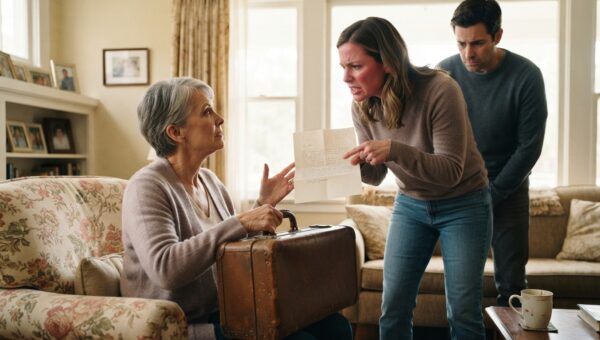
The coin purse always hit the marble counter with the exact same dull, heavy thud. It was a sound I had come to tune out during my six months behind the teller window at First Mutual, right alongside the hum of the change sorter and the rattling pneumatic tubes. Most Fridays at 2:15 in the afternoon, the lobby smelled like wet wool and stale peppermint, and I would be watching the digital clock creep toward closing time so I could grab a smoke out in the gravel alley.
I was twenty-six, tired of standing on my feet for eight hours a day, and entirely too busy processing overdraft waivers for people who lived beyond their means to care about the small change routine.
“Fifteen dollars? Ma’am, the ATM is outside.”
I didn’t even look up from the keyboard. The keyboard click was my shield against the endless parade of people who treated the branch like a social club. The woman standing on the other side of the glass partition didn’t answer right away. She was seventy-nine, wearing a gray cardigan with three mismatched tortoise-shell buttons and sensible orthopedic shoes that looked like they had walked half the county. She just stood there, her fingers resting lightly on the brass clasp of her purse, waiting for me to finish typing my entry for the commercial deposit before mine.
She placed three five-dollar bills on the scarred wooden ledge, smoothing them out with a thumb that had little pale blue veins branching across the knuckles.
I’ve deposited fifteen dollars every Friday since 1983. Her voice was remarkably steady, like dry paper sliding over wood, but it carried a quiet weight that made my fingers hesitate over the number pad. I sighed, tapping my ballpoint pen against the form, wishing she would just use the machine in the vestibule like everyone else under ninety.
A man in a sharp charcoal suit walked out from the glass-walled office to my left. That was Arthur Vance, our branch manager, fifty-eight years old with salt-and-pepper hair and a habit of checking the vault logs twice a day. He had been with First Mutual since the Reagan administration, and the rest of us treated him like an unpredictable weather system. I figured he was coming over to tell me to speed up my transaction times, because our branch efficiency rating had slipped three points below the district average that month.
Arthur’s face drained of color before he even reached the end of the partition. I watched the pink fade right out of his cheeks until he looked like wet plaster.
Mrs. Delgado. I am sorry. He didn’t look at me at all. His voice dropped into a register I had never heard him use, almost like he was standing in a church during a funeral.
He turned to the teller window, his eyes wide and fixed on the small, unassuming woman in the wool cardigan. This woman taught at Lincoln High for forty-one years. Her retirement fund was the seed money for our community lending program. The Delgado wing still bears her name on the blueprints in the basement vault.
Mrs. Delgado didn’t smile or look vindicated. She just opened her purse again, her movements slow and deliberate, reaching past a small tin of breath mints and a folded handkerchief to pull out a crisp, heavy piece of cream-colored paper.
She laid it across the counter right on top of my deposit slip.
A cashier’s check for thirty thousand dollars.
For the literacy fund, she told the teller. Her eyes finally met mine, and there was no anger in them, just a tired, profound patience that made my stomach drop harder than if she had screamed at me. My deposit built the program your daughter is enrolled in. The reading room downtown, Julian. The one with the blue carpet and the alphabet blocks on the low shelves. The girl reads because a woman who deposits fifteen dollars knows what a single book can do for a child who doesn’t have anyone at home to read to her.
The lobby went entirely dead silent except for the low hum of the ceiling vent overhead. I didn’t know what to say. My mouth opened, but no sound came out because my brain kind of stopped working for a second. The name badge pinned to my blue shirt suddenly felt like an iron weight pulling my chest down toward the floor.
I knew about the literacy fund. Every employee at First Mutual had to sit through a thirty-minute orientation video about it during our first week of training, nodding along while some corporate drone in Hartford talked about corporate social responsibility and local impact metrics. Maya, my seven-year-old, spent every Tuesday and Thursday afternoon in that exact room while I worked the late shift at the hardware store before I got hired here. She loved the corner beanbag chair and the picture books about sea turtles. I had never once wondered where the money came from. I figured it was some anonymous trust fund left behind by a dead banker who wanted a tax write-off.
Arthur stepped closer, his hand coming down to rest flat on the counter next to the check, his fingers trembling slightly against the wood. Clara, we thought you were done with the endowment phase after the library annex was finished back in ninety-six. He looked almost like he was going to cry, which shook me worse than his anger would have.
I’m never done as long as there’s a kid in this town who thinks they can’t learn because their parents are too busy working two jobs to buy them a dictionary, Mrs. Delgado said. She looked down at the fifteen dollars I hadn’t yet entered into the ledger. And put that in the general pool, Julian. Don’t throw it in the drawer with the service fees. It belongs in the ledger from nineteen eighty-three.
The ledger. That was the other thing sitting in Arthur’s office, locked in the bottom drawer of his steel filing cabinet, the original green-bound book from the winter the mill closed and the town nearly went under. My grandfather’s name was probably in that book on page four hundred, alongside half the families on the east side of the tracks who needed grocery loans to get through the strike. My father always told me that people in this town didn’t take charity, but he never mentioned that the charity was just a retired history teacher putting away fifteen dollars a week out of her own pension check so the neighborhood kids wouldn’t have to drop out at sixteen.
Julian, Arthur said quietly, his voice hard enough to cut glass now that he turned back to me. Process the deposit. Then pull the nineteen-eighty-three ledger from the archive shelf and show it to him. Let him see what fifteen dollars looks like when you don’t throw it at an ATM.
I reached out with fingers that felt thick and clumsy, picking up the three five-dollar bills. They were old bills, soft and worn around the edges like fabric, folded a thousand times in that canvas purse. I typed the numbers into the terminal, my hands shaking so badly I hit the backspace key three times before I could get the routing sequence right for the thirty-thousand-dollar check.
Mrs. Delgado didn’t walk away immediately. She stood there while the receipt printer chattered out the long strip of thermal paper, the sound cutting through the quiet like a tiny machine gun. She took the small white slip, folded it precisely in half, and tucked it back into the leather purse alongside her mints.
See you next Friday, Julian, she said softly.
She turned around, her orthopedic shoes clicking against the linoleum floor with a steady, rhythmic cadence that seemed to echo off every wall in the bank. Nobody said a word until the heavy glass front door swung shut behind her and the brass latch clicked into place.
Arthur stayed by my window for a long moment, looking down at the counter where the empty leather purse had rested just seconds before. He didn’t yell at me. He didn’t write me up or send me home early, which honestly would have felt a lot easier to deal with. He just reached out, tapped the edge of the keyboard with his index finger, and walked back toward his glass office without looking back.
I sat there staring at the green plastic terminal screen, watching the cursor blink in the empty transaction field, knowing I wouldn’t be going out to the alley for a smoke anytime soon. A worn leather coin purse sat empty on the polished marble counter, its forty-one-year mission complete, beside a single pristine receipt bearing a signature that built a future for a generation.