Forty-one years. That was how long the ritual took to complete each week. Every Friday morning at precisely 8:45, I walked up the three granite steps of the First Mercantile branch on Elm Street, my orthopedic shoes clicking a steady, predictable rhythm against the cold stone. I wore the same gray wool cardigan whether the morning air smelled like damp autumn leaves or biting winter frost.
My name was Clara Delgado, and for four decades, the teller behind counter four did not even need to ask for my passbook. They just looked at the small green canvas bag, took the three crisp five-dollar bills, and stamped the yellowed paper with the heavy iron date seal.
The teller behind window four this morning was named Chloe. She looked to be about twenty-four, with two silver hoops in her left ear and an ivory wireless earbud tucked deep into her right ear canal, playing a tin rhythm only she could hear. She did not look up when my knuckles tapped the polished walnut counter. Her fingers were flying across a sleek black keyboard, clacking away with frantic speed, her eyes glued to a dual-monitor setup that flashed green and blue numbers.
Fifteen dollars? Ma’am, the ATM is outside. Chloe pointed a pale fingernail toward the revolving glass doors without lifting her chin.
She let out a short, thin puff of breath that rattled the edge of her plastic name tag. We are really trying to migrate routine cash transactions to the lobby terminals this quarter. There is a very helpful tutorial video playing on the screen right next to the receipt slot if you need assistance with your card.
I did not move my feet. I set my worn leather purse down on the marble ledge, the brass clasp clicking shut with a dry, metallic snap. I had carried that bag since my third year teaching American literature down at Lincoln High, back when the leather was supple and dark instead of cracked and soft like old parchment.
I am aware of where the ATM is, Chloe, I said. My voice was quiet, steady, carrying the flat cadence of someone who had spent forty years trying to quiet a room full of thirty-six restless fifteen-year-olds on a Friday before a long weekend.
But I do not use machines for this. I have deposited fifteen dollars every Friday since 1983.
Chloe finally blinked, her fingers hovering half an inch above the plastic keys. A faint crease appeared between her thin eyebrows, annoyance tightening the corners of her mouth. She tapped her keyboard once, hard, as if trying to force my stubborn green passbook into her digital drop-down menu by sheer willpower.
Well, things have changed quite a bit since nineteen eighty-three, haven’t they, ma’am? Chloe said, her voice dropping into that bright, patronizing customer-service register that teachers learn to spot from three aisles away. We do not keep manual ledger books for fifteen-dollar deposits anymore. It costs the branch more in processing overhead than the actual cash is worth. If you could just take your bills to the kiosk outside, the machine will take care of it in ten seconds flat.
Nobody said anything for a second, and honestly, that felt worse than if she had started yelling.
The hum of the overhead air conditioning vents seemed to drop an octave, rattling the thin metal strips in the ceiling tiles. I reached into the front pocket of my cardigan, pulled out my small wooden-handled fountain pen, and laid it neatly across the closed passbook.
I am not asking for a favor, Chloe, I said. I am making my deposit.
Before Chloe could open her mouth to tell me about branch policy again, the heavy frosted glass door of the rear office swung open with a sharp click. Arthur Henderson stepped out. Arthur had been running this branch for fourteen years, ever since his hair was dark and thick instead of the silver-gray brush cut he wore now. He was carrying a thick manila folder under one arm, his eyes scanning the lobby for loan signatures, until his gaze caught on the stooped shoulders of the old woman in the gray cardigan standing at window four.
Arthur froze mid-step. His right foot stayed planted on the patterned carpet runner while his left hovered a few inches above the hard marble floor. The color drained right out of his face, leaving his cheeks the exact shade of unpainted drywall. He dropped the manila folder onto a side table, the papers sliding out of alignment against the polished mahogany, and hurried across the lobby with his loafers squeaking faintly against the stone.
Mrs. Delgado. Arthur’s voice cracked just a little bit, tight with a sudden, breathless panic. He did not look at Chloe. He planted both palms flat on the counter next to my green passbook, leaning in as if he had just found a crack in the foundation. I am so sorry. Please. Let me handle this.
Chloe blinked twice, her hands finally dropping away from the keyboard entirely. She looked from Arthur’s pale, sweating forehead down to my orthotics and back up again, her jaw going slack. Mr. Henderson, I was just explaining the digital transition protocol to, Arthur cut her off with a sharp chop of his hand that made the plastic pen tray rattle. Be quiet, Chloe. Just stop talking right now. He turned back to me, his breath coming in a shallow whistle through his nose. Mrs. Delgado, I thought you were visiting your sister in Knoxville this week. We didn’t expect you until next Tuesday.
My sister’s hip is acting up again, so I stayed home, Arthur, I said, my fingers resting lightly on the corner of my passbook. And Friday is Friday. Even if your new staff seems to think my fifteen dollars is an inconvenience.
Arthur closed his eyes for a full three seconds. When he opened them, he looked ready to fire her on the spot, but he kept his voice down, tight and shaking with a controlled fury. This woman taught at Lincoln High for forty-one years, Chloe. Her retirement severance and pension seed capital were the foundation of the community lending trust that literally kept this bank from being repossessed during the savings and loan crisis. Her framed portrait and founding charter are hanging in the executive board room thirty feet above your head right now.
The silence in the lobby got very heavy then. You could hear the distant roar of traffic out on Elm Street, and the faint, tinny sound of whatever music was still leaking out of Chloe’s wireless earbud. Chloe’s face went from pale to a hot, mottled pink. Her hand reached up, her fingers trembling slightly as she pulled the white plastic bud out of her ear and let it dangle against her collar by its thin white cord.
I didn’t, she started, her voice coming out small and high, nothing like the sharp confidence she had used five minutes ago. I didn’t know. Nobody told me about any founding charters.
Nobody tells you anything if you never look up from a screen, Arthur snapped. He pulled a fresh, crisp deposit slip from the brass holder, uncapped his own silver fountain pen, and slid it across the marble toward me with both hands, his posture almost bowing. Account 104-B, Mrs. Delgado? Same as every week since the autumn of eighty-three?
Same as every week, Arthur, I said.
I opened my leather purse. The lining was worn down to the coarse canvas backing near the bottom where my keys always sat. I did not pull out the three five-dollar bills this time. Instead, my fingers found a thick white business envelope, sealed with heavy mucilage and addressed to the First Mercantile Community Trust in my own neat, cursive hand using black ink that never faded.
I laid the envelope right on top of Account 104-B. The paper was heavy bond, the kind they sell at the stationer’s down by the courthouse for legal filings.
What is this, Mrs. Delgado? Arthur asked, his voice dropping to a cautious whisper. Another micro-loan guarantee? You’ve already endowed three scholarships over at the high school this semester.
No, Arthur, I said. This is the finish line.
I slid my thumb under the flap and pulled out a cashier’s check drawn on the State Employees Credit Union downtown. The numbers typed across the face in blue ink were clear and sharp: thirty thousand dollars, even. The memo line written in my own hand read simply: Lincoln High Community Literacy Trust – Final Endowment.
Arthur picked up the check by the very edges, as if it might disintegrate if he breathed on it too hard. His eyes darted across the figures, then down to my signature at the bottom, and finally up to my face. Thirty thousand? Mrs. Delgado, this is, this is the equity from your late husband’s timber parcel up in Monroe County, isn’t it? You said you were going to use that for your roof.
The roof can wait another ten years, Arthur, I told him, adjusting the strap of my purse over my forearm. The kids in the remedial reading program at Lincoln can’t wait that long. The state cut their after-school funding back in November, and you know it. This clears the remaining debt for their reading intervention software through the end of the decade. Every single elementary and middle school in the district will have full access.
Arthur stared at the check, his lips moving silently as he did the math in his head. Then he turned his head slowly, looking past the mahogany partition toward window four, where Chloe was standing frozen with her hands flat against the counter, her knuckles white.
Chloe, Arthur said, his voice terrifyingly quiet. What is the name of your little girl? The one you were crying about in the breakroom last month because she was failing her second-grade reading benchmarks?
Chloe didn’t answer right away. Her breath hitched, a sharp, ragged sound that caught in her throat. Her eyes were fixed on the bottom corner of the check, right where the printed logo of the district literacy initiative sat inside a small blue circle. Maya, she whispered. Her name is Maya.
I looked at her then. Really looked at her. Her mascara was starting to smudge in tiny dark crescents beneath her lower eyelashes, and her name tag was slightly crooked, clipped to her lapel at a clumsy angle. She looked like a girl who was working two shifts and worrying herself sick over a stack of bills she couldn’t quite clear.
Maya is a smart girl, Chloe, I said, my voice softening just a fraction. She sits in the front row of the after-school lab on Tuesdays and Thursdays. She has a very determined look when she sounds out her vowels. But she needed the new software modules to help her keep up with the pacing. The ones this check is buying.
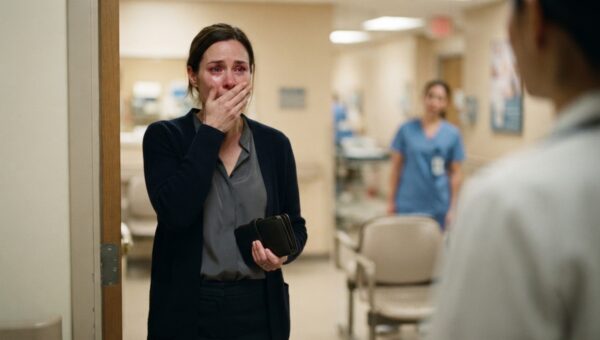
Chloe reached out, her fingers brushing against the cold marble of the counter as if she were trying to steady herself during an earthquake. She looked at me, really looked at me, past the gray cardigan, past the orthopedic shoes, past the old-fashioned leather purse that smelled like peppermint and cedar chips. Her chin started to tremble, a tiny, uncontrollable movement that she tried to hide by biting her bottom lip until it turned white.
You’re… she started, her voice breaking completely before she could finish the sentence. You’re the one who, I am the one who deposits fifteen dollars every Friday, I said, tapping the green passbook with one finger. Because when we started this bank in eighty-three, we promised each other that every small coin mattered just as much as the big ones. And the girl reads because a woman deposits fifteen dollars. Every single week. Without fail.
Arthur cleared his throat, a thick, wet sound, and carefully placed my passbook and the check inside a fresh manila folder. He looked like he wanted to salute, or cry, or both at once.
Chloe, Arthur said, his voice ringing through the quiet lobby with absolute finality. Step away from the window. Take your coat. Go to the front desk and ask Mrs. Gable to cover your terminal for the rest of the day.
Arthur didn’t wait for her to move. He came around the end of the partition, took my elbow with the gentle, reverent grip one might use on fine porcelain, and guided me away from the counter toward his private office with its leather chairs and heavy oak desk.
Let’s get this processed properly, Mrs. Delgado, Arthur murmured, his voice shaking just a little bit. And then I’m going to have Sarah bring in a pot of hot tea. Real china. Not the paper cups from the breakroom.
I let him lead me away. As we passed window four, I glanced back over my shoulder. Chloe was still standing there, her hands flat on the cold marble, staring at the empty space where my passbook had been. She wasn’t crying anymore, but she looked as if the floor had dropped out from under her feet and she was just now realizing how far down the drop really went.
The heavy brass doors of the bank were held wide open a few minutes later by a chastened, tearful Chloe, who stood just inside the threshold as I stepped out under the bright Friday afternoon sun, clutching my empty leather purse and my newly stamped paper passbook against my ribs. The air smelled like exhaust fumes and damp pavement, but the sidewalk was dry and firm beneath my shoes, and the fifteen-dollar receipt was tucked safely inside, right where it belonged.