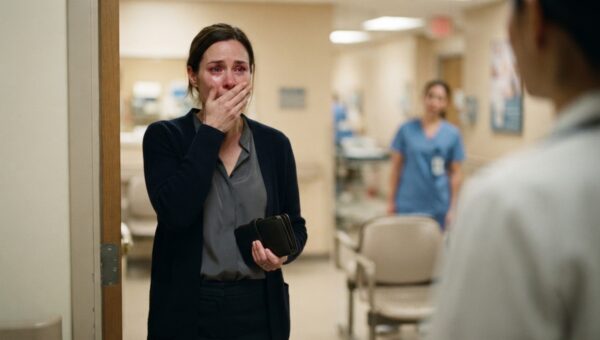
The cold green vinyl of the hospital bench was beginning to numb my thighs, but I didn’t care. Nothing about my body had felt right since Dr. Vance walked into our quiet kitchen three months ago and laid out the scans like a deck of cards. Terminal. Stage four. Inoperable. Eric had taken the news with that calm, devastating grace of his, squeezing my hand and telling me we were going to make his final months peaceful.
I had spent ninety-two days running on black coffee, hospital parking vouchers, and the heavy, sinking weight of a future that was being stolen one sunrise at a time. My mind was entirely hollowed out by grief when the woman in the gray windbreaker sat down beside me.
She didn’t look like a lunatic. Her hair was pulled back into a neat, no-nonsense bun, and her sneakers were scuffed at the toes like she walked miles every shift. She stared straight ahead at the ambulance bay for a long minute before she turned her head toward me. Her eyes were sharp, bloodshot at the corners, and carrying a quiet terror that matched my own. When she spoke, her voice was so low I barely caught the vowels over the hiss of a diesel engine idling by the curb.
“Set up a hidden camera in his room,” she whispered, her fingers digging hard into the fabric of her canvas tote bag. “HE’S NOT DYING.”
I blinked against the glaring afternoon glare bouncing off the windshield of an arriving van, my brain refusing to stitch her words into anything sensible. I tried to pull my purse closer, suddenly uneasy.
“What are you talking about?” I asked, my voice cracking from hours of disuse. “The doctors said he’s dying. He has weeks. Dr. Vance signed the papers.”
She let out a dry, humorless breath that smelled faintly of peppermint gum and stale office air. “Dr. Vance signs whatever Eric slides across his mahogany desk. Trust me. Set camera. You deserve to know the truth.”
Before I could ask her name, before I could demand to know what kind of sick game she was playing with a dying man’s wife, she stood up and walked away toward the bus stop without looking back. Her warning didn’t bring me hope. It brought a cold, crawling sickness that settled deep in my chest. I sat there for another twenty minutes until my trembling fingers finally dialed my brother-in-law to cover my twenty-minute absence, then drove straight to the electronics store off the interstate.
The clerk behind the counter was a bored kid with silver studs in both ears who barely glanced at me as I slapped down forty-eight dollars for a little black cube designed to look like a phone charger. I didn’t care about the legality. I didn’t care about privacy. The stranger’s face kept replaying behind my eyelids, sharp and certain. By the time I walked back through the heavy double doors of the oncology wing, Eric’s nurse had already wheeled him down to the basement imaging suite for his afternoon bone scan. The hallway was blissfully empty, smelling of floor wax and old bleach.
Room 412 was quiet, the gray sheets pulled tight over the mattress where my husband had spent two weeks pretending to waste away. My heart hammered so hard against my ribs I thought the nurses at the station would hear it. I slipped the tiny black cube into the narrow gap between the plastic casing of the wall-mounted television and the bracket, angled perfectly toward the bed and the small sitting area by the window.
It took twelve seconds. My palms were slick with cold sweat as I paired it to my phone, hiding the app inside a folder of grocery coupons and utility apps where nobody would ever look.
“Everything okay, honey?” Eric asked when he rolled back into the room twenty minutes later, his face pale and slack, his shoulders rounded in that pathetic, fragile slouch that had kept me crying myself to sleep every night. “You look a little flushed.”
“Just tired,” I whispered, leaning down to press a kiss to his damp forehead, feeling the bitter irony burn the back of my throat. “They said the scan will take until tomorrow to process.”
“Of course it will,” he sighed, closing his eyes with a delicate, trembling weariness. “Just keep holding my hand, okay? I don’t know how much longer I can keep fighting this.”
I stayed until visiting hours ended, nodding at all the right times, smoothing his blanket, playing the dutiful, breaking-hearted wife while a live feed streamed silently into the encrypted folder on my phone in my coat pocket. When I finally kissed him goodnight and walked out to my car in the gravel lot, I didn’t turn on the ignition right away. I locked the doors, pulled down the visor, and tapped the hidden app.
The video loaded with a soft, pixelated blur before clearing into sharp, high-definition color. At first, there was only the empty room, the rhythmic hum of the ceiling vent, and the dim amber glow of the bedside lamp. Then the door clicked shut.
Eric sat up.
He didn’t groan. He didn’t reach for the call button or grab his chest for the imaginary pain that usually had him doubled over in theatrical agony. He swung his legs over the side of the bed with a brisk, athletic snap, planted his bare feet firmly on the linoleum, and stood up straight. He stretched his arms high above his head, his spine cracking audibly in the quiet room, his posture tall and completely unburdened.
I stared at the four-inch screen in my hand, my breath hitching so hard my vision went gray at the edges.
He walked over to his travel duffel bag sitting in the corner, unzipped it with fast, practiced fingers, and pulled out a sleek black burner phone that I had never seen in our house. He punched in a number, pacing the length of the linoleum floor with long, confident strides that belonged to a man running marathons, not a man with three weeks left to draw breath.
“Yeah, it’s me,” Eric said into the phone, his voice carrying a sharp, barking edge I hadn’t heard since his commercial real estate firm went belly-up six months ago. “The transfer cleared through the Cayman branch this morning. Once the primary life insurance payout hits the escrow account on Friday, I’m gone. Vance already has his cut wired to the Swiss holding.”
I couldn’t move. My fingers were locked around the steering wheel so tight my knuckles turned the color of chalk.
“No, the wife suspects nothing,” Eric laughed, a cold, casual sound that made my stomach heave. “She’s crying in church half the time anyway. Easiest mark I’ve ever played. Just make sure the boat is fueled in Miami. I’m checking out of this charity ward permanently by Saturday noon.”
The screen kept glowing, playing the playback on a loop, but I couldn’t watch him pace anymore. The man I had loved for fourteen years, the man I had nursed through a phantom decline while draining our savings to pay for experimental treatments that never existed, was laughing about leaving me behind with a mountain of medical debt and a hollow shell of a life. The grief that had weighed me down for months didn’t just evaporate. It hardened into something jagged and metallic.
I didn’t cry. Not a single tear fell down my cheeks as I put the car in reverse and pulled out of the lot. The confusion was gone, replaced by a cold, surgical clarity that terrified even me.
By sunrise, I was sitting at the heavy oak dining table in our kitchen with Eric’s home office laptop open in front of me. He had always been careful with his passwords, but desperation makes for a poor locksmith. I remembered the code he used for our first joint savings account, his mother’s birthday, and plugged it into the encrypted folder hidden deep inside his tax records. It opened on the first try.
There it was. A digital filing cabinet of fraud. False oncology letterheads bearing Dr. Vance’s forged signature, fake staging reports, bank routing numbers for offshore accounts in the Bahamas, and email threads between Eric and a woman named Sarah who signed her messages with rows of little red hearts. The terminal diagnosis wasn’t just a lie. It was an exit strategy designed to liquidate our retirement, empty our home equity, and leave me holding the bag for hundreds of thousands in fraudulent insurance claims while he sailed off into the Atlantic sun.
My phone buzzed against the wood. An unknown number. I swiped the screen.
*I’m Clara,* the text read. *The woman from the bench. Dr. Vance’s former office manager. I have the signed paper trail showing Eric paid him thirty grand in cash for the fake charts. Let’s talk before he skips.*
We met forty-five minutes later in the dim, damp corner of a twenty-four-hour diner three towns over, where the coffee tasted like burnt copper and the vinyl booths were cracked down the seams. Clara slid a manila folder across the sticky laminate table without a word. Inside were photocopies of clinic ledgers, check stubs from Eric’s business account to Dr. Vance’s personal LLC, and a signed witness statement detailing how they had planned the whole thing over three late-night rounds of scotch in a downtown steakhouse.
“He threatened to ruin me if I didn’t shred the real blood work,” Clara said, her hands trembling as she wrapped them around a chipped ceramic mug. “I couldn’t watch him do it to you. My own husband died of real cancer last year. Watching Eric play sick while he robs you blind made me sick to my stomach.”
“He doesn’t know we have this?” I asked, my voice terrifyingly calm.
“Not yet,” Clara said. “Vance is out of town at a medical convention until Monday, which is why Eric scheduled the fake hospice transfer for Saturday morning. They thought they had a clear runway.”
“Not anymore,” I said, sliding the folder back into my bag.
Friday afternoon arrived with the gray, heavy drizzle typical of late November. I didn’t go to the hospital until three o’clock, walking through the sliding glass doors with my posture straight and my chin up, wearing my good wool coat instead of my usual tired cardigan. When I pushed open the door to Room 412, Eric was already dressed in a sharp navy blazer and pressed slacks, looking healthier and more vibrant than he had in five years. He was tossing a small overnight bag onto the mattress with a practiced grin.
“Honey,” he said, turning with a smooth, practiced look of frail exhaustion that faltered the second he saw my face. “You’re early. The discharge papers aren’t quite ready, “
“Save it, Eric,” I said, stepping into the center of the room and locking the door behind me with a sharp, heavy click.
He froze, his hand hovering over the zipper of his duffel bag. “What are you talking about?”
I pulled my tablet from my tote, tapped the screen, and propped it up against the sterile chrome water pitcher on the bedside tray. The video started immediately. High-definition audio filled the small room, broadcasting his voice loud and clear, echoing off the tile walls as he paced the floor, talking about Cayman accounts, burner phones, and his escape to Miami.
Eric’s face drained of every drop of color, his jaw slackening as he watched himself stretch, laugh, and dismiss me as an easy mark. For three agonizing seconds, neither of us moved. The silence in that room was heavy, dense, and completely unforgiving.
“Where did you, ” he started, his voice dropping all pretense of weakness, turning sharp and venomous. “You little fool. You don’t know what you’ve meddled in. Vance and I, “
“Vance is currently being interviewed by two federal agents in a hotel conference room in Chicago,” I said, my voice steady, cutting through his anger like a razor blade. “And your primary business account was frozen by the fraud division twenty minutes ago. The life insurance payout has been flagged. The boat in Miami isn’t waiting for you anymore, Eric.”
He lunged forward, his face twisting into an ugly, desperate snarl, reaching out to grab my arm. “You absolute bitch, you’ve ruined everything, “
I didn’t flinch. I didn’t step back. I pulled a small digital recorder from my pocket and hit stop, letting the little red light blink out.
“Touch me and the assault charges get added to the wire fraud indictment before you even reach the precinct downstairs,” I said softly, looking straight into his eyes. “The room next door is empty, Eric. But the holding cells down in the basement are wide open.”
He stared at me then, really looked at me, perhaps for the first time in fourteen years, and finally realized the game was over. His arms dropped to his sides, his shoulders slumping not with feigned weakness, but with the genuine, crushing weight of a trap that had finally snapped shut.
I didn’t wait for him to speak. I didn’t scream, or cry, or ask him why. I turned on my heel, unlocked the door, and walked out into the corridor without looking back once.
When I stepped out of the hospital entrance thirty minutes later, the cold afternoon air hit my face like clean water. I walked slowly down the concrete ramp, past the long row of metal benches where I had sat weeping just days before. Clara was gone, but the bench remained empty in the drizzle. I reached into my coat pocket, pulled out the laminated hospital parking pass that had cost me hundreds of dollars in daily fees, and tossed it straight into a public trash can by the curb. I took one long, deep, unburdened breath of fresh air, zipped my coat against the wind, and kept walking toward my car.