The linoleum under my left shoulder had a small grease smudge from where I had dropped a pat of butter three Sundays before, and I remember staring right at it as the kitchen floor rushed up to meet my face.
Leo did not scream. That boy has always been made of different material than the rest of us, measuring the distance between fence pickets with his thumb and keeping track of how many blue cars passed our porch on Tuesday afternoons.
He just knelt beside me, his small knees clicking against the hard tiles, and placed his palm flat against my wrist to check for a pulse the way he had seen them do on his nature shows.
“Grandma, look at me,” he said. His voice was too steady for a ten-year-old whose grandmother had just tipped sideways like an old ladder. “Stay right here. Don’t close your eyes.”
I wanted to tell him that my eyes felt heavy because the kitchen was warm, but my tongue felt thick and dry, like an old salt cracker left out on the counter. The amber bottles were still lined up in a neat row right beside the toaster. Leo had counted them one by one while I was boiling water for his oatmeal, lining up the tall ones and the short ones by height the way he organized his box of polished river stones.
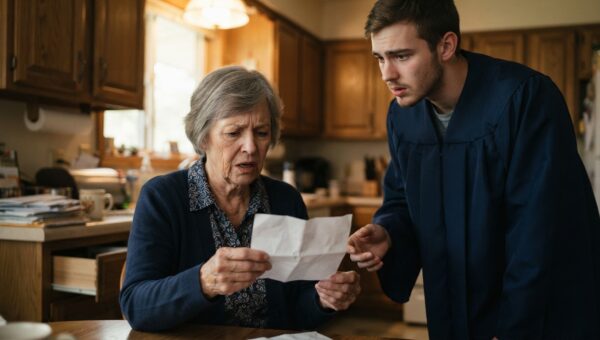
“Grandma, there’s supposed to be sixty,” he had said just a minute before the room tilted. “There’s a hundred forty.”
He had looked down at the tiny white squares scattered across the blue paper towel where I used the dull kitchen knife to divide them. Each pill had to be quartered with surgical precision so the edges would not crumble into useless dust, because thirty-one dollars was a lot of money when your total monthly check came out to $1,540 and the electric company sent a pink slip every time the wind blew too hard from the north.
My daughter Clara was forty miles away in her office on Elm Street, staring at spreadsheets for the county tax assessor and wondering why I had not picked up the phone when she called during her ten-minute morning break. I hadn’t picked up because talking took breath, and breath was something I had started rationing along with the metoprolol and the little white water pills Dr. Alan gave me back when my heart still knew how to keep its own rhythm.
“Leo,” I whispered, or tried to whisper. The word barely made it past my teeth before the ceiling started spinning in slow gray circles.
He did not wait for me to finish. He grabbed my old flip phone off the charger by the calendar, his small fingers punching the three digits he had memorized from the sticker on the refrigerator door. I heard him talking to the operator, his voice clear and sharp, giving our street name and the number on the mailbox without stuttering once.
The ambulance ride was loud and smelled like old wool blankets and cold metal. A young man with a mustache kept asking me what day of the week it was, and I told him it was Tuesday, even though I had a sneaking suspicion it might be Wednesday by the time we hit the county line. My chest felt like someone had wrapped a wet leather strap around my ribs and pulled it tight with a pair of pliers, an ache I had been calling stubborn heartburn ever since the first frost back in November.
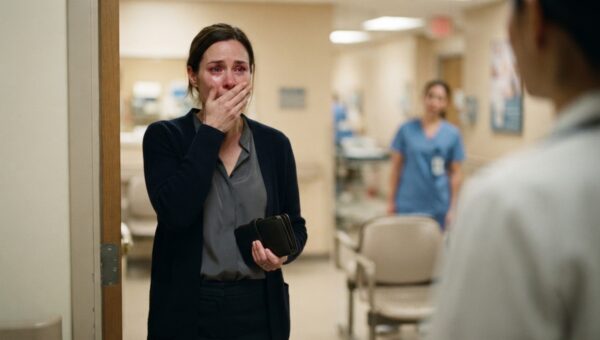
When Clara finally burst through the emergency room doors, her hair was coming out of its rubber band and her car keys were dangling from her thumb by the split ring. She looked at me lying there on the paper sheet with the IV tape holding a plastic needle to the back of my hand, and her face went completely slack, all the quick-tempered energy she usually carried around draining right out of her.
“Mom,” she said, and her voice cracked right in the middle, sounding smaller than Leo’s. “What happened? Why didn’t you call me?”
“I was busy,” I said, which was the oldest lie in the book.
Leo walked in right behind her, carrying a brown paper grocery bag. He set it down on the rolling hospital table with a dull clatter that made the nurse look up from her clipboard. Inside the bag were the amber pill bottles, each one marked with my name in faded black ink, along with the dull kitchen knife and the blue paper towel with all the little white dust specks.
“She was cutting them, Mom,” Leo said, looking up at Clara with those big, serious eyes that missed nothing. “She had too many left over because she was only taking a little piece at a time.”
Clara looked from the boy to the bag, then down at me. “Mom. Tell me that’s not true.”
“The rent went up forty dollars in October,” I said, staring at the white acoustic tiles on the hospital ceiling where someone had left a brown water stain shaped like Florida. “And the water bill came with that extra charge for the sewer line repair. You have your mortgage, Clara. You have the boy’s braces. I didn’t want you worrying about whether I could afford my own heart.”
Dr. Alan came in about twenty minutes later, smelling faintly of peppermint and stale tobacco. He pulled the privacy curtain closed with a sharp plastic ring-clatter that always meant business. He did not look angry, which was worse. He just looked tired in the way that country doctors get when they realize they have been looking at the symptoms while missing the whole person standing right in front of them.
“Your blood pressure was doing acrobatics for six months, Martha,” he said, pulling up a metal stool and sitting down with a groan. “You can’t fool a ticker by giving it a quarter-dose of what it needs to pump against gravity. It catches up to you eventually. Usually all at once.”
“I felt fine,” I lied again, though my chest gave a dull, heavy thump against the monitor leads to prove what a poor liar I really was.
“You didn’t feel fine,” Clara said, and for the first time that day, she reached out and took my hand, her fingers cold and trembling against my knuckles. “You looked thin the last three times I came over, and I just told myself you were getting older. I was too busy with the quarterly reports to look in your cabinets.”
We stayed in that little curtained room until the sun went down behind the brick water tower outside the window. Clara didn’t talk about her office or her spreadsheets once. She sat on the edge of the stiff vinyl chair and peeled an orange for me with her fingernails, dropping the white pith into a paper cup and handing me the segments one by one like I was five years old and had just scraped my knees on the gravel driveway.
The next afternoon Clara drove me back home in her station wagon, the heater clicking rhythmically behind the dashboard. When we walked through the back door, the kitchen looked smaller than I remembered, the afternoon light cutting across the linoleum and hitting the empty space in the corner where the oak china cabinet used to stand.
Clara stopped right by the doorway, following my eyes over to the empty wall.
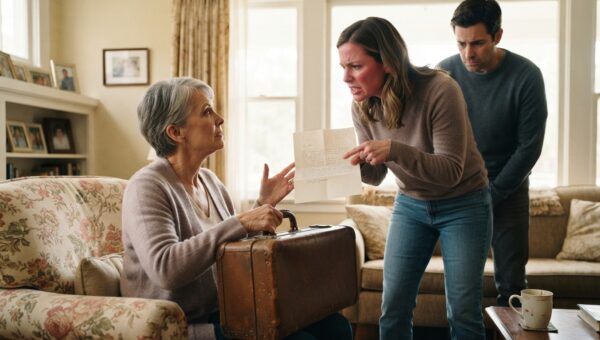
“Where are the silver gravy boat and the tea set Aunt Mae left you?” she asked softly, her hand resting on the back of the kitchen chair.
“I sold them to the antique dealer down by the grain elevator back in August,” I said, looking down at my shoes. “He gave me two hundred dollars cash. It paid for three months of the prescription before the price went up again.”
Clara didn’t yell. She just walked over to the counter where Leo had left the pill bottles and picked up the little brown paper bag. She looked inside, pulled out one of the bottles, and read the pharmacy label like she was trying to memorize every letter printed on the white paper.
“We are going to fix this,” she said, her voice dropping down into that stubborn tone she inherited from her father. “Not next month. Today.”
Before I could tell her that we didn’t have room in the budget for new arrangements, there was a knock on the front screen door. It wasn’t a visitor knocking with their knuckles; it was Dr. Alan, letting himself in with his usual two-tap warning and holding a thick manila folder under his arm.
“Thought you might need some paperwork before the sun gets down,” Dr. Alan said, walking right into the kitchen like he owned the place. He laid a new set of prescription sheets on the laminate counter right where the pill bottles had been. “I called the regional office over at St. Jude’s this morning. They have a senior assistance program that covers brand-name cardiac maintenance for folks on fixed income. Your copay on these generics is going to be zero, Martha. Not eight dollars. Zero.”
I stood there by the table, the old wool cardigan hanging loose around my shoulders, and felt the tightness in my chest finally begin to let go, bit by bit, like a knot being worked out of wet twine.
“I don’t take handouts,” I muttered, mostly out of habit.
“It’s not a handout, Grandma,” Clara said, stepping up beside me and putting her arm around my waist. “It’s just the arithmetic. And this time, we’re doing it together.”
By the following Tuesday, Leo was back over for his regular after-school visit, his backpack dropped by the back door with a heavy thud. He didn’t touch the pill bottles to count them this time. Instead, he pulled a brand-new plastic weekly organizer out of his bag, the little plastic lids marked with gold letters from Sunday down to Saturday, each one big enough to hold a full, unbroken dose of every pill Dr. Alan had ordered.
He sat at the kitchen table with me while the kettle whistled on the stove, snapping the little plastic tabs shut one by one with a sharp, clean click that echoed off the empty walls.
“Sunday, Monday, Tuesday,” Leo chanted quietly under his breath, his fingers moving with absolute care over the little plastic squares.
Clara came in from the porch carrying a brown paper sack of groceries and a fresh carton of milk, setting them down on the counter right beside the organizer. The afternoon light was coming through the window clean and yellow, hitting the side of the white porcelain teapot and the smooth blue plastic of the box Leo had filled.
We didn’t talk about the missing silver dishes or the months I spent cutting white tablets with a paring knife. We just sat there together in the quiet kitchen while the water came to a rolling boil, the three of us sharing a cup of tea with enough room left over in the budget to buy a loaf of fresh bread from the bakery down on Main Street.