The morning coffee always took four minutes in the old drip pot by the sink, and I usually spent those four minutes watching the gray cedar siding of the carriage house across the alley settle into the damp Savannah air. Twenty-nine years of watching that same wood turn from a pale wheat color to silver-gray. David used to stand right there beside me in his flannel robe, holding his mug by the rim because the handle had cracked off back in nineteen-ninety-two.
He never threw that mug away. He just wrapped a thick strip of rubberized tape around the break and kept right on using it every single morning.
When David died after three months of fighting a liver that simply quit on him, the house didn’t just get quiet. It got heavy. The air inside the rooms stayed thick with the smell of floor wax and cedar chests and old peppermint candies he kept in the jar by the front door. I spent the first week after the funeral walking from room to room with a dust rag in my hand, touching the edges of things just to prove they were still solid. Nobody called to ask how I was sleeping. They didn’t need to call. They were too busy gathering at Brenda’s house three blocks over to talk about the estate.
Brenda is my sister-in-law, and she has carried herself like she owns the county courthouse since we were girls in high school.
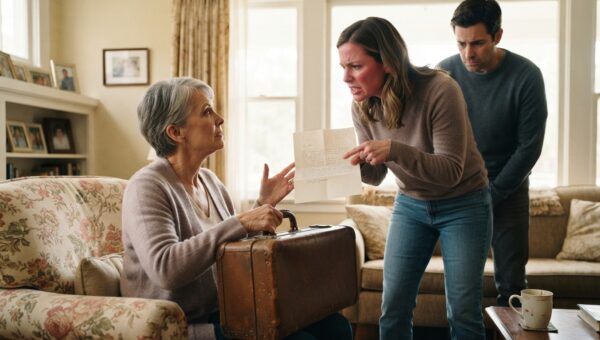
She’s the sort of woman who treats every family gathering like a board meeting where she’s the only one with a vote. Three weeks to the day after we buried David under the red oaks at the cemetery, Brenda showed up on my front porch without knocking. She didn’t wait to be invited in. She just pushed the screen door open with the toe of her loafers and walked straight into my kitchen like she was inspecting a property she had already put a bid on.
She sat down at the wooden table David built with his own hands when we first moved into the place. She didn’t take off her coat. She just folded her hands over her leather handbag and looked around the room as if she were tallying up the copper pipes and the silver flatware.
“We need to talk about the memorial,” Brenda said. Her voice had that flat, sharp edge she used whenever she was about to tell someone they owed her money.
“I thought the funeral on the twelfth took care of that,” I said, staying by the stove. I was wiping down the laminate counter where a drop of honey had dried clear.
Brenda let out a short, dry breath through her nose. “That was just for the public, Martha. The family is doing something proper this coming Saturday at the country club. A private dinner. Just blood.”
I stopped wiping the counter. The cloth felt dry and stiff in my palm. “Just blood,” I repeated. “After twenty-nine years.”
That was when she leaned forward across the oak table, her rings clicking against the wood, and delivered the sentence that cleaned out the last twenty-nine years like lint from a pocket.
“You’re not family anymore. You’re just the woman who used to be married to my brother.”
She didn’t blink when she said it. She looked at me the way she looked at the grocery clerk when an apple had a bruise on it.
I stood there with the yellow sponge in my hand, thinking about all the things she seemed to have forgotten in a mighty big hurry. I thought about the winter her mother was sick in bed for four months, when I drove out twice a day to change the sheets and spoon broth into a woman who couldn’t remember my name half the time. I thought about the three nieces who had lived in our spare bedroom for months on end when their own parents were sorting through messy divorces, eating our groceries and leaving wet towels on the bathroom floor. David had wanted to say no to the second niece, but I told him family comes first. Always.
Then Brenda looked right at me again, her chin tilted up just enough to catch the light from the window. “Because David is gone, and without him, you don’t belong here.”
You don’t belong here.
Those four words didn’t make me angry right away. They just made me feel cold in the center of my chest, like I’d swallowed an ice cube whole. Twenty-nine years of cooking their holiday dinners, balancing their ledger books when their businesses went under, and sitting on hard hospital benches while their husbands had their hips replaced. And according to Brenda, I was just a tenant whose lease had expired the moment the heart monitor flatlined.
I didn’t yell. I didn’t throw the sponge at her head, though God knows my arm was twitching for it. I just looked at her sitting there in David’s chair, wearing the wool coat I knew she’d bought with the inheritance from their uncle’s estate, an estate David helped manage for five years without taking a dime for his trouble.
“I understand,” I said. My voice didn’t even shake. That surprised me more than anything.
Brenda gave a brisk nod, satisfied that she’d managed the eviction without having to call the sheriff. She stood up, brushed a speck of lint off her wool sleeve, and walked toward the front door without saying goodbye. I watched her through the screen as she stepped down onto the concrete porch, her heels clicking sharp against the walk like small hammers.
When the front door shut, the house went back to that heavy, quiet weight. I walked into the front hall and stood by the old grandfather clock that David’s father had hauled over from the old house on River Street back in nineteen-ninety-seven. The brass weights inside were hanging still because I hadn’t gotten around to winding them since the Tuesday after the funeral. The pendulum just hung there, dead center, pointing down at the dark grain of the oak floorboards.
I reached out and touched the brass pendulum with my thumb. It was cold.
The rest of that week passed in a blur of gray light and silence. The phone didn’t ring once. Word travels fast in a town like Savannah, and once Brenda made her rounds at the bridge club and the Methodist women’s auxiliary, the whole town seemed to know that Martha had been quietly retired from the family ledger. People I’d waved to at the Piggly Wiggly for twenty years suddenly found very interesting things to look at in the produce aisle when I walked past the lettuce bins.
By Friday afternoon, I had made up my mind. I didn’t care about their country club dinner. I didn’t care about the smoked salmon or the ice sculptures Brenda probably ordered to make herself feel like a duchess. But I cared about David. And I cared about the twenty-nine years we spent building every brick of the life those people were now dividing up like loot from a warehouse fire.
On Saturday evening, the sun went down behind the live oaks and turned the sky the color of a bruised peach. I went upstairs to the small closet in the guest room where I kept my good clothes. I pulled out the silver-threaded dress David had bought me for our twenty-fifth anniversary at that little seafood place down on the coast. He had told me then that I looked like a queen, even though I’d spilled cocktail sauce down the front before the main course even arrived. I had the dry cleaner get the spot out three days later, and it had hung in the back of the cedar closet ever since, smelling faintly of cedar and mothballs.
I put it on, zipped it up without asking for help, and fastened the small silver pearl earrings David gave me the day we closed on the mortgage for the house. I didn’t put on much makeup, just a touch of powder and some rose salve for my lips. When I looked in the oval mirror by the bureau, I didn’t see an old woman who didn’t belong. I saw the person who had stayed when everyone else packed up and left.
The country club parking lot was full of large black SUVs and silver sedans with local law enforcement stickers and medical board plates. I pulled my little gray station wagon right up near the gravel circle by the front entrance, right behind Brenda’s husband’s Lincoln. The parking attendant looked twice at my fender, which still had a dent from where David backed into the mailbox three winters ago, but he didn’t say anything. I killed the engine and sat there for a minute, listening to the small ticking of the cooling radiator.
The double doors of the club were made of heavy mahogany with brass push-plates that looked like polished gold under the carriage lamps. As I walked up the three brick steps, I could hear the low murmur of voices through the wood, laughter, glasses clinking, and Brenda’s unmistakable sharp carry-over laugh that always sounded like dry leaves scraping across a sidewalk.
I didn’t knock. I just put my hand on the cold brass bar of the right-hand door and pushed.
The doors swung inward with a heavy, smooth motion that didn’t make a single squeak. The room went dead silent about three seconds later.
Seventy people, second cousins, local bank presidents, insurance adjusters, and church elders, were scattered around round tables covered in white linen tablecloths. Brenda was standing near the microphone stand by the small stage at the far end of the room, holding a glass of white wine and halfway through what looked like a toast about how David had always been the pillar of their family.
She stopped mid-sentence. Her mouth stayed half-open, the wine glass hovering an inch from her lower lip.
I didn’t stop at the threshold. I walked right down the center aisle between the tables, my heels clicking sharp against the parquet floor. Nobody moved. Uncle Arthur, who was ninety-one and half-blind, squinted across his bread plate and muttered something about who let the light in, but nobody answered him.
Brenda set her wine glass down so hard on the edge of the stage that a little splash of yellow liquid spilled over the white cloth. She hurried down the three carpeted steps, her face turning the color of a fresh beet, and planted herself right in my path about ten feet from the podium.
“Martha,” she said, her voice tight and shaking just enough to show she was losing her grip on the room. “You can’t be here. This is a private memorial. For family only.”
She used that same tone she’d used in my kitchen, loud enough for the people at the front three tables to catch every syllable. She wanted the audience. She wanted them to see her put the stray dog back outside where it belonged.
I stopped about two feet away from her. Up close, I could see the tiny powder-caked pores around her nose and the way her fingers were clawing at the strap of her handbag.
“Brenda,” I said, and my voice carried better than hers because I didn’t have to strain to sound important. “I am David’s wife. For twenty-nine years. I think I have a right to hear what people have to say about him.”
“You were told,” Brenda hissed, stepping closer so her breath hit my cheek smelling of gin and peppermint. “You were told you don’t belong here. You have no legal claim to this gathering. Security can, “
“Security?” I interrupted, and for the first time since David took his last breath, I felt the ground firm up under my shoes. “You want to call the men who used to borrow David’s truck to tell them to throw out the woman who washed your mother’s sheets? Go ahead, Brenda. Call them.”
I didn’t wait for her to answer. I raised my voice just enough to reach the back rows where old Mr. Henderson from the hardware store was sitting with his hat in his lap.
“David loved this town,” I said, looking right at the crowd now. “And he loved most of the people in this room. He spent fifteen years helping run the county drainage board without taking a salary so half your properties wouldn’t flood every time the river rose. And when his sister here lost her house in ninety-eight, it was the money from my grandfather’s timber sale that paid off her second mortgage so her kids wouldn’t have to change schools.”
A low murmur rolled through the middle tables like wind through high grass. Brenda turned her head sharply toward the back, her face draining of whatever color was left in it.
Then, from the third table back, Aunt Sarah stood up. She’s eighty-eight and uses a heavy wooden cane with a rubber tip, but she stood up straight and hard, leaning her weight into the hickory shaft.
“Sit down, Brenda,” Sarah said. Her voice wasn’t loud, but it had that dry, iron authority that old Southern women keep in reserve for funerals and weddings. “Martha cooked my Thanksgiving turkey for ten years when my hips gave out. Let the woman sit down.”
Two other people at Sarah’s table shifted their chairs back, making that loud scraping sound on the wood floor. Cousin Jimmy, who hadn’t spoken to me since the reading of the dry-goods store partnership back in ought-six, raised his hand halfway and pointed to the empty chair right beside him, the seat Brenda had undoubtedly reserved for some county commissioner who never showed up.
“There’s a plate right here, Martha,” Jimmy said, clearing his throat like he had a sandbur stuck in his windpipe. “We didn’t know you weren’t on the list.”
“She knows,” I said, looking straight at Brenda.
Brenda stood there for another five seconds, her chest heaving under that expensive wool coat, looking like she wanted the floor to open up and swallow her whole. But floors don’t open up for people like Brenda. They just have to stand there and watch the room drift away from them.
She didn’t call security. She didn’t say another word. She grabbed her handbag off the edge of the stage, turned on her heel, and walked out through the side service door toward the kitchens without once looking back.
I didn’t take the seat at Jimmy’s table. I stayed standing by the microphone for a moment, looking at the photographs of David they had pinned to the felt board behind the podium, pictures from thirty years ago when his hair was thick and dark and he still had that little gap between his front teeth he always tried to hide when he smiled for the camera.
“He would have hated the salmon,” I told the room, and a few people laughed, a real, nervous, genuine sound that broke the ice better than any prayer could have.
I stayed for twenty minutes. I talked to Mr. Henderson about his bad knee, and I let Cousin Jimmy’s wife pour me a glass of iced tea that tasted mostly of tap water and lemon. Every person who came up to shake my hand looked a little embarrassed, the way people do when they realize they’ve let a dog bite someone who was only trying to feed it. I let them say their pieces. I accepted their handshakes, not because I had forgiven them, but because I finally understood that what they thought of me didn’t add or subtract a single day from the life David and I had made together in that house on Elm Street.
When I finally walked back out through the heavy mahogany doors, the night air had turned cool and sharp, carrying that particular smell of damp river mud and pine straw that means you’re within ten miles of the Savannah basin.
I didn’t go straight home. I drove past the grocery store and the old Methodist church where the steeple light was already blinking against the dark. When I pulled into my own driveway, the house was dark except for the little porch lamp I’d left burning by the screen door.
I turned off the ignition, but I didn’t get out right away. I sat there in the dark cab of the station wagon, listening to the small ticking of the metal cooling down in the night air. I looked down at my wrist, where my mother’s old silver-banded watch was ticking away the seconds, steady and quiet, keeping its own time whether anyone was listening or not.
I reached for the door handle, ready to go inside, where the grandfather clock from nineteen-ninety-seven was waiting in the hall to chime the hour on its own terms.