The green Dodge pickup with the rusted tailgate backfired twice down by the grain elevator, and Buster dropped flat onto the cracked sidewalk like he had been hit.
He did not just stop. His chest hit the concrete with a dull thud, his front paws splayed out wide, his amber eyes rolling back just enough to show the white crescents underneath.
His tags did not even jingle anymore because they were jammed tight between his collar and his thick neck hair. I stood there with the nylon leash burning my palm, waiting for the trembling to reach my own wrists. It usually did.
The thermometer on the wall outside the hardware store read 84 degrees, which was entirely too hot for October in eastern Nebraska, but my skin felt like it was coated in a layer of gray frost.
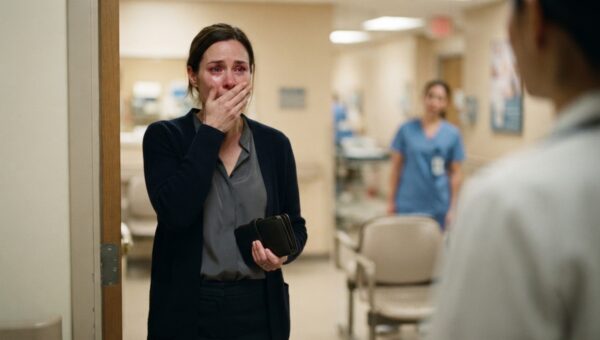
That was the third time we had tried to walk around the block since Dr. Aris signed the paperwork clearing me to leave the house without the portable IV pump strapped to my ribs. The pump was gone, but the hollow space it left behind felt bigger than the machine ever was. My fingers were still tingling from the platinum-based drugs, that strange, permanent prickling that stayed under your fingernails long after the nurses flushed the lines.
Buster refused to budge. He was a seventy-pound hound mix with ribs you could count through his brindle coat and ears that looked too big for his skull, a rescue pulled from a hoarding case down near Beatrice three weeks before my second round of infusions.
“Come on, boy,” I whispered. My voice sounded thin, like dry paper tearing.
Buster let out a low, bubbling whine from deep in his throat and tucked his rear end down until his belly was flat against the warm concrete. He was terrified of the sky, terrified of the wind rustling the dead leaves along the curb, and terrified above all else of the simple momentum of forward motion. Every time I pulled gently on the strap, his muscles locked into iron cables.
I knew that feeling better than I cared to admit.
There are certain kinds of quiet that settle into your bones when you are nine years old and the county social worker tells you to pack your three flannel shirts into a brown grocery sack because the state found a better placement forty miles north.
You learn very quickly that standing still is safer than moving. When you stay in one spot, nobody can yell at you for packing too slow. When you don’t make a sound, nobody notices when you break a glass or track mud across the linoleum.
I looked down at Buster. Buster looked at a crack in the concrete where a dandelion had somehow survived the frost.
“All right,” I said to nobody at all. “We aren’t going anywhere then.”
I let go of the leash entirely, letting the nylon loop snake out into the dust, and sat down right there on the grass beside him. My knees protested immediately, clicking like dry twigs, and the damp clover soaked through the seat of my denim trousers within three seconds.
The neighbors across the street, Clara and her husband Virgil, were out clearing their gutters with a yellow aluminum ladder, but they pretended not to see me sitting cross-legged in the middle of a barren patch of boulevard weeds with a shivering dog.
Clara just raised one red-gloved hand in a silent, polite wave and went back to scraping out wet maple leaves. She was good like that. She never asked why I looked like a ghost walking through daylight.
I reached into my canvas tote bag and pulled out the paperback I had been carrying around for four days without reading a single line. It was an old copy of Willa Cather’s *My Ántonia*, the spine cracked and held together with clear yellow tape that smelled like old library paste.
I opened it to page forty-two and started reading out loud to the traffic.
“I had no notion of what a book meant,” I read, my voice rough and cracking on the vowels, “until I sat down under the cottonwoods and listened to the wind.”
Buster’s left ear twitched.
I kept going, keeping my tone level and slow, matching the rhythm of the delivery trucks crawling past on Main Street two blocks over. I read about the yellow grass and the long winters and the way the earth smells right before a hard frost. I didn’t look at him, and I didn’t pull the leash.
After about six pages, the rigid trembling in Buster’s front shoulders gave one long, shuddering sigh. The iron cables in his legs turned back to bone and muscle. Slowly, with infinite caution, he dragged his front half forward three inches until his chin was resting directly across my right ankle. His breath was hot and wet against my wool sock.
“There,” I whispered, resting my hand on the space between his ears where the fur was thin and warm. “See? Nobody’s leaving.”
That afternoon set a pattern that lasted through November and into the bitter weeks of the first December snow.
My treatment schedule was brutal, two weeks on and one week off, leaving me with mouth sores that tasted like old pennies and a profound, bone-deep exhaustion that made even lifting a gallon of milk feel like hauling gravel. On the bad days, I couldn’t make it past the mailbox before my lungs felt like dry sponges. Buster learned those days before I even laced my boots. He wouldn’t go to the door. He would just lie across the threshold of the kitchen with his nose pointed toward the living room rug, waiting for me to surrender.
When we did manage to get outside, we rarely made it past the large silver maple tree in the middle of the front yard.
I would bring out an old wool stadium blanket, lay it flat over the frost-heaved dirt, and sit there with my knees pulled up to my chin while Buster anchored himself to my hip. I read three whole novels that autumn, plus a collection of local poetry I found in the church basement sale box for a quarter. *The Prairie Schooner*, old issues from 1974 with water stains on the covers.
Dr. Aris noticed the change during my checkup in mid-November. She clicked her ballpoint pen against the metal clipboard and looked at the printouts of my blood work, then up at my face.
“Your resting heart rate is down eight beats a minute from last month, Martha,” she said, adjusting her wire-rimmed glasses. “Whatever you’re doing with that dog of yours, keep doing it. Your system is actually resting.”
“We just sit in the grass, mostly,” I told her, staring at the white paper lining the examination table.
“Rest is hard for people who spent their youth waiting for the other shoe to drop,” she said quietly, writing something down in the chart with sharp, efficient strokes. She didn’t say it like a doctor giving advice. She said it like someone who had lived through a few hard winters herself.
By December, the ground froze solid, and the grass turned the color of an old brown paper sack.
We still went out. I bought a heavy down parka at the secondhand store on Court Street for $14.50, the kind with fake coyote fur around the hood that shed orange fibers every time the wind blew. Buster didn’t need a coat because his undercoat had grown in thick and greasy, smelling faintly of wet earth and old straw.
The test came on a Tuesday morning when the sky was the color of a galvanized tub and the air smelled like woodsmoke from the packing plant down by the river.
I had just finished the last round of blood tests, and my stomach was sour and churning with that familiar, chemical bile. I didn’t want to go outside. I wanted to pull the floral quilt over my head and sleep for three days until the room stopped tilting sideways. But Buster was standing by the hall closet with his nose jammed into the bottom of the coat rack, his tail giving one tiny, hesitant wag.
“All right, stubborn,” I muttered. “Ten minutes. That’s it.”
We walked down the sidewalk toward the park, past the old brick Methodist church where the wind always seemed to funnel off the prairie with twice its normal force. The street was quiet except for the crunch of our boots and the dry rattling of corn stalks in the vacant lot behind the grain elevator.
Then came the sound.
It wasn’t a truck this time. It was a pneumatic gravel loader coughing to life behind the lumber yard, a sharp, metallic *clang-hiss-bang* that echoed off the metal siding of the feed store.
Buster spun around so fast his hind legs skidded on a patch of black ice. His head went up, his eyes wide and wild, and for one terrible second, the nylon leash went taut as a bowstring. I felt the old panic rise up in my chest, that hot, blinding surge of helplessness that always made me want to drop everything and run for the nearest door.
He backed up three steps, his breath pluming white in the freezing air, his jaws parted in a silent scream of pure, unadulterated terror. He was going to bolt. I knew he was going to bolt. If he hit the end of that six-foot lead while I was this weak, I would go down on the ice, and once I was down, I wasn’t sure I had the strength to get back up.
The memory of the foster home in Callaway flashed behind my eyes, the gray linoleum floor, the blue vinyl suitcase sitting by the screen door while the rain came down in gray sheets against the glass. The feeling of being dropped off like a stray package with the postage already paid.
I didn’t pull him toward me. I didn’t yell.
Instead, I let go of the loop entirely. The nylon strap hit the frozen dirt with a soft hiss.
I dropped right down onto my knees onto the hard, frozen ruts of the boulevard grass, right there in the gravel dust and the dead weeds, and I sat flat on the ground with my hands open in my lap.
Buster froze mid-stride, his ears pinned back against his skull. The gravel loader banged again, louder this time, shaking the telephone wires overhead.
He looked down the street toward the open road. He looked back at the fence line of the churchyard. Then he looked at me, sitting in the dirt with my old orange parka pooling around my boots like a heap of fallen leaves.
The distance between us was four feet of gray, frozen dirt.
He didn’t run down the street. He didn’t bolt toward the alleys. With a low, ragged groan that sounded more like a human sigh than an animal sound, Buster turned around, crawled on his belly through the dried thistle, and dropped his entire seventy-pound weight straight into my lap.
His ribs were heaving against my thighs, fast and hot, but as I wrapped my arms around his thick neck and buried my face in his scruff, his breathing began to slow down. One beat. Two beats. Matching the steady, stubborn thump of my own heart against my ribs.
We stayed there in the frozen grass for six minutes by the bank clock down on the corner. Nobody walked past. The gravel loader finished its cycle and went quiet, leaving only the sound of the wind moving through the dry corn stalks across the road.
“Good boy,” I whispered against his ear, my voice thick and shaking. “We’re right here.”
That was three months ago.
The snow has melted off the front yard now, leaving behind those ragged patches of dead yellow turf that always show up before the green shoots have the strength to push through. The lab work came back clean last Thursday, the kind of clean where Dr. Aris doesn’t look at her clipboard twice before she smiles and tells you to come back in six months instead of six weeks.
The hair is starting to grow back on my head in soft, gray-white curls that stick out in every direction like a dandelion seed head after a storm.
We don’t use the leash anymore when we walk to the end of the block. We don’t need to. Buster walks three paces ahead, stops when I stop, and looks back over his shoulder every twenty feet to make sure the world hasn’t shifted while he wasn’t looking.
The front door stands wide open to the spring air, letting the smell of damp earth and river mud drift through the screen.
I am sitting on the wooden porch step with my coffee mug cooling between my palms, watching the late afternoon sun turn the gravel road the color of old copper. Buster is lying right beside my boots, his chin resting across my instep, completely still, completely certain that nobody is packing bags tonight.