The notification light on my phone didn’t blink when the funeral director called, but the small digital chime cut through the quiet air of my father’s study just as I finished wiping down the mahogany desktop where he kept his ledgers.
I always thought my father’s trips were just business. He would pack a single green canvas duffel bag every June, step into his sedan, and drive away for two solid weeks without offering a single word of explanation.
I was 10 years old in 1975 when those annual disappearances started. My mother never questioned him once. She would just stand on the front porch with a dish towel folded over her thumb, watching the tail-lights vanish down our gravel lane, and then she would turn back inside to bake bread or mend curtains. We had a good, quiet life in that house. They were married for fifty years before a sudden heart attack stopped my father’s heart right in the middle of a Tuesday morning crossword puzzle.
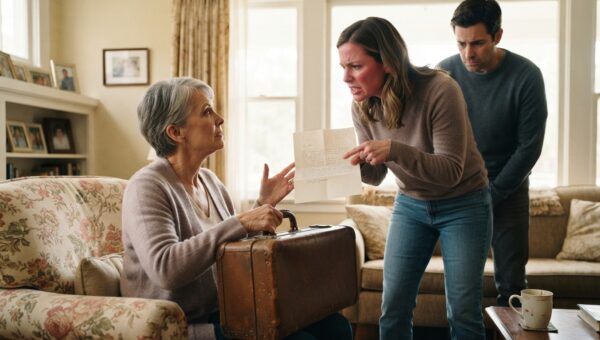
Last week, while clearing out his study, I noticed a slight shadow underneath the bottom shelf of the heavy oak bookcase. It wasn’t dust. It was the distinct outline of a heavy iron latch pressed flat against the floorboards. I had to slide three entire rows of leather-bound tax law books out of the way before I could haul the thing out into the open.
It was an old military footlocker, its olive-drab paint chipped away at the corners to reveal dull gray metal underneath. The brass padlock gave way after three solid blows with the flat end of a claw hammer.
The lid groaned open with a dry, metallic rattle that smelled of mothballs and damp wool. Resting right on top were two framed military service medals from the sixties and a thick stack of architectural blueprints for a single-room cabin. But underneath those papers lay a folded sheet of graph paper. I unfolded it on the desk and stared at a hand-drawn map featuring winding state routes, a series of hand-lettered mile markers, and a single X marked deep inside the Green Mountains of upstate Vermont. I had never heard my father mention Vermont in my entire life.
I didn’t call my mother to ask. I just grabbed my keys, locked the front door behind me, and pointed my car north up the interstate.
The three-hour drive bled out into the gray afternoon as the suburban sprawl slowly gave way to the dense, jagged timberlands of the north.
By late afternoon, I was bouncing down a rutted logging road that didn’t appear on any modern GPS app. The map from the footlocker was surprisingly accurate. After four miles of dodging potholes and low-hanging pine branches, I found the rusted metal gate hanging open from a single rusted hinge. Beyond it sat a tiny, overgrown cabin, completely hidden behind a thick curtain of hemlocks and wild fern. The cedar siding was weathered silver, and the tin roof was choked with pine needles.
The front door wasn’t even locked. The brass knob turned under my palm with a dry click, and I stepped inside into a room that smelled faintly of old cedar and paraffin wax. A small, round oak table sat beneath a grimy north-facing window.
Resting on top of that table was a single framed photograph and a small, battery-operated cassette player with a gray plastic body.
I walked across the creaking floorboards and picked up the photograph first. My breath caught in my throat. It was my mother, younger than I had ever seen her, wearing a faded plaid shirt and laughing so hard her eyes were crinkled shut. Standing right beside her with his arm around her waist was a man I had never laid eyes on in my life. He had dark, unruly hair, a crooked grin, and a heavy silver ring on his right hand. They looked happy in a way I had never once seen my parents look together.
Next to the frame sat the cassette player. My hand was shaking slightly as I pressed the small plastic play button down until it clicked.
The tape hissed with a low, steady magnetic hum for two long seconds. Then my father’s voice filled the empty cabin, clear and steady and entirely unmistakable.
“If you’re listening to this, it means I didn’t make it back for June,” his voice said through the tiny built-in speaker. The tinny sound bounced off the rough wooden walls. “And it means you finally found the road up here. I suppose you’re wondering about the timing. You always were observant, even when you were ten. They said you could never know why I had to marry my…”
The tape clicked off with a sharp metallic snap as the built-in batteries gave out, or the recording simply ended.
I stood there in the dusty silence of that room for a long time, listening to the wind sighing through the pine boughs outside the window. The blueprints scattered across the footlocker back home suddenly made sense. So did the receipts for lumber and roofing supplies I found tucked inside his desk drawer. Every single June, for fifty years, my father had driven four hours north to maintain a ghost. He came here to keep a roof over the memory of a man who had vanished from my mother’s life long before I was ever born.
I looked back down at the photograph of my mother and the dark-haired man. Julian. I didn’t know his last name yet, but I knew his face. I knew the way he looked at her with an absolute, unguarded devotion that my father had only ever shown from a distance, through the quiet discipline of annual absence and fifty years of unflagging stewardship.
The drive back south was a blur of gray asphalt and oncoming headlights. I didn’t stop for coffee. I kept the hand-drawn map folded on the passenger seat next to me, the edges slightly damp from where my thumb had pressed against it. When I finally pulled into the driveway of my parents’ house, the kitchen light was still burning.
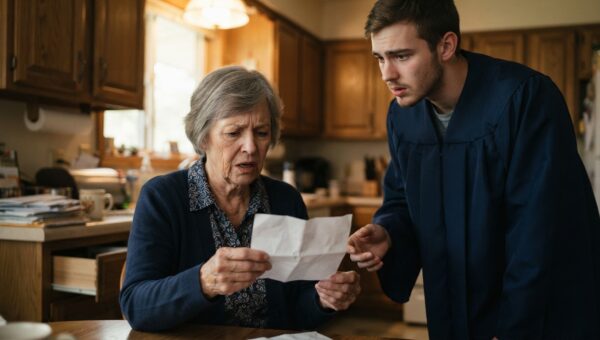
My mother was sitting at the laminate kitchen table, her reading glasses pushed up onto her forehead, sorting through a pile of condolence cards. She looked up as the front door swung open, her gray eyes steady and unsurprised, as if she had been expecting me to walk through that door with the exact weight I was carrying.
“You found it, didn’t you?” she asked softly. Her voice didn’t shake. There was no panic in her face, only a deep, settling exhaustion that had been waiting half a century to finally exhale.
I didn’t answer right away. I walked across the kitchen and placed the framed photograph of her and Julian right in the center of the table, next to the stack of sympathy cards.
She looked down at the image. Her thumb reached out and traced the edge of the glass, right over Julian’s smiling face, with a tenderness that made my chest ache.
“He never missed a year,” I whispered. “Not one.”
“I know,” she said quietly, her gaze fixed on the young man in the frame. “He told me before we walked down the aisle in seventy-four. He told me he would give me a good home, and a clean name, and fifty years of peace. But he said he owed Julian a fortnight every summer to keep the cabin standing. And I told him that was the only fair price for a life built on a promise.”
She looked up at me then, her eyes bright with unshed tears that never quite spilled over her lashes. “Your father wasn’t a romantic man, but he was a man of his word. He took care of me because Julian couldn’t anymore. And he took care of Julian’s memory because I couldn’t bear to do it alone.”
We sat there together in the quiet kitchen as the evening shadows stretched across the floor. There were no more secrets left in the house, only the heavy, enduring weight of what two men and one woman had quietly agreed upon in a different lifetime.
The framed photograph of my mother and Julian now sits on the study desk at home, resting right beside my father’s heavy brass military medals, united at last under the quiet light of a Sunday afternoon.