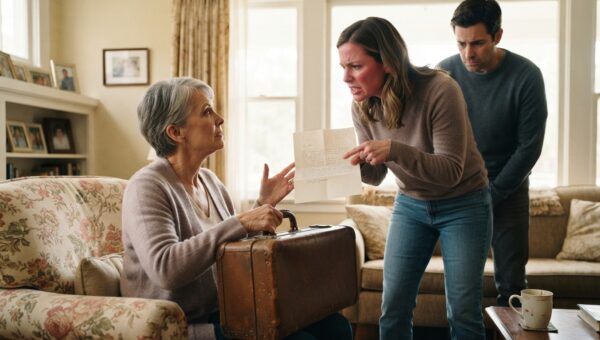
I got the math wrong for six whole weeks after the funeral. I sat at my father’s walnut desk trying to balance the estate ledger, assuming the missing two weeks every June were just corporate audits or heavy machinery deals in Chicago that he never cared to talk about. My father was a man of cold ledgers and heavy iron staplers.
He did not explain himself. When he walked out the front door every June fourteenth with a canvas duffel bag tossed into the trunk of his Plymouth, my mother simply handed him his thermos of black coffee and kissed his cheek. She did not ask questions. Fifty years of marriage built on quiet routines and closed bedroom doors.
I was ten years old in 1975 when those June trips started. Back then, I thought every father vanished for two weeks out of the year. I figured it was just part of being a grown-up, like paying property taxes or wearing a tie to church. My mother stayed behind in our brick ranch house, tending to her hydrangeas and keeping the kitchen so clean it smelled like lemon oil and bleach. They had a good, steady life. They never yelled. They never threw plates. They just existed side by side like two pieces of heavy furniture placed in the same room by an interior designer who cared nothing about how they fit together.
Last Tuesday, the task fell to me to clear out his study. The real estate agent was coming by on Friday to appraise the lot, and every drawer had to be emptied into contractor bags. Behind a stack of old plumbing manuals and tax returns from the Carter administration, my foot caught on something heavy near the baseboard. It was a metal footlocker, painted army green, held shut by a brass padlock that had rusted stiff over the decades. I had to use a flathead screwdriver and a heavy claw hammer to pry the hasp off. The metal gave way with a sharp, echoing snap that made my heart jump in my chest.
Inside, beneath a layer of mothballs and stiff wool blankets, sat the evidence of a life my father had kept entirely separate from ours. There were three rusted military medals, a handful of greasy blueprints for an engine block I did not recognize, and a hand-drawn map on yellowed grid paper marked with grease pencil lines leading straight into the remote timber country of upstate Vermont.
But it was the items resting right on top that made my hands go cold. A framed photograph of my mother at twenty-two, her hair pinned back in that soft fifties wave I only ever saw in old albums, laughing up into the face of a man with broad shoulders and a thick mustache who was definitely not my father. And right beside it, a cheap Panasonic cassette recorder with a red-tabbed tape sitting inside the well.
I did not call my wife. I did not finish sorting the tax returns. I took the map, folded it twice into my back pocket, grabbed the cassette recorder, and walked straight out to my truck. The drive up Route 9 took nearly four hours. The traffic thinned out somewhere past Brattleboro, the interstate giving way to two-lane blacktop that wound through thick spruce forests and over gravel-choked creeks where the water ran the color of strong tea.
My knuckles were white against the steering wheel the whole way. I kept turning the photograph over in my mind, trying to reconcile the smiling woman in the frame with the quiet, gray-haired mother who sat across from me at Thanksgiving dinner carving the turkey without saying a word.
The property on the map was not a town. It was an old logging clearing tucked deep behind a wall of overgrown sumac and birch trees. A tiny, unpainted cabin sat in the middle of the clearing, its cedar shingles curling up like dry leaves, the front porch sagging dangerously toward the damp earth. The gravel driveway was completely choked with weeds that had been growing undisturbed for at least a few seasons. I parked the truck near an old rusted water pump, got out, and walked up the three wooden steps. The front door was unlocked. It swung inward with a dry, splintering groan that sounded like someone clearing their throat in an empty church.
The air inside smelled like cedar dust, wood smoke, and old wool. It was cold, even though the afternoon sun was beating down on the tin roof outside. A single cot stood against the back wall with a gray army blanket folded neatly at the foot. A cast-iron woodstove sat in the corner with a pile of split birch logs stacked beside it. On the small plank table in the center of the room sat the exact twin of the photograph I had found in my father’s footlocker. Only here, the glass was clean. Someone had wiped the dust off it recently.
I pulled out the cassette recorder, my thumb shaking slightly as I pushed the plastic play button down until it clicked into place. The machine hummed for a long second, the magnetic tape hissing against the head, and then my father’s voice filled the small, empty room. It sounded older than I remembered, but steady. Hard. The voice of a man who had made his peace with a very heavy burden long before I was ever born.
“If you’re listening to this, Warren, it means I’m gone and you finally found the box,” the voice on the tape said. The sound of the recorder picking up the heavy rasp of his breathing made it feel like he was standing right behind my shoulder in the dim cabin. “Your mother never wanted you to know this part. She thought some doors were better left nailed shut. But a man can only carry a lie for fifty years before his knees start to buckle. In the spring of 1975, right before you were born, Arthur came back from the tree line. Not the way we hoped. Not whole. He had half a lung left and a mind that kept slipping back into the mud outside Pleiku. The army told us he was dead. We buried an empty casket at Fort Dix with his name on the brass. But he didn’t die. He crawled out of a civilian clinic in Hanoi three years late and made his way back across the Canadian border, hiding out because he didn’t know who was hunting him or who was still keeping score.”
I stopped breathing. The cabin seemed to shrink around me, the rough-hewn logs pressing in from every side. I stood there staring down at the wooden table, my fingers tightening around the edge of the board until the grain dug into my palms.
“Your mother was carrying you,” the recording continued, the tape clicking softly with every revolution. “She loved Arthur with every piece of her heart. When the telegram came in seventy-four saying he was gone, she broke in half. I was his sergeant. I brought his duffel bag back to her front porch in Peoria. That was how we met. I watched her drown in that house, month after month, trying to figure out how to breathe with a ghost sitting across the kitchen table. I loved her enough to step into the wreckage. I offered her my name so you would have a roof and a clean birth certificate. We had a good life, Warren. A real life. But on our wedding night in June of seventy-five, a telegram came through the Western Union office in town. Arthur was alive. Broken, hiding in a boarding house up north, but breathing.”
The tape hissed louder for a moment, a long, ragged intake of breath echoing from the small speaker.
“I drove up here three days later,” my father’s voice said, dropping into a lower, heavier register. “I found him living in a tarpaper shack with no heat and canned beans for supper. He looked at me and asked me why I brought him his old watch. He didn’t even remember our company commander. But he remembered her. He kept asking when she was coming home to bring him his boots. I couldn’t bring him back to Peoria. It would have ruined your mother, destroyed her standing, torn your life to pieces before it even started. So I made a choice. I bought this patch of timber with my own discharge money. And every single June, when the weather cleared and the roads opened up, I told your mother I had business in Chicago. And she packed my duffel bag, handed me my coffee, and looked me dead in the eye without saying a single word. Because she knew. She always knew.”
A heavy silence settled over the room as the tape reached the end of the spool, the motor whirring uselessly against the plastic shell before clicking off with a sharp metallic snap.
I did not move. I stood in the center of that dusty cabin with the sunlight cutting through the windowpanes like yellow blades, watching the dust motes drift in the air. My father hadn’t been running away. He hadn’t been keeping a second family or hiding money or living some double life out of selfishness. He had spent two weeks out of every twelve months coming up here to chop firewood, clear the gutters, stock canned peaches, and sit on a broken porch with a man who had lost his name, all to keep the fragile peace of our home from shattering into pieces. Fifty years of guilt and duty, shared silently between a husband and a wife who never once broke their contract.
I didn’t stay in the cabin much longer. I searched beneath the floorboards near the woodstove, exactly where the map indicated, and found a cedar box containing forty years of medical receipts, letters written in my father’s precise, cramped cursive, and a small gold wedding band wrapped in a piece of greaseproof paper. Arthur had passed away two winters ago, according to the final hospital note from a clinic in Burlington, but my father had still driven up every June anyway, just to walk the perimeter, check the roof, and sit on the porch where his old friend used to smoke his pipe.
The drive back down through Vermont was entirely different. The trees didn’t look threatening anymore; they just looked old, holding onto things they didn’t have the strength to let go of. When I pulled into the gravel driveway of my parents’ house in Illinois, the kitchen light was on. My mother was sitting at the laminate table by herself, wearing her old cardigan, folding cloth napkins with the slow, precise movements of someone who had nothing left to rush for.
I walked through the back door, set the metal footlocker down on the linoleum with a heavy thud, and pulled the framed photograph of her and Arthur out of my jacket pocket. I placed it right in the center of the table, alongside my father’s three rusted military medals.
She looked down at the metal disks, then up at the photograph, her hands pausing midway through folding a yellow cotton square. Her face didn’t pale. Her expression didn’t break. She just reached out with one slow, liver-spotted hand and touched the edge of the wooden frame, her thumb brushing over the glass where Arthur’s face was smiling out at the empty kitchen.
“He always brought you back the best maple syrup from up there,” she whispered, her voice dry and steady as a ticking clock. “I suppose you found the key.”
I didn’t answer her with words. I just pulled out the chair across from her, sat down, and reached out to help her fold the rest of the napkins.