I got the math wrong for forty years. I always figured kindness was a ledger you balanced day by day, writing down the cost of a bar of soap, a fresh towel, and a gallon of milk, hoping the column on the right stayed just a little higher than the one on the left.
Cecil used to laugh at me when I sat at the laminate counter with my green ledger and a stubby yellow pencil, licking the lead before I tallied up the weekly take from the ice machine.
He would set a mug of instant coffee down right on top of my columns and tell me people weren’t math problems. He was right, of course. I just didn’t understand how heavy that truth would feel when the numbers finally ran out on us.
Thirty-one years ago, Route 9 was still a living thing, humming with transport trucks and families heading north before the mountain passes choked with ice. That January brought a storm that locals still talk about when they gather at the diner down by the creek. The wind didn’t just blow; it scraped the paint right off the signposts and piled drifts three feet high against our front door.
I remember the headlights cutting through the blinding white slush around two in the morning. A battered blue sedan drifted into the turnaround, its muffler dragging on the frozen asphalt with a sharp, metallic screech that made Cecil drop his crossword puzzle.
A young girl got out of the driver’s seat. She couldn’t have been more than twenty, with wet hair sticking to her forehead and a thin denim jacket that wasn’t built for a Missouri freeze. She wasn’t crying, which somehow looked worse. She carried a bundle wrapped in a gray flannel blanket so tight her knuckles looked like peeled white birch.
Cecil was already at the door before I could find my slippers, throwing his weight against the wood to break the suction of the wind.
“Get in here right now,” Cecil said, reaching out to pull her shoulders past the threshold before the drift took the door out of his hands.
She stood in our small office with the snow melting off her canvas sneakers, shivering so hard her teeth clicked like billiard balls. When I reached for the baby, she pulled back instinctively, clutching the bundle to her chest as if I meant to rob her.
“I’ve got eleven dollars,” she said, her voice thin and flat from the cold. “And the gas gauge is pinned on empty.”
I didn’t even look at the register. I took her elbow and led her down the breezeway toward Room 6, the unit closest to the boiler room where the baseboard heaters hummed with a steady, reliable rattle.
“Keep your money, honey,” I told her, pushing the heavy brass key into the lock. “You can pay us back when the weather clears and you’re headed home. Right now you need dry clothes and some hot broth.”
We spent the next four hours heating water on the hot plate in the office and finding an old flannel shirt of Cecil’s that wrapped around her twice. By dawn, the snow had stopped, and the world outside was dead silent, buried under a clean white blanket that muffled every sound on the highway.
When Cecil went down to check on Room 6 at six o’clock, the door was unlatched and swinging slowly in the tail end of the draft. The blue sedan was gone, leaving two dark tracks in the drifted snow that vanished toward the interstate. On the bedside table, tucked neatly beneath a clean white ceramic coffee mug, sat an eleven-dollar bill folded into a small, square triangle.
We never saw her again. Over the years, Cecil and I built a life around that empty room and thirty-nine others just like it, watching the highway slowly die as the new interstate bypassed us ten miles to the west.
Cecil passed away in 2019, right when the roof started leaking through the fiberglass insulation in the laundry room. I tried to keep up with the repairs myself, climbing up on an aluminum ladder with a bucket of tar whenever the spring rains hit, but my knees gave out long before the leaks did.
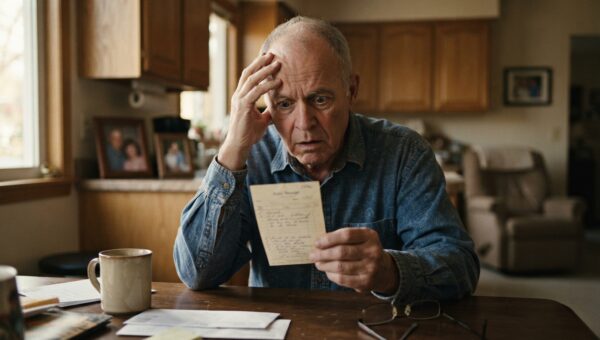
Last winter the letters from the regional bank started coming in yellow envelopes that smelled like damp basements. I kept telling myself I had time, that the bank manager knew me from the Lions Club and wouldn’t pull the plug on an old woman who had lived her whole adult life under the same neon sign.
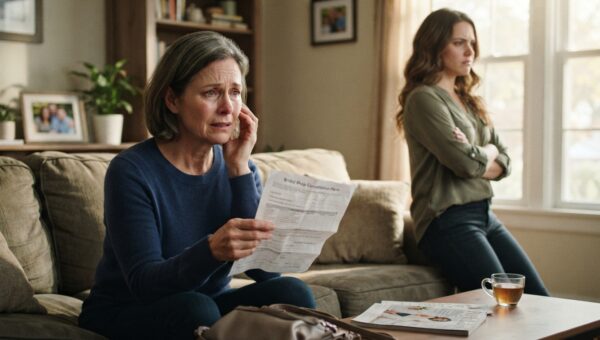
I was wrong about that too. The letter arrived on a Tuesday in late January, setting a hard deadline of March first for fourteen thousand dollars in back taxes and deferred maintenance. Fourteen thousand might as well have been a million when your daily take is twenty-five bucks from a trucker passing through for the night.
The wind was kicking up again that afternoon, carrying the sharp scent of upcoming sleet off the fields as I walked out to the front post to unplug the vacancy sign. My fingers were stiff in my wool gloves, and the rubber on the cord had cracked from years of summer heat and winter frost. I wrapped my hand around the plug, giving it a hard twist to break the ice seal.
A low, heavy purr cut through the wind. A black sedan with state plates turned off Route 9, its tires crunching slowly over the frozen gravel of our drive.
My hand stopped on the cord. I didn’t pull.
The car glided to a stop right in front of the office window, idling with a quiet confidence that didn’t belong anywhere near the Starlite. The driver’s side door clicked open, and a woman stepped out into the freezing slush.
She wore a tailored charcoal wool coat that hit her mid-calf and leather boots that didn’t have a speck of salt on them. But it wasn’t the coat that made my chest tighten; it was the way she held the door of Room 6 open with one hand, looking down at the concrete threshold as if she were reading invisible footprints in the ice.
She turned around slowly, her eyes scanning the faded green siding of the office until they landed on me standing by the pole with the dangling cord.
“I’ve looked for you for thirty-one years,” she said. Her voice was steady, but there was a tremor in her lower lip that told a different story. “The baby you kept warm that week is…”
She stopped, taking a deep breath of the freezing air as if she were trying to anchor herself in the memory.
“I’m Dr. Evelyn Vance,” she said, taking a few steps closer across the frozen gravel. “And I have a feeling you’re about to turn off that sign for good.”
I let go of the electrical cord. It swung down against the wooden post with a dull thud.
“Come inside before you freeze,” I said, my voice sounding older and thinner than I meant it to. “The coffee’s instant, but it’s hot.”
We didn’t talk about the motel or the bank while we walked to the office. Evelyn followed me through the scarred screen door, her eyes taking in every detail of the faded calendar from 2004 hanging by the file cabinet and the green linoleum floor worn thin right where I stood to take reservations.
I poured two mugs from the glass pot that had been sitting on the burner since noon, handing her the chipped white mug with the blue cornflower on the side.
“You haven’t changed your haircut,” she said softly, staring over the rim of her cup. “My mother kept a Polaroid of you standing right in this doorway. She looked at it every time things got hard, right up until the day she passed away three years ago.”
I pulled out the wooden chair behind the counter and sat down, my joints popping in the quiet room. “Your mother was a brave girl. She didn’t want to leave that eleven dollars, but Cecil wouldn’t hear of taking it.”
Evelyn reached into her leather briefcase and pulled out a heavy manila folder, setting it squarely in the middle of the laminate counter where my old green ledger used to sit.
“She told me about the eleven dollars every single year on my birthday,” Evelyn said, unlatching the brass clasps on the folder. “She told me about the heater in Room 6 and the way the man with the gray mustache rubbed my feet because they were blue from the cold. She became a high school history teacher because she believed people remembered kindness the same way they remembered historic landmarks. And she passed that down to me.”
She slid a stack of legal papers across the counter toward my hands. I looked down, expecting foreclosure notices or more bad news from the county seat, but the top sheet bore the letterhead of the State Historic Preservation Office.
“I’m an architectural historian now,” Evelyn continued, her voice gaining strength as she tapped a finger against the paper. “For the past six months, I’ve been heading a state initiative to catalog and preserve vernacular roadside waystations along Route 9. When I pulled the county public filings last week to verify our regional list, I saw your name on the notice of default.”
I swallowed hard, feeling the heat rise in my cheeks. “The bank wants fourteen thousand by March. I don’t have it, Evelyn. This place is all I have left of Cecil, but the bank doesn’t care about thirty-one years of memories.”
Evelyn didn’t look away. She reached across the counter and laid her hand over my knuckles, her skin warm and steady against my arthritic joints.
“The state doesn’t want this place torn down for a truck stop parking lot either,” she said. “Room 6 and this office are officially being designated as a protected mid-century heritage site under our regional development charter. The emergency preservation grant covers exactly fourteen thousand dollars in structural arrears, conditioned on you staying on as the resident historian to help us restore the property.”
I stared at the papers, my brain refusing to line the words up into anything that made sense. “You’re saying the state is paying our debt?”
“I’m saying I spent thirty-one years listening to my mother talk about the two people who saved our lives when we had nothing,” Evelyn said, her eyes bright with unshed tears. “This isn’t charity. It’s preservation. And we have a lot of work to do before March.”
An hour later, the sun dropped below the tree line, casting long, purple shadows across the frozen parking lot of the Starlite Motel.
I walked back out to the front post, my boots crunching in the fresh snow. I reached up and grabbed the rubber plug, sliding the prongs back into the rusted metal outlet on the pole.
The old transformer above my head hummed twice, clearing its throat against the cold, and then the red neon letters of the word V-A-C-A-N-C-Y flared to life, casting a warm, steady crimson glow across the snow outside Room 6.