Forty-two days. That was the exact length of time I had been living with a knot of cold iron sitting right behind my ribs, smiling across breakfast counters and nodding through phone calls while I quietly loaded a spring gun and waited for the trigger to reset itself.
The mail carrier dropped the certified envelope on my front porch on a rainy Tuesday morning in late October.
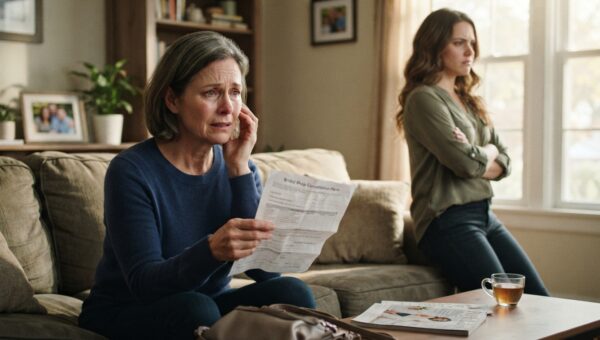
It was a thick manila packet from the regional mortgage processing center, addressed to me at an address I hadn’t lived at in five years, confirming the receipt of my supporting documentation for an eighty-five-thousand-dollar home equity line of credit. I had not applied for a home equity line of credit. I lived in a rented two-bedroom duplex with my seven-year-old son, Leo, and my credit score was the only clean thing I had managed to salvage out of a decade of my family treating my life like their personal overdraft facility.
I opened the packet in the kitchen while the coffee pot was still gurgling. Inside were copies of my driver license, my W-2 forms from the clinic where I worked as an intake coordinator, and a signed authorization letter bearing my signature. Except it wasn’t my signature. It was a sloppy, hurried forgery of the way I used to sign my name back in high school before I learned how to press my pen down with enough weight to make it look like an adult.
Attached to it was a credit inquiry pulled three days prior. The address listed for verification on that inquiry belonged to my brother Marcus. And tucked beneath that was a separate, smaller hit: a soft pull on a secondary credit bureau using my son Leo’s Social Security number, testing the limits of an unblemished file belonging to a seven-year-old child.
My mother called twenty minutes later to ask if I could spot her six hundred dollars for a car repair. She used the same sweet, wheedling tone she had used since I was twelve years old, the one that meant she had already spent the money and was just calling to collect the tribute.
“I’m a little tight this week, Mom,” I had said, my voice steady enough that I almost surprised myself.
“Oh, sweetheart, everyone’s tight,” she had laughed, that light, dismissive chirp that always made me feel like I was taking up too much space in the room. “Just put it on that store card you never use.
You know we’ll pay you back as soon as your father’s commission clears.”
That commission wasn’t coming. Nothing was coming except the quiet realization that my family had been systematically turning my future into grease for their squeaking wheel for years. They had already drained nineteen thousand dollars in revolving credit lines I forgot I even had, using online portal passwords they bullied out of me during a tax-filing weekend two years back. The mortgage application was just the grand finale. They wanted the equity from my duplex down payment to clear out my father’s latest failed landscaping supply venture.
I didn’t cry. I didn’t slam the kitchen counter or smash a mug against the refrigerator. I just walked out to my sedan, drove straight past the clinic, and kept going until I reached the federal building downtown.
The investigator who took my file was a man named Miller with graying temples and a desk that looked like it had survived three different wars.
He didn’t offer me a tissue or tell me how sorry he was. He just looked at the forged W-2, looked at my driver license, and then looked at Leo’s birth certificate with an expression that was entirely devoid of pity, which was honestly the best thing anyone could have offered me at that moment.
“How long do you want to play this out?” Miller asked, tapping a yellow legal pad with a blue ink pen.
“Long enough to make sure they can’t bury the paper trail,” I told him.
“That means letting them keep moving,” he said. “That means dinner parties. Holidays. Phone calls. You have to act like nothing is wrong. If they catch a whiff of panic, they’ll shred the hard copies and claim identity theft by an unknown party.”
So I went home. I picked Leo up from after-school care, made him macaroni and cheese for dinner, and listened to him talk about his third-grade science project while my mind mapped out every forged document sitting in Miller’s metal filing cabinet.
Which brings us to tonight.
The dining room table at my parents’ house smelled intensely of heavy roast beef, artificial butter, and the lilac room spray my mother used to cover up the damp smell of the basement stairs. The floral wallpaper had been peeling slightly at the corner near the china cabinet since I was in middle school, and nobody had ever bothered to paste it back down. It was my thirty-fourth birthday, and the entire production was designed to look like an act of domestic grace.
My father carved the roast with the long-handled electric knife that made a loud, vibrating whine every time he pressed the trigger. My mother bustled around the table carrying bowls of instant mashed potatoes and canned green beans, her bracelets clinking against each other like small, nervous bells. Marcus sat across from me, scrolling on his phone between bites of buttered roll, his thumbs moving at a frantic, rhythmic speed.
“You look tired, Clara,” my mother said, setting a heavy glass bowl of gravy down so hard it splashed onto the lace runner. “You’ve been working too many hours at that clinic. A girl needs to rest. Doesn’t she, Arthur?”
My father didn’t look up from his meat. “She’s got no one to look after her, that’s her problem. Needs a steady hand in the house. A mortgage on that duplex would give her some real stability, get her settled down.”
“Well, we’re working on that,” Marcus muttered, his eyes still glued to his screen. “Everything’s moving on schedule.”
I kept my fork halfway to my mouth, the tusk of gray roast beef resting against the tines. “Is it, Marcus? What kind of schedule?”
“Just family business,” my mother cut in too fast, her smile tightening until the skin around her mouth looked like stretched parchment. “Eat your potatoes, honey. You’re entirely too thin. You look like a ghost.”
The birthday cake sat on the sideboard behind my chair, a lopsided white sponge cake with pink buttercream roses that my mother had picked up from the grocery store bakery because she knew I hated chocolate. The plastic plaque on top said *Happy 34th Clara* in blue gel icing that was already starting to sweat under the kitchen lights.
“We need to cut the cake before Leo gets sleepy,” I said softly, standing up from my chair and walking over to the sideboard.
I picked up the silver-plated cake knife. It was an old wedding present from a marriage that had dissolved six years ago, one of the few things I had kept because the handle was heavy and solid in the hand. I brought it back to the table, positioning myself right between my father’s chair and Marcus’s elbow.
That was when the whisper happened. It wasn’t even subtle. My mother leaned across the gravy boat, her breath smelling faintly of peppermint and cheap sherry, and murmured directly into my father’s ear.
“Tell Marcus to go change the locks on her apartment.”
My father gave a single, sharp nod and poked Marcus under the table with his fork handle. Marcus looked up, shoved his phone into his hoodie pocket, and reached down for the set of brass keys that sat right beside his water glass, the spare set I had foolishly handed over three years ago when they offered to water my ferns while I went to a conference in Denver.
“I got to run out for a second,” Marcus said, standing up so fast his chair legs screeched against the linoleum. “Forgot something back at my place. Be right back for cake.”
“Don’t take too long, son,” my father said, carving another thick slab of meat with a greasy flourish. “We want to get through dessert before the local news comes on.”
I watched Marcus grab his jacket off the back of the kitchen chair and walk out the front door, the screen door slamming behind him with its familiar, spring-loaded twang. He was heading straight for his gray sedan parked in the driveway, fully intending to drive across town, let himself into my duplex with the stolen spare key, and secure the physical perimeter for the fraudulent home equity line of credit before I got home to notice my deadbolts had been swapped out.
What he didn’t know, what none of them knew, was that four unmarked federal vehicles were currently parked three houses down the street, their engines cut and their lights off in the gathering November gloom. Miller had briefed me on the protocol at four o’clock that afternoon: the moment Marcus crossed the threshold of my apartment with the intent to execute a fraudulent takeover under false pretenses, the trespass charge would lock in alongside wire fraud and identity theft.
I turned back to the table, holding the heavy silver cake knife in my right hand. I didn’t sit down. I just stood there beside my mother’s chair, looking down at the white sponge cake with its melting blue lettering.
“Sit down, Clara,” my mother said, her voice dropping an octave as she noticed I hadn’t moved. “The cake’s going to get warm.”
“It’s fine, Mom,” I said. My voice didn’t shake. It had the flat, level sound of a winter morning when the thermometer bottoms out and everything is locked solid in the frost. “Actually, we aren’t going to have cake just yet.”
My father stopped chewing. His jaw stayed halfway open, a piece of gray beef visible on his tongue before he slowly closed his mouth. “What are you talking about? Sit down and cut the cake.”
“Marcus isn’t coming back for cake,” I said.
The silence that settled over the dining room wasn’t the comfortable quiet of a family finishing a Sunday meal. It was the heavy, airless stillness of an elevator cable snapping halfway between floors. My mother’s hand froze mid-reach toward the gravy boat, her fingers trembling slightly against the ceramic rim.
“What did you just say?” she whispered, her voice thinning out into a reedy rasp.
“I said Marcus isn’t coming back,” I repeated, turning the cake knife over in my hand so the flat of the blade caught the light from the overhead fixture. “He went to change the locks on my apartment, remember? Only he’s going to have a little bit of trouble getting inside. Agent Miller and three of his associates are already waiting in the hallway. They’ve had a warrant for his arrest since four o’clock this afternoon.”
My father stood up so fast his chair tipped over backward, crashing against the floral wallpaper with a loud, hollow thud. “You out of your mind? You calling the police on your own brother?”
“Not the police, Dad,” I said, looking right into his eyes for the first time in five years, seeing the exact moment the panic hit him behind his bifocals. “The federal marshals. It turns out that forging a signature on a home equity line of credit isn’t just a family disagreement. Especially when you use a federal postal route to mail the application.”
My mother let out a sharp, choking sound, her hands flying up to cover her mouth as if she could physically push the words back down her throat. “Your own family. After everything we did for you. After we raised you, “
“You didn’t raise me, Mom,” I said, my voice dropping until it barely carried across the room, steady and cold as a pump handle in January. “You used me. You used my credit, you used my name, and today you tried to lock me out of the only place my son and I have left to sleep.”
The front doorbell didn’t ring. It was a heavy, rhythmic pounding against the wooden frame, three solid knocks that had the unmistakable weight of government boots behind them.
My father turned toward the hallway, his face turning a mottled, grayish purple, his mouth working silently like a fish pulled up onto dry dock. My mother slumped back down into her chair, her fingers clawing frantically at the lace tablecloth until the whole setting slid an inch to the left.
I didn’t look at them again. I laid the heavy silver cake knife down right beside the untouched slice of roast beef on my plate, wiped my fingers on my napkin, and left it there on the table.
The front door of my parents’ house was already opening as I walked down the narrow hallway, the cool night air rushing in to chase away the smell of lilac spray and hot grease. I stepped past two dark-jacketed investigators standing on the porch and walked down the concrete walkway toward my car, leaving the door wide open behind me.