The heavy brass latch on my front door clicked shut with a solid, final sound, and for the first time in three days, the silence in my house felt like my own. Grandma had been gone for exactly ninety-six hours. Her wooden rocking chair still sat by the south-facing window in the parlor, the embroidered cushion slightly depressed on the left side where she always leaned her weight when she was shelling peas or darning socks.
I had not touched it. I could not bring myself to walk past it without half-expecting her to look up over her bifocals and ask me why I was moping around like a stray dog.
My mind kept pulling backward, past the quiet hospital room where her breathing finally smoothed out into nothing, all the way back to the autumn of my tenth year. That was the year the world narrowed down to a single suitcase left on a gravel driveway. My mother had married a man named Dale, a man who possessed thick, oiled hair and a booming laugh that always sounded like it was being performed for an audience that wasn’t there. Within six months, they had a baby boy they named Julian, a child my mother immediately anointed as some kind of small, living god. I was ten, old enough to be in the way, old enough to remember what a normal kitchen felt like before the shouting started, and old enough to be discarded without a backward glance.
Grandma didn’t ask questions when she drove her old station wagon down our lane and found me sitting on my cardboard box by the mailbox with my winter coat clutched in my lap. She just put the gearshift into park, climbed out with her joints popping, and hoisted the box into the trunk. “Get in, Clara,” she had said, her voice like gravel rolled in honey. “We don’t pick favorites in my house, and we certainly don’t leave good things sitting by the road.”
For twenty-one years, that house with the sloping porch and the smell of boiled coffee and peppermint tea was the only universe that mattered. Grandma didn’t have much money, but she had a spine made of old iron and a heart that took in every stray thing that wandered onto her property. She taught me how to can tomatoes, how to balance a ledger down to the penny, and how to stand up straight even when my knees were shaking.
We built a life out of quiet routines and heavy quilts, a life where my mother was nothing more than a bad memory fading around the edges like an old photograph left too long in the sun.
Then Grandma caught the pneumonia that was going around the county, and three weeks later, she was gone. The funeral had been a blur of black wool coats and damp cemetery grass, populated mostly by neighbors who brought casseroles in disposable aluminum pans and spoke to me in hushed, careful tones. I sat in the front pew of the little Methodist church, staring at the grain of the wooden bench, feeling as though the floor beneath me had turned into dry sand.
And then came the knock.
It was a Tuesday afternoon, just past two o’clock. The sky over the valley was the color of a wet slate roof, low and heavy with the promise of sleet.
I was standing at the kitchen sink rinsing out the coffee pot when the rapping started at the front door. Three sharp, confident raps that didn’t sound like a neighbor bringing over a leftover ham or the mail carrier dropping off a package.
I dried my hands on my jeans, walked down the narrow hallway past Grandma’s rocking chair, and pulled the door open without checking the peephole.
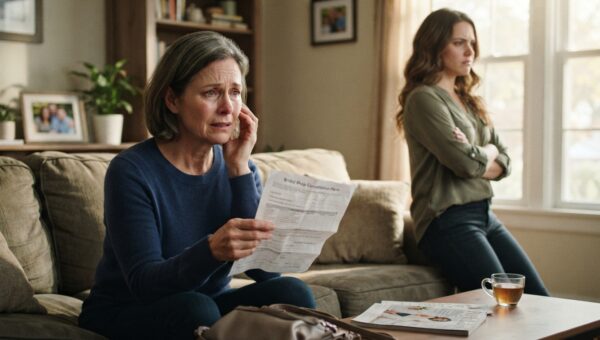
Standing on my porch was a woman who looked like a ghost assembled from old memories and expensive face cream. Her hair, once a dark, glossy chestnut, was now heavily frosted with silver, teased up into a stiff shell that refused to move even in the damp breeze coming off the fields. She was wearing a camel-hair coat that looked too heavy for her shrinking frame, and her lips were painted in that exact shade of hard, defensive red I remembered from twenty-one years ago.
“Well, Clara,” my mother said, stepping forward before I could even draw breath. “Aren’t you going to invite your own mother inside? It is freezing out here, and I’ve been driving for three hours.”
I didn’t move. My hand stayed flat against the interior edge of the doorframe, my fingers curling around the wood until the grain bit into my skin. My brain felt like it was trying to wade through thick mud, refusing to connect the woman standing on my welcome mat with the person who had driven away in Dale’s station wagon two decades ago.
“You have the wrong house,” I said, my voice sounding strange and thin in my own ears. “My mother died on Thursday.”
Her face twitched, a tiny, involuntary spasm of irritation that she quickly smoothed over with a practiced, tragic smile. “Oh, don’t be dramatic, Clara. I know you’re upset about Mother. It’s been a terrible week for all of us. But family is family, and a mother doesn’t just stop being a mother because of a few misunderstandings over the years. May I come in? My hip has been acting up since the turnpike.”
She didn’t wait for an answer. She simply sidestepped my shoulder, brushing past me with a faint cloud of heavy, amber-scented perfume that filled the hallway and instantly turned my stomach. It was the exact same smell I remembered from the morning she left me behind. She walked straight into the parlor as if she owned the mortgage, her low-heeled boots clicking sharply against the hardwood floor.
“My word, Clara,” she said, looking around the room with a critical eye. “You haven’t changed a thing. Mother always was so hopelessly stuck in the past with this furniture. We’ll have to get some brighter curtains in here. And the kitchen is twice the size we need once we clear out some of her old junk.”
We.
The word hung in the air between us like a dirty rag. I closed the front door slowly, the heavy latch clicking shut with a finality that made her pause and turn around. I walked back into the parlor, staying by the doorway, my arms folded tightly across my chest.
“Who is we?” I asked.
My mother sighed, a theatrical, long-suffering sound that she used whenever she wanted to make everyone else in the room feel unreasonable. She tossed her coat over the back of Grandma’s rocking chair, exposing a beige silk blouse that had a faint grease stain near the hem. “Me, of course. Where else would I go? Dale passed away three years ago down in Florida, you know. And Julian… well, Julian has his own life now. Big house out in Scottsdale, very successful in real estate. But he has his own family to worry about, and frankly, his wife is high-strung. A bachelor apartment isn’t any place for his mother.”
There it was. The exact shape of her desperation, wrapped in excuses and delivered with the casual entitlement of someone who believed the world still owed her a debt. Her golden boy, the perfect son for whom I had been discarded like a cracked teacup, had taken her money, watched her sell her house, and then quietly eased her out of his life when she became an inconvenience.
“Julian didn’t even come to the funeral,” I said quietly.
My mother’s chin went up, a defensive shutter coming down over her eyes. “Julian sent a very generous floral arrangement. You saw it, didn’t you? The white lilies? They cost over two hundred dollars. But he’s a busy man, Clara. He has contracts to close. He can’t just drop his entire life because an old woman passed away in the middle of Iowa.”
“Grandma wasn’t an old woman to me,” I said. “She was my mother. You stopped being mine twenty-one years ago when you put me on the porch with a cardboard box.”
She scoffed, waving a manicured hand dismissively through the air. “Oh, for heaven’s sake, are you still harping on that? You were a difficult, sullen child. Dale didn’t want the tension in the house, and quite frankly, neither did I. Mother offered to take you off our hands, and it was the best thing that could have happened to you. Look at you. You grew up fine. You have this whole house now that Mother’s gone. It’s paid for, isn’t it? The deed was always in her name.”
The room seemed to shrink around us. The dust motes floating in the gray afternoon light looked like tiny pieces of ash. I thought about the little girl I used to be, sitting on the bottom step of the stairs with my knees pulled up to my chin, listening to the muffled sound of my mother laughing in the kitchen while I tried to figure out what I had done wrong to deserve being erased.
“I remember the last time I tried to give you something,” I said. My voice didn’t shake. The anger had burned down so low and steady that it felt like cold iron. “I was eleven. We came to that family dinner at your house in town. I had spent three days making a card out of construction paper and glitter glue. I walked right up to you while you were sitting at the dining table, and I handed it to you.”
My mother blinked, genuinely confused for a second, trying to drag up twenty-one years of selfish memories from a brain that only ever cataloged her own grievances. “A card? What on earth are you talking about?”
“You didn’t even look at it,” I said, stepping further into the room. “You took it out of my hand, turned around, and handed it to Julian like he was the one who deserved it. I stood there and told you, ‘I got that for you.’ And do you remember what you said?”
Her silence was the only answer I needed. The red on her lips seemed to stand out too brightly against her pale, tight skin.
“You laughed,” I whispered, the words tasting like copper in my mouth. “You looked right at me and said, ‘Oh, what would I need that for? I have everything I want.’ Then you told me to go sit in the kitchen with the coats.”
“Clara, really, this is ridiculous,” she snapped, her voice rising in a sharp, brittle register. “Bringing up ancient history because you’re bitter that Mother left the property to you instead of some charity. I’m telling you, things were complicated back then. Dale was under a lot of pressure at the lumber yard. We had a baby to think about. A mother has to make hard choices.”
“You made your choice,” I said. “You chose Julian. You chose Dale. You chose a life where I didn’t exist unless it was convenient for you to forget I was out here.”
She took two steps toward me, her hands reaching out in a pathetic, pleading gesture that looked entirely rehearsed. “I’m older now, Clara. My knees are bad. I sold the condo in Des Moines to help Julian with his new venture, and things… well, things didn’t work out the way we planned. I don’t have anywhere else to go. We’re family. We’re all we have left.”
The irony of it sat between us like a physical weight. For twenty-one years, I had been nothing to her. Now that her golden investment had crashed and burned, now that she had nowhere to turn and no one left to exploit, she had tracked down the ghost she left behind, expecting the same unconditional love Grandma had given me. She expected me to open the spare bedroom, cook her meals, and wipe her brow in her old age, all while pretending that a handmade card never ended up in the trash bin of a house I wasn’t allowed to stay in.
“No,” I said.
She stopped moving. Her hands hovered in the air for a second before dropping slowly to her sides. “What did you say?”
“I said no. You don’t live here. You don’t stay here. You don’t walk through this door.”
Her face went from tight denial to genuine, ugly fury in less than a second. The mask slipped completely, revealing the small, bitter woman underneath who had spent a lifetime blaming everyone else for the mess she made of her own house.
“After everything I did for you?” she hissed, her voice dropping into a venomous register. “Taking you in, letting Mother raise you so you wouldn’t starve? You ungrateful, cold-hearted little, “
“Grandma raised me,” I interrupted, cutting her off cleanly. “You abandoned me. There is a difference. And now you’re finding out what it feels like to be the one standing on the outside with nowhere to go.”
I walked over to the back of Grandma’s rocking chair, picked up her heavy camel-hair coat by the collar, and carried it across the room. I didn’t throw it at her. I laid it neatly over the back of the small wooden chair by the front door, right where visitors who weren’t staying long were supposed to wait.
“Your car is still running in the driveway,” I said, pointing toward the window where the gray exhaust was pluming up into the cold Iowa air. “The turnpike goes both ways. You can make it back to Des Moines before dark if you hurry.”
She stood in the middle of Grandma’s parlor, her chest heaving, her mouth half-open as she searched for some weapon, some final cruel remark that would pierce the armor I had spent twenty-one years building. But she had nothing left. The golden boy had taken everything and locked her out, and the daughter she threw away had learned too well how to stand alone.
“You’ll regret this,” she whispered, her voice shaking with impotent rage as she snatched her coat off the chair. “When you’re old and alone like I am, you’ll realize what you threw away.”
“I was already old and alone at ten years old,” I said. “And Grandma taught me how to survive it.”
She didn’t say anything else. She turned on her heel, her low heels clicking furiously against the floorboards, and yanked the front door open. The cold wind rushed into the hallway, smelling of wet earth and winter rain. She stepped out onto the porch, turning back once with a look of pure, unadulterated venom before slamming the door behind her with a crack that shook the picture frames on the wall.
I stood there in the quiet hallway for a long time, listening to the crunch of tires spinning on the gravel driveway as her sedan backed out toward the road. The engine noise faded slowly, swallowed up by the vast, empty quiet of the fields.
I walked back into the parlor and stood beside Grandma’s rocking chair. The embroidered cushion was still warm from where her coat had rested, or perhaps it was just my imagination playing tricks on the grief that was still sitting heavy in my chest. On the mantelpiece above the cold brick fireplace sat a small, framed photograph of Grandma taken back when her hair was still dark and her smile was fierce enough to scare off the devil himself.
I reached out and touched the edge of the wooden frame. Her steady, painted eyes looked back at me with complete, unwavering approval.
The heavy brass latch on the front door was firmly set. The house was quiet. And for the first time in my life, the weight I was carrying didn’t belong to anyone else.