The notification on my screen popped up at 6:14 in the morning, right as the coffee maker finished sputtering its last brown drops into the glass carafe. It was just a simple text from the delivery service about a misrouted package left at the wrong threshold on my block. Usually, I would have just shaken my head, texted the neighbor across the courtyard, and gone about my quiet Tuesday routine.
But this box had my father’s old surname scrawled across the shipping label in heavy black marker, and my father had been resting under a granite marker in the cemetery outside Syracuse for nearly six years.
I walked down the concrete steps of my building in my slippers, the morning air carrying that damp, iron-cold bite that always hits upstate New York before the sun clears the ridge. The box sat squarely on the neighbor’s welcome mat, wrapped in brown paper that smelled faintly of cedar and dry basement air. When I hauled it up to my kitchen table and sliced through the packing tape with a dull butter knife, I figured I was looking at some forgotten paperwork from his old real estate office. Instead, I pulled out a single silk ribbon, faded to the color of dried tea, and a paper playbill stub dated July 1974.
The performance date stamped on the ticket was three weeks after the exact date my mother had always claimed Thomas was lying unconscious in a hospital bed following a violent highway collision.
According to every story I had heard growing up, my father had spent that entire summer strapped to monitors in a sterile white ward while my mother prayed beside him with my unborn sister tucked quietly beneath her apron. But this little scrap of cardstock had writing on the back in my mother’s unmistakable hand. She wrote with small, tightly looped letters all her life, the kind of handwriting that looked like rows of neat little waves rolling onto a beach.
I read the note four times while the kitchen grew dead silent except for the hum of the refrigerator. It gave a specific hotel address in a bustling city neither of my parents ever claimed to have visited back then, asking simply if a Mr. Thomas had ever stayed there under a company account. My chest tightened up in that strange, hollow way it does when you realize the floor you are standing on is suddenly made of glass.
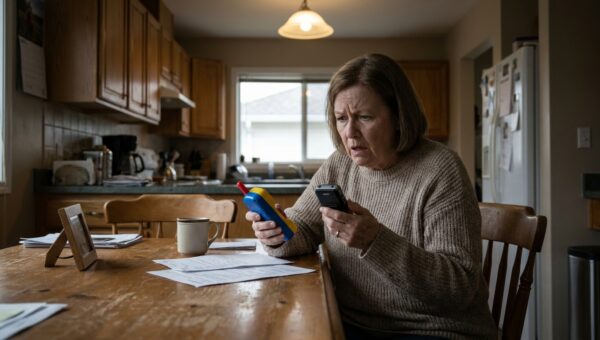
I didn’t even wait for a decent hour in the morning; I pulled my phone from my pocket and dialed the number I had looked up online for that old hotel address, which the internet told me was now a regional commercial bank branch.
The manager put me on hold for what felt like hours, the tinny canned music scratching through my tin speaker while my thumb traced the frayed edge of the silk ribbon. When he finally came back on the line, his voice was polite, measured, and entirely unbothered by the decades that had passed since that summer. Yes, he eventually told me, looking through the digitized ledger archives they kept in the basement storage. For almost a month that same summer, a reservation had been logged under that exact name, and it was made by someone whose identity fundamentally reordered every historical milestone our family had ever celebrated.
I sat down right there on the tiled kitchen floor, my knees refusing to carry my weight any longer as the room seemed to tilt slightly on its axis. Inside my father’s old leather wallet, which rested at the very bottom of the shipping box beneath a pile of yellowed insurance claim forms, I found a train pass from the central terminal and a crisp twenty-dollar bill. Tucked right behind the worn currency was a handwritten note in a completely different, jagged handwriting that said simply, This is all for him. I stared at the numbers on the train pass until they blurred together into gray smears against the faded leather.
I looked at the date on the ticket again, calculating the timeline with a sick, heavy certainty settling deep in the pit of my stomach. It was only six months before my younger sister was born, right in the thick of the winter freeze when our family legend insisted everything was stable and whole. My mother had always told us that pregnancy was a quiet time of recovery, a time when our household slowly stitched itself back together after my father’s brush with death on the asphalt. But the mathematics of grief and timing rarely lie when you finally lay the actual receipts out in the open daylight.
My hands were shaking as I picked up an old yellowed envelope that had slipped out of the box and landed near the baseboard heater. There was a faded phone number scribbled in the margin near the return address, written in the same jagged ink as the note tucked inside the wallet. I didn’t think about what I was doing; I just let momentum carry my fingers across the keypad, pressing the digits one by one until the line began to ring in my ear. A raspy, elderly voice answered on the third ring, sounding like old paper rubbing together in a drafty room.
I gripped the phone tightly against my ear, listening to the static hiss of the long-distance connection before I finally let the words slip past my lips. My father was not alone that summer, was he? I asked the stranger on the line, the question hanging in the quiet kitchen like a physical weight. The woman on the other end didn’t gasp or slam the receiver down in shock; she just let out a long, slow sigh that sounded like someone laying down a heavy bundle they had been carrying for half a century.
She told me about a quiet house near the river, about a second household that existed entirely outside the margins of our official family tree, and about an arrangement made out of sheer desperation and quiet compromise. My father’s month-long absence in 1974 was not due to a medical coma from a crash at all, but a deliberate separation orchestrated during a family crisis involving a prior entanglement. A separate household had provided for him temporarily while my mother managed her pregnancy alone, a reality she apparently knew and quietly endured with that stubborn, tight-lipped grace she wore like armor until her dying day.
The phone call ended softly, with the click of the line disconnecting and leaving me alone in the quiet kitchen with my coffee getting cold on the counter. I didn’t scream, and I didn’t cry the way people do in the movies when their entire world collapses into ash. I just felt a strange, heavy peace settle over me, like the cold realization that comes after a long storm finally passes and you look out to see what is left standing. My parents were never the saints or the tragic victims the family mythology had painted them to be; they were just two flawed, desperate people trying to navigate a messy life with whatever tools they happened to have in their hands.
Later that afternoon, my sister came over with groceries, her usual cheerful chatter filling the hallway before she even pushed the door open. I didn’t tell her everything all at once over the kitchen table, but I poured us both a cup of tea and slid the faded 1974 play ticket across the laminate surface toward her. We spent three hours sitting there together, talking through the pieces of a puzzle we never even knew we were supposed to be solving. Instead of shattering our bond, the truth somehow drew us closer, bridging the gap between the sisters we thought we were and the real history we actually came from.
When the sun finally dipped below the ridge and cast long, orange shadows across the hardwood floors, I walked over to the bedroom dresser and pulled open the top drawer. I gently placed the faded 1974 play ticket stub and the old silk ribbon side by side among my folded linens, smoothing out the frayed edges with my thumb. I closed the drawer quietly, letting the afternoon light fade into the quiet corners of the room as I finally let the ghosts of that summer rest.