PART 1
The printer jammed at 6:45 PM on a Tuesday, and I stood there listening to the plastic rollers groan while the rest of the floor cleared out. Most people at Apex Logistics were out by five, especially on the administrative floor. But I stayed because the Q3 regional restructuring projections were mine. Every cell of the spreadsheet, every column tracking driver retention rates across the tri-state area, and every tiered cost-reduction model had been built on my dual-screen setup over the previous four months.
My brother-in-law, Julian, walked past my cubicle with his coat slung over his shoulder, tapping his phone screen with a thumb ringed in heavy silver. Julian had been married to my sister Sarah for twelve years, and for ten of those years, he had drifted through mid-level sales jobs before stumbling into a corporate liaison role. Six months ago, through a combination of executive restructuring and casual golf games with the regional vice president, Julian had been parachuted into the position of department director. Suddenly, he was my boss.
“Marcus,” he said, pausing and leaning against the partition with a casual smirk. “Still tinkering with those numbers? Don’t overcomplicate it. The executives want clean lines, not a textbook.”
“These aren’t random numbers, Julian,” I said, leaning back from my monitor. “If we shift the regional dispatch hubs as I outlined in section four, we save four hundred thousand dollars in overhead annually.
It keeps the drivers from burning out and stops the client churn in Dayton.”
Julian waved a hand dismissively, his diamond-accented watch catching the fluorescent ceiling light. “Right, right. Streamlining. Just email me the master file by tomorrow morning. I am taking it into the executive steering committee at noon. I will present the framework and give you a brief nod during the opening slide.”
I felt a familiar, dull knot tighten behind my ribs. For three years, I had kept the Cincinnati office stable through two botched software migrations and a massive supply chain crunch, all while Julian played golf and collected bonuses. But I nodded because Sarah was my sister, and family dinners were already strained enough without me starting a turf war at corporate.
“Make sure the formatting matches the corporate template,” Julian added over his shoulder as he walked toward the elevators. “I want my name on the lead author line for the distribution packet.
Optics matter, Marcus. You are operations; I am strategy. That is how the board sees it.”
I watched him go, feeling that cold settling in my stomach. I turned back to my dual monitors and hit save on the final document, watching the timestamp read 7:12 PM. Then I packed my briefcase, locked my desk drawer, and drove home to a quiet house where my wife was already asleep.
The next morning, I arrived at the office at seven to put the finishing touches on the appendix. When I sat down and tapped my spacebar to wake the terminal, the screen flashed a gray dialogue box: ACCESS RESTRICTED. USER CREDENTIALS REVOKED BY SYSTEM ADMINISTRATOR.
My office phone buzzed three seconds later. It was HR compliance.
“Marcus,” a dry voice said. “Can you come down to conference room B? Julian and corporate legal need a word regarding your terminal activity.”
PART 2
I walked down the carpeted corridor with my coffee cup still warm in my hand, though my throat felt entirely dry.
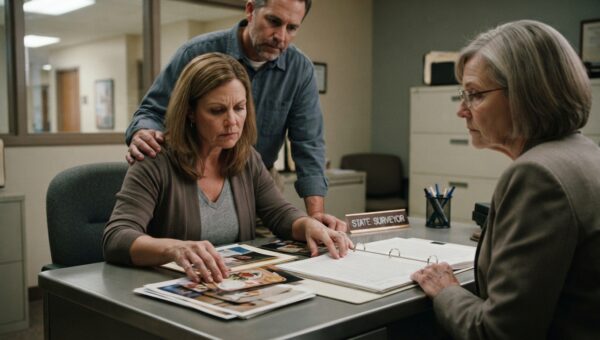
Conference room B had glass walls that looked out over the loading docks, and through the frosted panels, I could see Julian sitting at the head of the mahogany table. He had his suit jacket off, his sleeves rolled up to his forearms, and a grave, burdened expression plastered across his face. Beside him sat Brenda from human resources and a corporate attorney named Vance whose firm Apex retained for liability issues.
I pulled out a chair across from them and set my coffee down. “What is this about?”
Julian looked at Brenda, shaking his head with a display of deep disappointment. “Marcus, I didn’t want to bring this to formal channels. I really didn’t. But when IT flagged the irregular file transfers on your workstation last night, we had to look closer.”
“Irregular file transfers?” I repeated.
Vance, the attorney, slid a printed log across the table. It showed a series of downloads from the main server onto an external drive at 7:14 PM the previous evening.
“Company policy is strict regarding proprietary restructuring blueprints,” Vance said, his voice flat and professional. “This department strategy, which Director Vance compiled for the executive committee presentation at noon today, represents four hundred thousand dollars in intellectual property. Transferring those drafts to an unauthorized external storage device right after being denied administrative clearance constitutes a serious breach of confidentiality and potential industrial theft.”
I stared at the paper, feeling the surreal weight of the accusation pressing down on my chest. “Denied clearance? I built this file. Every formula in that spreadsheet was generated on my desk over the last four months. Julian didn’t even know what an integer-programming model was until I explained it to him over Thanksgiving.”
Julian winced, running a hand over his face. “See? This is what I mean, Brenda. He is volatile. Ever since I got the director promotion, he has been acting resentful about the hierarchy. He thinks because we are family, he can claim ownership of department-wide strategy. But the truth is, Marcus missed his targets last quarter, and now he is trying to walk out with our intellectual property to sell to a competitor.”
Brenda looked at me with heavy, practiced sympathy. “Marcus, your terminal has been locked pending an internal inquiry. We are offering you a clean resignation by end of day, effective immediately, which allows us to waive further legal action regarding the data theft. Your $48,500 annual performance bonus, naturally, is forfeited due to the disciplinary review.”
They had mapped it out down to the hour. The executive committee presentation was at noon. Julian would present my exact restructuring plan, take full credit for saving the firm $400,000, secure his promotion to vice president, and pocket the $48,500 bonus tied to the project metrics, while I was thrown out the back door as a disgruntled thief.
I looked at Julian across the table. He was watching me with a steady, unblinking gaze, waiting for me to break, to yell, to confirm their narrative of the unstable subordinate.
“Is that your final position?” I asked, my voice dropping an octave.
“It is the company’s position, Marcus,” Brenda said, sliding a termination agreement across the table. “Please sign it by ten o’clock.”
PART 3
I stood up, leaving the coffee cup on the table and the termination agreement untouched. “Keep the paper,” I said. “I am going back to my desk to pack my mug.”
“Marcus, security will escort you if you attempt to access the floor,” Vance warned.
“I don’t need the floor,” I said. “I need the parking lot.”
I walked out of conference room B, ignored the security guard hovering near the elevators, and took the stairwell down to my car. Once inside my sedan, I pulled out my laptop and tethered it to my phone hotspot.
They thought they owned the data because they locked me out of the corporate server at 7:00 AM. They assumed that because Julian held the administrative credentials, he held the entire history. But they didn’t know about the automated backup script I had written six months ago after watching a previous manager wipe a shared drive out of spite. Every keystroke, every version history, every timestamped formula revision, and every email draft proving my authorship was automatically mirrored to a secure, encrypted personal cloud repository that required my biometric key to access.
I opened the repository, sorted the files by modification history, and generated a comprehensive forensic metadata report. It showed Julian opening my blank master file at 9:00 AM the previous day, renaming it with his own author tag at 4:30 PM, and attempting to purge my local access logs at 6:50 PM just before the printer jammed.
I checked the clock. It was 10:45 AM. The executive committee presentation started in seventy-five minutes on the fourth-floor executive board room.
Instead of calling HR back, I opened my corporate email client, bypassed the local server route through my secure tunnel, and addressed a single message directly to the three members of the board of directors, the company CEO, and corporate compliance.
Subject: Forensic Audit and Authorship Verification for Q3 Restructuring Initiative.
Inside, I attached the complete metadata trail, the raw version histories, and a short, plain statement of facts. I did not rant. I did not accuse Julian of malice. I simply attached the unalterable digital footprint showing that every financial projection, dispatch model, and cost-saving metric was created, edited, and finalized by me over a four-month period, alongside the morning transcript from conference room B where Julian and legal attempted to force my resignation.
At 11:55 AM, as I sat in my sedan in the parking lot eating a cold sandwich from the console, my phone started vibrating against the passenger seat. It didn’t stop.
First came a text from Brenda in HR: *Marcus, please do not leave the building. Executive leadership has paused the noon presentation.*
Then a text from Sarah: *What on earth is going on? Julian just came out of the boardroom white as a ghost and security is packing up his office. Call me right now.*
I let the phone buzz. I watched through the windshield as two corporate security guards walked out of the glass lobby doors, carrying a heavy cardboard box filled with desk ornaments, a framed family photo, and a heavy silver watch collection. Julian followed them, his suit jacket wrinkled, his head down, refusing to look toward the parking lot.
ENDING
Two days later, the corporate compliance office emailed me a formal retraction letter and an updated compensation statement. The $48,500 performance bonus was reinstated in full, along with an immediate lateral promotion to senior operations director—the exact title Julian had been occupying. Furthermore, internal audit had formally noted the falsification of corporate reports, resulting in Julian’s immediate termination without severance.
My sister Sarah called me on Sunday morning, her voice tight and defensive, trying to explain that Julian had simply been under a lot of pressure because of their new mortgage and the expensive private school tuition for their kids.
“He made a mistake, Marcus,” she said through the speakerphone. “Can’t you talk to the board? Family doesn’t do this to family.”
“Sarah,” I said, looking out my kitchen window at the maple tree in the yard. “He tried to strip my livelihood and brand me a thief to cover his own incompetence. That isn’t a mistake. That’s a choice.”
“So you’re just going to cut us off?” she asked, disbelief sharpening her tone.
“I am going to keep doing my job,” I said. “Goodbye, Sarah.”
I hung up the phone, placed it face down on the wooden kitchen table, and picked up my coffee mug. The house was entirely quiet, and for the first time in three years, the numbers on my desk belonged to me.