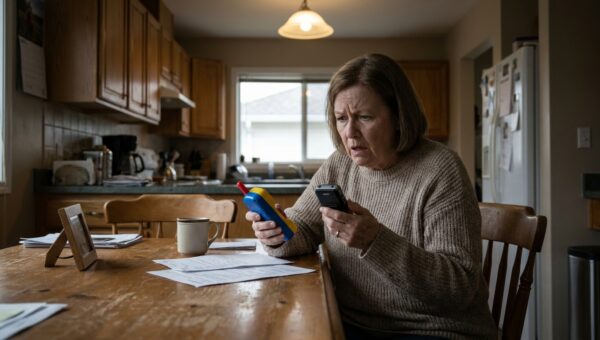
The cold greasy smell of the airport parking deck was still stuck in the back of my throat when my phone started buzzing against the dashboard. I’d barely set my suitcase down in the hallway of my house in Atlanta after a trip to see my sister in Savannah, and my hands were still shaking from the traffic on I-85.
When I flipped the screen over, Alton’s name was blinking at me. Alton never called on a Tuesday afternoon unless the lawn mower threw a belt or he wanted me to babysit the golden retriever they’d bought after their third anniversary.
I hit speakerphone and tossed my keys onto the chipped maple counter. “Hello, Alton.”
“You need to find your unstable daughter,” he said. He didn’t say hello. His voice had that flat, ironed-out sound he used whenever he was trying to convince people he was the smartest person in any room. “She’s been gone ten days.”
The kitchen went dead quiet except for the hum of the refrigerator. My brain didn’t catch up to the words right away. Ten days? Deline called me every single Sunday at 2:15 in the afternoon without fail. Even when she had strep throat last winter, she’d croaked out five minutes of weather and grocery prices just so I wouldn’t worry.
“What do you mean, ten days?” I asked, my voice dropping an octave the way it always did when I was trying not to scream. “Where is she?”
“Packaged up her things and walked out last Monday,” he said, sounding annoyed like she’d left the garage door open in the rain. “Took her car. Left a note on the island. I figured she went up to your place or down to the coast to clear her head. But she’s not answering my texts.”
My chest tightened so hard I had to grip the edge of the laminate counter with both hands. “If she left last Monday, Alton, why in God’s green earth are you only calling me today? Why didn’t you call the police?”
There was a long pause on the other end, the kind of heavy, oily silence that tells you a lie is being manufactured in real time.
“She’s not my problem,” he answered.
The click of the disconnect sounded like a pistol shot in the empty house.
I didn’t cry. Mothers like me, who raised girls in towns where the factories closed down and left everyone to fend for themselves, don’t waste time leaking water when the roof caves in.
I grabbed my phone back up and dialed my brother Garrison before my thumb could even stop shaking. Garrison didn’t work local patrol anymore. He spent twenty-eight years sitting behind gray metal desks in Atlanta and Washington doing things he never talked about, until he retired to a cabin up in the Blue Ridge. But he still had friends who liked returning favors.
“Lois,” Garrison answered on the second ring. “You sound like you swallowed a hornet.”
“Deline’s missing,” I said. I didn’t bother with a greeting. “Alton says she’s been gone ten days. He didn’t call the law. He told me she wasn’t his problem.”
Garrison was quiet for three seconds. Then I heard the scrape of a wooden chair legs against a floorboards. “Pack an overnight bag. I’m coming down to your place right now. Don’t call Alton back. Don’t post anything on Facebook. Just wait for me.”
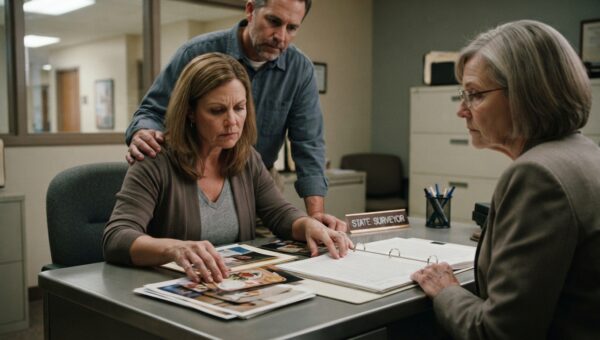
Two days later, Garrison slid a photograph of an ordinary brick house across my kitchen table.
The coffee in my mug had gone cold enough to grow a skin on top. I looked down at the glossy 4x 6 print. It showed a small, single-story rancher with dark red brick, white aluminum siding around the eaves, and an overgrown patch of dry ornamental grass where a flowerbed used to be. There were no curtains in the front window. Just a reflection of a telephone pole and gray sky.
“That’s out on county road twelve,” I said, my voice barely a whisper. “Past the old grain elevator where nobody goes.”
“It’s not listed in Alton’s name,” Garrison said, tapping the corner of the photo with a thumbnail bitten down to the quick. He had lines around his eyes I hadn’t noticed at Thanksgiving. “He bought it four months ago under a dummy LLC registered out of Delaware. Paid cash through a commercial title company in Savannah. No mortgage. No public record linking him to the deed unless you know which filing cabinets to pry open.”
I looked from the photo up to my brother’s face. Garrison looked irritated, not afraid. That was his FBI face. When Garrison got calm like that, someone was about to have a very bad week.
“Why would Alton buy a rundown brick house on the edge of town?” I asked.
“Because Deline found out what he was doing with her inheritance,” Garrison said softly. “The money your mother left in trust when she passed. Alton didn’t invest it in commercial real estate like he told Deline at the kitchen table. He liquidated every last share of those blue-chip stocks to cover margin calls on a bad land deal he made over in Macon. Deline found the bank statements two weeks ago. She told him she was filing for divorce and walking straight to my office.”
The room tilted slightly. I remembered the Sunday before she stopped calling. Deline had sounded breathless on the phone, her voice dropping low like she was standing too close to someone she didn’t trust. *“Mom, I need to talk to you about some papers. Just wait until I see you this weekend.”* She never made it.
“He didn’t report her missing because he needed ten days to clean out her name,” I said, the realization hitting me like a cold wave off Lake Michigan. “He needed time to clear her accounts, change her passwords, and convince the neighbors she went off the deep end.”
“He called her unstable to three different people at his country club on Friday,” Garrison confirmed, sliding his car keys across the laminate. “Setting the stage. Standard playbook for men who think they’re smarter than everyone else in the room. Get your coat, Lois. We’re going for a drive.”
The gravel in the lane of that brick house crunched under Garrison’s tires with a dry, hollow sound that set my teeth on edge.
It was nearly four in the afternoon, but the clouds overhead were the color of wet slate. The house looked smaller in person, wedged between a stand of scrub pines and an abandoned soybean field that hadn’t been turned under in two seasons. Alton’s dark silver sedan was parked around the back on a cracked concrete slab, right beside the side door where the screen was dangling from one rusty hinge.
“Stay in the car,” Garrison said, killing the engine before the oil even had time to settle.
“Not a chance,” I said, already pushing my door open. “That’s my daughter in there, Garrison. You brought the badge. I brought myself.”
He didn’t argue. He knew better than to try stopping me once I’d made up my mind. We walked side by side across the dead grass, our boots sinking slightly into the damp red clay. The air smelled of stale mildew and old carpet padding.
Garrison didn’t bother knocking. He pulled a small leather case from his jacket, fished out a slim piece of tempered steel, and had the side door open in less than five seconds with a quiet *click* that felt too loud in the stillness.
The inside of the house was freezing. It smelled like bleach and oranges, that sharp, chemical reek people use when they’re trying to scrub something out of hardwood floors. The furniture was all wrong for Alton. There was a cheap vinyl sofa with a split seam and a folding card table in the middle of the empty living room. No pictures on the walls. Just yellowed drywall and the faint gray outline where a calendar used to hang.
“Deline!” I called out, my voice cracking against the hollow walls. “Deline, honey, it’s Mom!”
A faint thump came from the back of the house, muffled by a closed hollow-core door with a heavy brass deadbolt screwed into the outside frame.
I didn’t wait for Garrison. I threw my weight against the wood, my shoulder hitting the cheap latch with a dry splintering crack. On the second hit, the screws pulled straight out of the pine jamb, and the door swung wide into a small, windowless back bedroom that smelled of cold sweat and fear.
Deline was sitting on a bare mattress in the corner, her arms wrapped around her knees, wearing the same gray cotton sweatshirt she’d worn to my house for Mother’s Day. Her face was pale, and her lip was split, but when she looked up and saw my face, she let out a sound that tore right through me, half a sob, half a laugh.
“Mom?” she whispered, her voice like sandpaper. “How did you find me? He took my phone.”
I dropped to my knees on the dusty floorboards and pulled her into my arms so hard I could feel her ribs pressing against my chest. She was shaking like a wet sparrow, her hair matted and tangled around her ears.
“Your uncle Garrison is here,” I murmured into her hair, rocking her back and forth the way I used to when she had the croup as a little girl. “You’re safe now, baby. Nobody’s touching you again.”
“She has my ledger,” a voice said from the doorway.
We both froze.
Alton was standing in the broken bedroom doorway. He wasn’t wearing his suit jacket; his sleeves were rolled up to his elbows, and he had a cardboard box full of manila folders tucked under one arm. His expression wasn’t panicked. It was that cold, arrogant squint he always wore when he thought he had a winning hand at poker.
“You’re trespassing,” Alton said, looking straight at Garrison. “Both of you. And she signed a voluntary occupancy agreement for medical observation. You take one step out of this house with her, and I’ll have you arrested for breaking and entering, Lois. You always were a hysterical old woman who couldn’t mind her own business.”
Garrison stood up slow from where he’d been checking the window latch. He didn’t look mad. He looked like a cat watching a mouse that had already run out of floor.
“Medical observation, Alton?” Garrison asked, his voice entirely too quiet. “In a house bought under a shell corporation in Delaware using embezzled trust funds?”
Alton’s jaw tightened just a fraction. The color drained out of his cheeks, leaving him looking pasty under the harsh overhead bulb. “I don’t know what you’re talking about.”
“Of course you don’t,” Garrison said, stepping forward and pulling a folded sheaf of documents from his coat pocket, official-looking papers with blue backs and federal seals stamped in red ink. “That’s why the U.S. Attorney’s office in Atlanta signed off on a search warrant for your primary residence twenty minutes ago. Turns out when you transfer four hundred thousand dollars out of a protected inheritance into an unlisted commercial account, the IRS tends to get curious about the paperwork.”
Alton took half a step back, his eyes darting toward the broken side door. “You don’t have jurisdiction out here.”
“Federal fraud crosses state lines when you use wire transfers through a bank in Charlotte,” Garrison said, his voice dropping into that flat, stone-cold register he used when he was reading someone their rights. “And unlawful confinement of a witness in a federal investigation carries a ten-year minimum. Drop the box, Alton.”
Alton looked at me then. For a second, I saw real panic behind his eyes, not because he cared about Deline, and not because he cared about me, but because he realized the net had closed tighter than he could untie.
“She was spending it all,” Alton spat out, his voice rising in ugly desperation. “She didn’t know anything about business. I was just protecting the portfolio.”
“Drop the box, Alton,” Garrison repeated, taking another step closer.
Alton let the cardboard box slide from his arm. It hit the dirty floorboards with a dull thud, spilling manila folders and bank printouts across the dust.
I didn’t look at him anymore. I kept my arms around Deline, helping her up from the mattress, feeling the steady, living warmth of her against my side. We walked right past him out of that small, dark room, stepping over the papers he had spent ten days trying to hide, and out into the gray afternoon air where the wind was finally starting to clear the sky.
Three days later, the sun was sitting just right across the scarred maple table in my kitchen, throwing a warm, steady circle of light over the empty coffee mugs.
Deline was sitting on the sofa in the living room, her phone resting undisturbed on the coffee table beside her, silent and blank, with no one left on the other end to fear. Through the open window, we could hear the distant sound of neighbor kids riding their bikes down the street, loud and careless and free.
I poured two fresh cups of coffee and walked over to the couch, handing her the warm mug without a word. She took it with both hands, her fingers steady for the first time in weeks, and leaned her head against my shoulder as we watched the late afternoon shadows stretch long and quiet across the floor.