The envelope from the credit union had sat on the edge of the laminate counter since Tuesday morning, tucked neatly between a stack of supermarket coupons and a stack of past-due utility notices that I kept forgetting to sort. I had picked it up three separate times while wiping down the coffee rings, my thumb tracing the blue return address emblem before setting it back down.
I told myself I was just busy with the afternoon shift prep at the mill. I told myself it could wait until the weekend when the office was closed anyway and I did not have to stare at numbers while my boots were still caked in wood pulp and lime dust.
Except the numbers did not care about my shifts. David had been spending a lot of time in the home office with the door clicked shut, clicking away on his laptop late into the night while the floorboards groaned under his pacing. Whenever I walked past with a basket of laundry, the screen would snap dark or he would tilt the lid down an inch just enough to hide the blue-lit ledger columns. I had put it down to his usual tax panics or another one of his endless get-rich-quick schemes that never quite left the kitchen table.
When I finally ripped the perforated edge open, the paper came out cold and stiff.
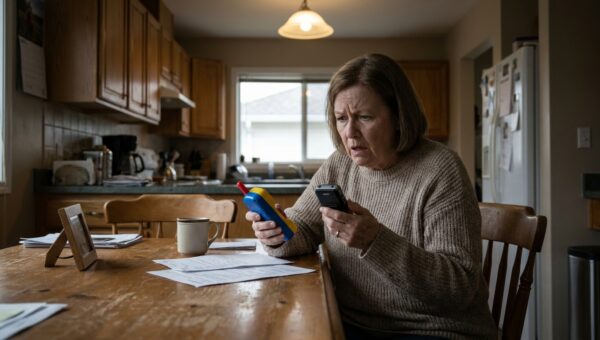
My eyes skipped past the header, past the routing codes I had memorized over nearly two decades of monthly deposits, straight to the bottom line where the bold font spelled out the available balance. Twelve dollars and four cents. Eighteen years of bonuses from the paper mill, birthday checks from my mother before she passed, and every single spare dollar I had scraped together from overtime shifts so Emma and her sister would never have to sign their names to a student loan.
The kitchen didn’t spin the way they show it in the movies. It just got very narrow and very heavy. The air felt thick in my chest, like I was breathing wet wool straight off the line, and my knees simply gave out beneath me. I remember the sharp edge of the yellow pine chair digging into my thigh as I slid down onto the linoleum, the paper fluttering from my fingers to land face-up near the baseboard heater.
I just sat there on my hands and knees, staring at the little black print that made eighteen years vanish into thin air.
Then the back door clicked open. Emma and her sister dropped their canvas bookbags by the coat rack with a dull thud, the heavy textbooks sliding against the wall. They walked into the kitchen together, their sneakers squeaking slightly on the slick floor where I had mopped that morning. They didn’t scream when they saw me crumpled by the baseboard. They didn’t even drop their groceries. They just stopped walking, two tall eighteen-year-old girls with identical dark hair pulled back in loose clips, and looked down at the blue statement lying by my knee.
Emma didn’t look surprised. That was the part that stayed with me later. Her face didn’t twist into the hollow horror I was wearing. She just walked over, knelt down beside me on the cold linoleum, and picked up the paper with steady fingers.
Her sister stayed standing by the island, her arms crossed tight over her canvas jacket, watching the driveway through the small window above the sink where David’s Ford truck was already gone from the gravel.
“Mom, don’t worry,” Emma whispered, her voice dropping into that quiet, flat tone she used whenever she was about to fix something broken in the garage. “We handled it.”
I looked up at her through a blur of salt and dust, my throat burning so badly I couldn’t get the words out to ask what on earth she meant by handled. David was gone. He had taken his duffel bag from the hall closet while I was down at the plant, leaving behind a brief Post-it note on the microwave about needing some space to think, and now our entire future was sitting at twelve dollars and four cents. But Emma just reached out and touched my wrist, her skin cool and steady against mine.
Three days dragged by like a slow leak in a tire. The house was too quiet, filled only with the hum of the refrigerator and the ticking of the wall clock in the hallway. I didn’t call the police. I didn’t call his sister down in Portsmouth. I just sat at the kitchen table with a cold cup of tea, staring at the space where David’s boots used to sit by the back door, wondering how a person tells their children that their education has just been traded for a bus ticket out of town.
The landline on the wall began to ring at precisely 2:14 on Friday afternoon. The shrill, old-fashioned bell cut through the quiet like a knife, making me jump half out of my chair. I didn’t want to answer it. I knew the ring. I knew the frantic, stuttering rhythm of it before the caller ID even flashed his name across the little plastic screen.
I let it ring three times, four times, five times, watching the red LED light pulse against the white wall. When I finally lifted the receiver, I didn’t even get a chance to say hello before David’s voice came screaming through the speaker, thin and frantic with static, sounding like he was calling from the bottom of an empty well.
“What did you do?” he shouted right into my ear, the sound so loud I had to pull the plastic receiver an inch away from my face. “My cards are all rejected. Every single one of them. The hotel desk just told me my reservation was canceled for non-payment and I am standing here in the middle of terminal three with people staring at me.”
I didn’t say a word. I just held the receiver against my ear and listened to the background noise of announcements and rolling luggage wheels bleeding through his frantic breathing.
“Did you freeze the accounts?” he yelled, his voice cracking on the edge of genuine panic. “You lock the primary? How did you lock the primary? I moved the routing numbers this morning and there was nothing there. Just twelve dollars. Where is the rest of it? Tell me where you put it.”
“I didn’t touch it, David,” I finally said, my voice sounding flat and strange in the quiet kitchen.
“Then where is it?” he shrieked, a muffled curse cutting off his sentence as someone bumped past him in the crowd. “I need those clearance codes right now. She is standing right here and she wants to know why our flight tickets aren’t going through. Answer me.”
Before I could reply, the receiver was gently lifted from my fingers. Emma had walked up behind my chair without a sound. She took the phone from my hand, pressed the speaker button with her thumb, and laid it right down in the center of the scarred maple tabletop where we used to do eighth-grade math homework.
“He’s still at the airport,” Emma said to her sister, who was leaning against the pantry door with her arms crossed.
“Put your mother back on the phone,” David’s voice roared from the little plastic box on the table, tinny and desperate. “Emma? Is that Emma? Put your mother on the line right now or I swear to God I’m calling the police.”
Emma leaned down, resting her hands flat on the wood on either side of the phone, her face inches from the speaker. She didn’t raise her voice at all. She spoke in that same calm, measured way she used when she was explaining a physics project to her teacher.
“Dad, you didn’t check the legacy provisions,” Emma said clearly. “You thought because Mom’s name was on the monthly statements that she was the only signature required for a wire transfer. But you forgot that Grandfather set up the original trust back when the mill was still his. He made both of us co-signatories the day we turned eighteen, specifically so things like this couldn’t happen.”
The speaker went dead silent on the other end. You could hear the faint echo of an automated boarding announcement in the background, but David didn’t say anything for three long seconds.
“What are you talking about?” he finally whispered, the bluster completely gone from his voice. “I checked the portal. The account was right there.”
“The account you saw was the buffer account,” her sister added from the doorway, her voice as smooth as river glass. “We saw you exporting those PDF files last month, Dad. We saw you moving your personal items to the cloud. You were predictable from the very first week. Forty-eight hours ago, we migrated the entire balance into an educational escrow vault under the grandfather clause. The only thing left in your path was the twelve-dollar operating minimum.”
The sound of David’s breathing on the other end was shallow and ragged now. “You can’t do that. That’s family funds. That’s joint property.”
“It’s protected,” Emma said, and then she reached out and hit the red button on the base of the phone, cutting the connection off mid-sentence. The dial tone hummed for a second before the machine clicked into silence.
Nobody moved in the kitchen for a long time. The afternoon sun had shifted around the corner of the house, throwing a long, bright bar of light across the scarred grain of the table, right over the spot where the empty statement had been lying three days ago.
Emma walked over to the counter, picked up her laptop, and set it down between us. She tapped the trackpad once, waking the screen to life with a soft blue glow. She didn’t say anything about the man standing stranded at terminal three with a woman who was probably already turning around to find her own taxi. She just turned the screen toward me.
There it was, written out in plain black and green text. One hundred and eighty thousand dollars. Locked, verified, and sitting safely in an unbreachable educational trust that required three signatures to move a single dime, two of which belonged to the girls sitting right across from me.
I reached out and laid my palm flat against the cold metal of the laptop lid, feeling the faint warmth of the battery underneath. My hands didn’t shake anymore.
Emma poured two cups of hot water from the kettle into our old chipped mugs, sliding one across the wood toward me while her sister pulled up a chair and sat down next to us. We didn’t talk about David’s phone call, and we didn’t talk about the empty duffel bag in the hall closet. We just sat there together in the late afternoon sun, listening to the quiet hum of the refrigerator, knowing the future was right where it belonged.