The gravel in our lane has always held onto winter water long after the sun comes up, making a wet, sucking sound under tires that you can hear through double-paned glass. When Marcus cracked my ribs and walked out the door, my five-year-old son did not cry first. He listened. He listened to the truck tires spit gravel in the driveway.
He listened to the front door slam hard enough to make the kitchen light flicker. He listened to the thin, wet sound of tile against the cold tile while my breath hitched and the taste of copper sat heavy on my tongue.
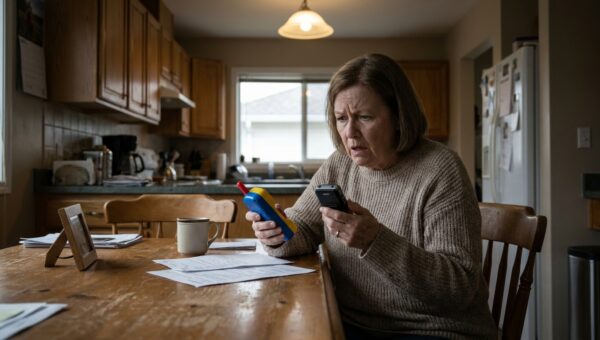
Then Noah crawled beside me, pulled my phone from under the fallen chair, and held it with both hands like it was something sharper than a knife. “This is what Grandpa is for,” he whispered. His thumb found the name. It was a contact that had sat silently at the bottom of the directory for five years, buried under Marcus’s strict rule that my family was toxic, that my father Arthur was an old man who only knew how to break things.
I didn’t stop him. I couldn’t. Every breath felt like swallowing a box of broken glass, and the kitchen was spinning in slow, sickening circles. Noah pressed the screen against his small ear, his face set with a terrifying, grown-up seriousness that a five-year-old has no business wearing. I watched him wait through three rings. Just three.
“Grandpa?” Noah said into the speaker. “Mom’s hurt. The truck went away.”
I heard the sharp intake of breath on the other end before Arthur even spoke. “Noah? Where are you?” My father’s voice didn’t sound old or slow; it sounded like an engine turning over in zero-degree weather, immediate and hot and loud. “Put your mother on the phone right now.”
I took the warm plastic from Noah’s small fingers, my hand shaking so hard the casing rattled against my wedding band. “Dad,” I whispered, and the single word tore right through the ribs Marcus had just broken.
“Don’t move,” Arthur said. “Don’t touch anything. I’m three miles out. I never stopped watching the lane, honey. I’m coming right now.”
The next forty minutes passed in a blur of gray light and shallow breaths. Noah stayed right beside me on the cold kitchen floor, refusing to let go of my sleeve, humming a soft, wordless tune he used when he was trying to soothe his stuffed animals.
Every time the wind rustled the maples outside, we both flinched, waiting for the rumble of Marcus’s dodge ram to turn back up the drive. But it wasn’t Marcus. It was the familiar, heavy thrum of my father’s old Ford diesel idling at the end of the gravel, followed by the crunch of boots on the stones.
When the front door pushed open, Arthur didn’t knock. He filled the doorway, his gray work jacket unzipped, his eyes scanning the shattered mug on the counter and the overturned chair with a cold, terrifying clarity. He didn’t ask questions. He walked straight across the linoleum, knelt down beside me, and his large, grease-stained hands hovered gently over my shoulders before finding a safe place to support me.
“Look at me,” Arthur said quietly, his voice thick with a rage he was keeping locked behind his teeth. “We’re going to the clinic first, and then we’re coming back with the state police to change every lock on this house.”
“He took the spare key,” I breathed, tears finally hot on my cheeks.
“Let him try the door,” Arthur said, helping me to my feet while Noah grabbed his small blue backpack from the hook by the pantry. “Let him try.”
The clinic in town smelled like bleach and damp paper. The doctor on duty was a quiet woman named Dr. Vance who didn’t blink when she saw the purple bruise spreading across my ribs or heard how Marcus had shoved me into the pantry door because I asked about the grocery money.
She took the X-rays in silence, her mouth a straight line, and handed me the medical report with a crispness that felt like armor.
“You have two fractured ribs,” Dr. Vance said, writing out a referral for local domestic support and handing me a sealed envelope. “You need to stay off your feet, and you need to stay somewhere safe. This report goes straight to the sheriff’s office. I’m filing it on your behalf.”
By the time Arthur drove us back to the house three hours later, the sun was sitting low behind the hills, casting long shadows across the neglected lawn. Parked at the edge of our property was a state trooper cruiser, its amber lights blinking softly in the twilight. Arthur had called them from the clinic parking lot, setting wheels in motion that Marcus could never outrun with a slammed door and a cloud of dust.
Officer Miller met us on the porch, a tall man with a clipboard and a calm demeanor that made my shoulders drop an inch. “We secured the perimeter, Mr. Collins,” the officer said, nodding respectfully to my father. “Your husband hasn’t returned yet, but we logged the damage inside. The locks are already changed. Here are the new keys.”
Stepping back into my own kitchen felt like walking into a stranger’s house. The air smelled different without Marcus’s damp wool jacket hanging on the back of the door and without his heavy boots scuffing the baseboards. I sat at the sturdy oak table while Arthur and Officer Miller went through the paperwork for the temporary restraining order.
That was when I noticed the mail on the counter. A stack of envelopes from the credit union, unopened, sitting under a heavy ceramic mug. Noah was sitting on the floor by the radiator, quietly coloring with a green crayon on the back of an old receipt, his shoulders finally relaxed.
I reached out and flipped open the top statement. My eyes scanned the balance, and the room seemed to tilt sideways. The joint savings account where we kept our emergency cushion, the money my grandmother had left me for a rainy day, wasn’t just low. It was zeroed out. A withdrawal of $15,567 had cleared three days ago, transferred to an external routing number I didn’t recognize. Below that was a notice of a second mortgage application filed on the house under my forged signature.
“Dad,” I called out, my voice tight and thin.
Arthur walked back into the kitchen, wiping his hands on a clean shop rag he kept in his back pocket. He looked down at the paper I pointed to, and for the first time all day, I saw the exact moment his expression hardened from worried father to something ancient and protective.
“He cleaned us out,” I whispered. “He took everything before he left.”
“He thought he was leaving you with nothing so you’d have to crawl back,” Arthur said, picking up the statement and folding it neatly into his pocket. “He didn’t count on Noah having a better memory than he does.”
Three days crawled by like weeks. We stayed at Arthur’s house on the other side of town, a quiet place where the floorboards creaked in a familiar way and the kitchen light never flickered once. My ribs ached with every breath, a dull, throbbing reminder of what living with Marcus had actually cost me, but the constant, low-grade panic in my chest had finally turned into something cold and solid.
On the fourth morning, just as the frost was burning off the grass in Arthur’s backyard, Marcus came back.
We were sitting at the kitchen table when the sound of the Dodge ram engine rumbled up the lane. I didn’t jump. I didn’t hide. I looked over at Noah, who was busy building a towering fort out of wooden blocks, completely unbothered by the noise outside. Arthur stood up from the counter, setting his coffee mug down with a firm *clack*, and motioned for me to stay put.
“Let me handle the front door,” Arthur said, his hand resting briefly on my shoulder.
I stood up anyway, following him into the narrow front hallway. Through the frosted glass of the front door, I could see Marcus’s heavy silhouette standing on the porch, his hand raised to knock again. When the heavy brass deadbolt turned and the door swung open, Marcus’s sneer fell apart the second he saw who was standing there.
“Arthur?” Marcus scoffed, trying to push past my father with his shoulders squared. “What are you doing here? Where is she? This is my house.”
“It’s not your house anymore, son,” Arthur said, his voice terrifyingly quiet. He didn’t raise his voice, but he didn’t move an inch, blocking the doorway like a stone pillar.
Marcus tried to peer over my father’s shoulder, his eyes locking onto mine through the gap in the hallway. “Get your coat, we’re going home,” he snapped, his voice dropping into that familiar, venomous register that used to make my stomach drop. “You think you can play games with the locks? You’re broke without me. You can’t even pay the water bill.”
I stepped out from behind Arthur, resting my hand against the wooden doorframe, keeping my voice level and clear. “The water bill is paid, Marcus. And so is the lawyer’s retainer.”
Marcus laughed, a short, ugly sound that lacked any real humor. “With what money? You don’t have a dime to your name.”
From behind me, Officer Miller stepped out from the living room, holding a thick manila folder and a crisp set of legal papers. He didn’t smile as he held them out toward Marcus’s chest. “Marcus Vance? You’re officially served with a temporary restraining order, a notice of eviction from the property on Mill Street, and an emergency subpoena regarding the fraudulent transfer of fifteen thousand five hundred sixty-seven dollars from joint accounts.”
Marcus stopped breathing for a second. His eyes darted from the officer’s badge down to the papers, then back to my face, realization finally hitting him like a physical blow. “You called the cops?” he stammered, his face flushing a dark, ugly red. “Over a little argument? You’re ruining everything over a little shove?”
“A cracked rib isn’t an argument, Marcus,” I said, and the words came out smoother and steadier than I ever could have imagined. “And you’re not coming back inside.”
Marcus opened his mouth to argue, to threaten, to start shouting the way he always did when things didn’t go his way, but Arthur took one slow step forward. My father didn’t touch him, but the look in his eyes made Marcus snap his jaw shut.
“Step off the porch, Marcus,” Arthur said softly. “The deputy down the road is already waiting to escort you off the property. If you step one foot past this gravel again, I won’t bother calling the law.”
Marcus looked like he wanted to lunge, like the old violence was right there under his skin, itching to break out. But he saw the cruiser idling at the edge of the drive, and he saw me standing tall behind my father with Noah’s small hand holding onto the hem of my shirt. With a final, venomous curse, Marcus turned on his heel, stomped down the wooden steps, and tore off down the lane, spitting gravel all the way.
We watched the taillights disappear around the bend until the lane went completely quiet again.
Later that evening, back at Arthur’s sturdy oak kitchen table, the silence felt different. It wasn’t the kind of silence that grew teeth or waited for a door to slam. It was heavy with safety, warm and thick like fresh bread. Noah sat across from me with a fresh box of crayons, coloring bright, uninterrupted strokes of blue and green across a clean sheet of paper under a steady, non-flickering light.
I traced the edge of a fresh cup of chamomile tea Arthur had poured for me, feeling my ribs ache with every deep breath I took, and knowing, with absolute certainty, that I had survived.