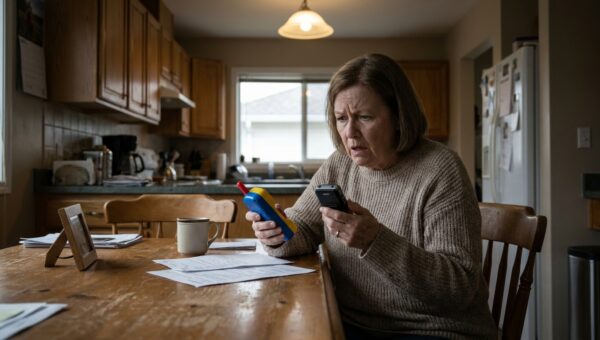
The jury summons arrived on a Tuesday morning when the frost was still thick enough on the trash cans to scrape off with my thumbnail. It was tucked right between an advertisement for roof repair and a church bulletin that I had already read twice on Sunday evening. I pulled it out while the kettle was whistling on the back burner, expecting the usual yellow postcard about county tax reassessment or perhaps a reminder regarding the water district election.
Instead, the bold black lettering at the top demanded the presence of Edward Kowalski in the municipal courthouse on the fourth day of April. Edward has been gone four years. He left behind a half-empty tin of lozenges on the nightstand, two pairs of worn work boots by the back door, and a headstone of gray granite down at St. Jude’s that the winter moss had already started to claim. I sat right there at the Formica table with my coffee getting cold in the mug, turning the heavy card over twice, thinking the post office had misdelivered mail from some cousin down in Springfield who shared his exact name. But the address block matched ours down to the zip code.
I didn’t call because the telephone lines at the county annex are always tied up with automated recordings that send you looping through three different departments before dropping the connection entirely.
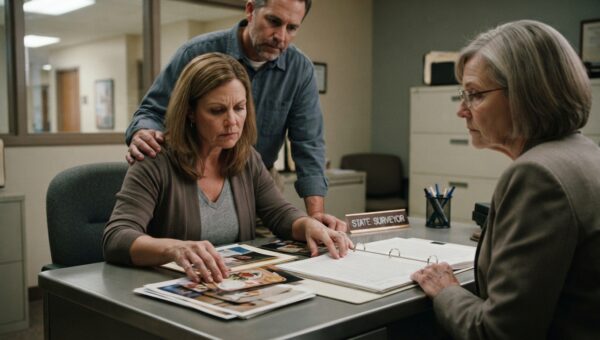
I put on my wool coat, the heavy brown one with the horn buttons that Edward bought me for our thirtieth anniversary, and drove the old Buick down to the courthouse myself. You have to clear these things up in person, otherwise the computer systems just keep spitting out red warnings and threatening bench warrants for people who have been resting under six feet of Kansas clay for forty-eight months. The courthouse lobby smelled of floor wax and wet wool from the morning drizzle, and the line at the clerk’s window was mercifully short. Sarah Geller was behind the counter, a woman I had known back when her oldest boy was in my eighth-grade English class, though she looked tired around the eyes today with her hair pinned up in a careless twist. I laid the jury summons right on the scratched wood of the counter ledge between us and told her there had been some administrative mix-up that needed a stroke of a pen and a death certificate copy from my purse.
Sarah took the paper, glanced down at the name, and punched the numbers into her terminal without looking up. Then she stopped. Her fingers hovered over the keyboard for a second before she hit the enter key again with a sharp clack. According to the county database staring back at her from the glowing monitor, my husband renewed his driver’s license eleven months ago. She frowned, muttered something under her breath, and typed the social security number in by hand to check the cross-reference files. The screen flickered, refreshed, and updated the record with a fresh set of data points. He had updated his address to a modest rental property on Elm Street up in Mason City, just across the county line. He had even registered to vote in November during the midterm elections, casting a ballot in a district where we hadn’t owned property since we sold the old lake cabin back in ninety-four.
I told her right then that she had the wrong Edward Kowalski in the system, that my husband was buried under a cedar tree three miles away, and that someone in the vital statistics office had dropped the ball during the big software migration last spring.
She didn’t answer me right away. She just stared at the monitor, her face going very still, and then she turned the heavy flat-screen monitor around so I could see the digital file photo on file. It is not my husband. It is a stranger wearing my husband’s name, his exact birthday, his Social Security number, eleven miles from where I buried him. The man in the photograph had thin brown hair, a patchy mustache that Edward never would have worn in a hundred years, and a bored, slack-jawed expression that belonged to someone twenty years younger than my husband was when his heart finally gave out in the home office. I just stood there because my brain kind of stopped working for a second, looking at those stranger’s eyes on a county computer screen while the radiator beneath the window hissed and clanked in the silence. Nobody said anything for a second and honestly that felt worse than if the fire alarm had gone off. Sarah Geller picked up her desk phone, her hand shaking just enough to make the receiver clatter against the plastic cradle, and what she said into it made the blood ring in my ears.
“Get me audit control right now,” Sarah whispered into the mouthpiece, keeping her eyes fixed on my face like she was afraid I might shatter right there on the linoleum. “I’ve got a dead-flagged profile showing an active renewal and a live physical address match on Elm Street. No, don’t route it through records, it’s a direct override from the portal.”
I didn’t wait for her to finish talking to the supervisor because the weight of it suddenly settled into my chest like a cold stone. I turned away from the counter without picking up the jury summons, walked right back out through the heavy glass doors, and got back into the Buick with my hands trembling so hard I could barely get the key into the ignition. The drive up to Mason City took twenty minutes along the state highway where the cornfields had been plowed under into long, muddy rows of gray stubble. I kept seeing that stranger’s face behind Edward’s name, floating there on the blue glow of Sarah’s monitor like a ghost trying to rent a room in a house that had already been locked up. Julian Vance was the name on the printout Sarah had hurriedly shoved across the counter before I left, a name I had never heard of in my life, though the state investigator who called me three days later filled in the ugly parts of the puzzle. Julian Vance had been a temporary transport aide during Edward’s final outpatient physical therapy sessions down at the county medical center, a quiet young man who carried clipboards and pushed wheelchairs down long linoleum corridors while my husband was too weak to walk on his own.
Julian had watched Edward sign his name on intake forms, memorized the digits of his social security card from a misplaced insurance duplicate left on a waiting room table, and realized that a retired woodshop teacher with no living children and a reclusive widow made for an invisible target in the municipal records. He had waited six months after the funeral, long enough for the probate notices to clear the local paper and for the county death registry to get buried under three thousand newer entries, before he started building the synthetic identity vector. When the DMV rolled out its new digital renewal portal during the database migration last spring, Julian used the loophole to attach Edward’s unblemished credit history and vital statistics to his own facial photograph, buying himself a clean slate, a valid driver’s license, and the right to walk around with my husband’s history taped to his back like a stolen coat. He rented a small, faded yellow duplex on Elm Street with a sagging front porch and a rusted-out lawnmower sitting in the weeds, living a quiet, unremarkable life on a dead man’s good name while I was tending geraniums by the headstone on Sunday afternoons.
When I pulled the Buick up to the curb across the street from the Elm Street duplex, the gray Dodge sedan parked in the gravel drive matched the registration details Sarah had printed out from the DMV terminal. I sat there in the cab with the engine idling, watching the lace curtains in the front window twitch before a man in a faded blue sweatshirt stepped out onto the porch carrying an empty plastic coffee mug. It was him. The stranger from the license photo, looking even smaller and more ordinary in the cold daylight than he did on the computer screen. He looked around once at the gray sky, tossed the coffee dregs into a patch of dead winter grass, and turned back toward the front door just as I pushed my car door open and stepped out onto the damp pavement. The gravel under my boots made that dry, sharp crunch that always sounds too loud when you are angry, and he stopped with his hand on the brass doorknob, looking over his shoulder to see who was disturbing his morning routine.
He didn’t run. He just stood there on the top step with his fingers curled around the brass handle, his eyes darting from my old winter coat to the license plates on the Buick parked by the telephone pole. I walked right up the concrete path through the overgrown weeds, my breath pluming out in white clouds in the damp air, and stopped three feet from the bottom of his steps. “You’re wearing the wrong shoes, Julian,” I said, my voice sounding steadier and colder than I actually felt inside. He blinked twice, his jaw tightening as the color drained out from under his patchy mustache, leaving his skin the color of skim milk. “I don’t know what you’re talking about, lady,” he muttered, trying for a rough edge that didn’t fit his sloped shoulders or the nervous way his Adam’s apple jumped in his throat. “You know exactly who I am and you know whose numbers are sitting in your wallet right now,” I told him, holding up the folded printout from the county clerk’s office like a shield between us. “Edward was a good man who built cabinets that outlasted both of us, and you’re nothing more than a thief hiding in his shadow because you couldn’t build a life of your own.”
He tried to push the door open to slip inside, but I stepped right onto the bottom step, looking him square in the eye with all the grief and fury of four long years rising up behind my teeth. “The state police are already looking at the terminal logs from the courthouse, Julian, and they’ll be here before you finish your morning coffee,” I said, my voice dropping into that quiet register I used to use when an eighth-grader tried to lie about a missing book report. “You can wait here for them, or you can go inside right now and pack your things, because that name belongs to a dead man who doesn’t owe you a single thing.” He looked at the paper in my hand, then down at the gravel driveway where a state trooper’s cruiser was already turning the corner with its headlights off, sliding quietly toward the curb like an answer to a question we had both been asking since March.
Julian let go of the doorknob, his shoulders dropping two inches as the last of his cheap defiance leaked out into the cold morning air, and he stepped back inside without saying another word. I didn’t watch him pack. I turned around, walked back to the Buick, and drove home to the quiet house where Edward’s tools were still hanging on the pegboard in the garage exactly where he left them.