Fourteen years is a long time to spend believing you know the sound of a man’s breathing. I knew the exact rhythm of Eric’s chest when he slept, the heavy, even pull of a man who worked forty hours a week at the lumber yard and spent his Saturdays fixing carburetors in the gravel driveway. When that rhythm changed, when it turned into a shallow, rattling gasp that filled our quiet hallway with the smell of clinical sanitizer and slow defeat, I stopped sleeping altogether.
Dr. Vance told us it was an aggressive, fast-moving lung carcinoma, the kind that didn’t care about clean living or non-smoking lungs or the fact that Eric was only forty-two years old. He told us in that low, careful voice doctors use when they are reading from a script they have memorized too many times.
“We are looking at palliative comfort now, Marsha,” Dr. Vance had said, sliding a thick manila folder across his polished mahogany desk. “A matter of weeks, perhaps a month if his system responds to the pain management.”
I remember the way the fluorescent light hummed overhead, casting a sickly yellow hue over Eric’s pale cheekbones and sunken eyes. Eric had looked at me then, his hand trembling as he reached across the desk to grip my fingers, his skin dry and hot. “We’re going to beat it, Marsha,” he whispered, his voice cracking with a fragility that made my throat tighten until I couldn’t swallow. “We’re going to fight this together.”
Except he wasn’t fighting anything.
The break came on a Tuesday afternoon when the rain was coming down in sheets, turning the parking lot at Mercy General into a gray mirror of dripping cars and low gray sky. I had stepped outside for twenty minutes to clear my head, needing to escape the smell of rubbing alcohol and the steady beep of the monitor that felt like a countdown I was powerless to stop. I was sitting on a damp concrete bench near the ambulance bay, clutching a paper cup of lukewarm tea, when a woman in a heavy wool coat sat down beside me. She didn’t look at me at first. She just stared straight ahead at the idling tailpipe of an ambulance before she turned her head, her dark eyes sharp and entirely devoid of the grief I had been wearing like a lead vest for three months.
“You’re Eric Vance’s wife,” she said, her voice flat and matter-of-fact.
“Yes,” I managed, my fingers tightening around the paper cup until the cardboard gave way and warm tea spilled over my knuckles.
She leaned in closer, the smell of damp wool and peppermint cutting through the exhaust fumes. “Set up a hidden camera in his room. HE’S NOT DYING.”
I stared at her, the words bouncing off my brain like stones against glass. The rain was drumming a heavy beat against the roof of the overhang. “What are you talking about? The doctors said he’s dying. He can barely sit up.”
She didn’t blink. “Trust me. Set up the camera. You deserve to know the truth.”
Then she stood up, pulled her coat tighter around her throat, and walked out into the rain without looking back.
I sat there on that bench for ten minutes while the tea cooled on my lap, my chest burning with a strange, sour mixture of confusion and a cold little spark of doubt that I tried immediately to push away.
Eric was dying. I had seen the charts. I had seen the gray tint to his skin, the way his ribs pushed against his hospital gown like fence wire. But her voice stayed in my ear, stubborn and jagged, repeating itself every time I thought about going back inside.
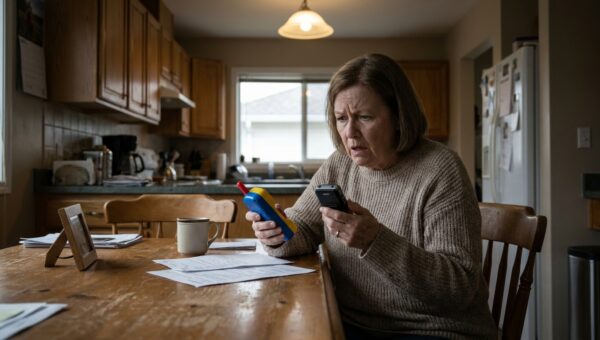
By 4:00 p.m., I had driven four miles to a small electronics shop off the highway and bought a small, black cube disguised as a USB charging block. The clerk behind the counter was a teenager with headphones around his neck who barely glanced at my face as I slapped down a forty-dollar bill. I didn’t care how it looked. I only cared about the small instruction manual tucked inside the cardboard box and the app I downloaded onto my phone while sitting in my sedan in the back of the hospital lot.
The opportunity came at 5:15 p.m., right when the evening shift change created just enough confusion in the palliative wing. A nurse named Brenda wheeled Eric down toward the diagnostic annex for a routine blood draw, leaving his private room empty for twenty minutes. I moved fast, my heart hammering against my ribs like a trapped bird. I slipped through the heavy wooden door, walked straight to the small television mounted in the corner, and plugged the black cube into the lower wall outlet, angling the tiny lens so it commanded a clear view of the entire bed and the small seating area near the window.
“Hurry up,” I whispered to myself, my hands shaking so badly I dropped the plastic cover twice.
When the door clicked shut behind me, I retreated to my car in the parking deck four floors down. The rain had slowed to a steady, miserable drizzle that plastered the parking garage windows with gray film. I opened the app on my phone, tapped the live feed icon, and held my breath as the screen flickered from black to a clear, high-definition view of Eric’s hospital room.
The room was empty at first. The bed was made up with those stiff white sheets, the pillows propped up to look like a body was resting beneath them, but the room itself was silent except for the low hum of the air conditioner. I waited, my thumb tracing the edge of my phone case, wondering if I was losing my mind, wondering if I had just committed an insane, unforgivable betrayal based on the words of a crazy woman in a wool coat.
Then the door opened.
It wasn’t Brenda pushing the wheelchair. It was Eric.
He didn’t shuffle. He didn’t lean on a metal walker or drag his feet across the linoleum. He walked through that door with a long, easy stride, dropped a heavy canvas duffel bag onto the foot of the bed, and tossed his hospital gown onto the floor like it was a wet towel. He was wearing a dark gray zip-up hoodie and dark jeans that fit him just fine, though he looked a little thinner than he had six months ago.
I froze, my breath catching in my throat so hard I thought I might gag.
“She buy it?” a voice asked from just outside the camera’s frame.
Eric laughed. It wasn’t the weak, rattling cough I had listened to for ninety days. It was a full, loud, resonant laugh that I hadn’t heard since our anniversary trip to Traverse City. “Marsha buys everything I give her,” Eric said, shaking his head as he pulled a folded wad of cash out of his pocket and tossed it onto the bedside tray. “The woman thinks I’m a saint. Vance says the transfer clears by Friday morning, and then we’re out of state before she even realizes the joint accounts are hollowed out.”
Dr. Vance stepped into the frame then, wearing his crisp white coat, his stethoscope dangling from his pocket. He picked up the cash, counted it with two fingers, and grinned. “It helps when the medical board doesn’t look too closely at palliative paperwork for terminal cases. Nobody questions a dead man’s signature, Eric. Especially when his wife is too busy crying over a fake chart to check the patient portal herself.”
“Sarah’s already got the truck packed down in Cincinnati,” Eric said, walking over to the window and looking out toward the parking lot, toward where my car was sitting four floors down. “Just give me two more days of acting like I’m on my deathbed for the nurses, and we’re gone.”
The phone in my hand felt heavy, like a piece of lead I couldn’t drop even if I wanted to. My brain didn’t scream or panic. It just went cold. Every memory of the last three months, every tear I had shed into my coffee, every night I had spent sleeping upright in that uncomfortable vinyl chair by his bed, every dollar I had spent on organic broths and special supplements he claimed he needed to keep his strength up, replayed in my head like a film running at triple speed. He hadn’t been sick a day in his life. The weight loss had been managed through a restrictive diet and some clever theatrical makeup Vance had prescribed him to wear during visiting hours. The terminal diagnosis was nothing more than an exit strategy with a built-in alibi.
I didn’t cry. Not a single tear came. I simply sat there in the dark of my sedan, watched the two of them clink their paper water cups together in a silent toast on my phone screen, and felt something inside my chest snap shut like a deadbolt.
“Okay,” I said aloud to the empty car. “Okay.”
I didn’t call the police from the parking lot. I didn’t call a lawyer. I walked back through those automatic sliding glass doors with my shoulders back and my chin up, my steps making a sharp, steady click against the polished tile floor. I took the elevator to the fourth floor, walked down the familiar corridor past the nurses’ station where Brenda was busy updating charts, and stopped outside Eric’s door.
I didn’t knock. I pushed the door open and walked right in.
Dr. Vance was still there, leaning against the counter by the sink while Eric was sitting on the edge of the bed tying his boots. They both froze. Eric’s face went slack, the color draining from his cheeks not from illness, but from pure, unadulterated shock as he saw the look in my eyes.
“Marsha,” Eric stammered, his hands dropping from his shoelaces. “Honey, you’re back early. I thought you went home to get some rest, “
I didn’t answer him. I walked across the room, pulled the small black phone out of my coat pocket, and set it squarely in the middle of the bedside tray table. I hit play on the video file.
The audio filled the small, sterile room immediately, loud and clear in the quiet space. *Marsha buys everything I give her… Vance says the transfer clears by Friday morning… Sarah’s already got the truck packed down in Cincinnati…*
Eric stared at the screen, his mouth opening and closing like a landed fish. Dr. Vance straightened up from the sink, his face twisting into an ugly, panicked scowl. “Mrs. Vance, where did you get this? This is an illegal recording, “
“Shut up, Julian,” I said. My voice didn’t shake. It sounded like someone else’s voice entirely, cold and level and hard as iron.
Eric lunged forward off the bed, his hands reaching out toward the phone. “Marsha, let me explain. It’s not what it looks like, Sarah was just a, “
“Don’t touch me,” I said, stepping back so fast he almost tripped over his own boots. I looked at him, really looked at him, and wondered how I had spent fourteen years sharing a bed with a stranger who looked like my husband. “You’re not dying, Eric. But your marriage is dead, your bank accounts are frozen as of twenty minutes ago when I called the credit union from the lobby, and the hospital board is already reviewing Dr. Vance’s patient files upstairs.”
Eric’s face flushed a dark, furious red. “You can’t do that! You don’t know what you’re, “
“I know enough,” I said, turning toward the door. “I know you’re leaving for Cincinnati with Sarah. I suggest you pack light. The police are downstairs talking to administration about wire fraud and medical impersonation, and I don’t think they’re going to let you take the duffel bag.”
Dr. Vance made a sharp sound in the back of his throat and bolted for the door, brushing past my shoulder without looking me in the eye. Eric stood there by the bed, his hands clenched into fists at his sides, his mouth working silently as the mask of a dying man crumbled away to reveal nothing at all underneath.
I didn’t wait for him to find the right words. There weren’t any left.
I turned around and walked out of the room, leaving him standing in the middle of the empty space with his duffel bag at his feet. When I reached the hallway, I stopped by the nurses’ station and handed Brenda my visitor badge without a word.
“Is everything alright, Mrs. Vance?” Brenda asked, looking confused.
“Everything is just fine,” I said, offering a small, tight smile. “My husband is finally cured.”
I walked down the stairs instead of taking the elevator, my boots hitting every step with a solid, reassuring thud. When I pushed through the heavy glass doors and stepped out into the evening air, the rain had stopped entirely, leaving the asphalt dark and clean under the streetlights. I reached into my coat pocket, pulled out the small black camera I had retrieved from the wall outlet on my way out, and dropped it into the green municipal trash bin by the curb.
I looked up. The clouds were breaking overhead, letting a pale slice of moonlight fall across the wet pavement of the parking lot. For the first time in three months, I took a deep, full breath of the cold night air, turned my back on the hospital doors, and walked toward my car alone.