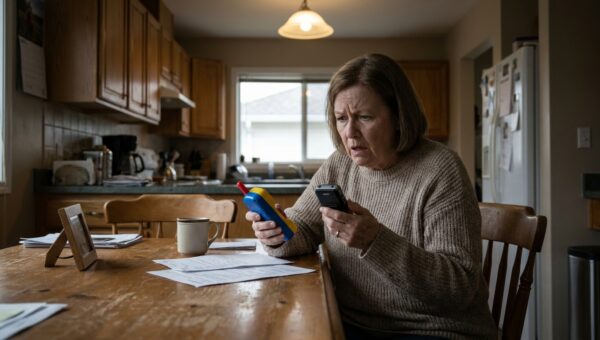
The phone was cold against my palm where Noah pushed it into my hand. My ribs felt like someone had driven a dry wedge between the bones every time I tried to draw a full breath, and the taste of copper stayed thick and greasy at the back of my throat. I didn’t want to look down at the screen.
I didn’t want to see the numbers that hadn’t lit up in five years, since the day Mark finally managed to convince me that my father was too toxic to keep around. But the phone was already unlocked. Noah’s small thumb had done it while I was still staring at the place where the kitchen chair had tipped over.
“This is what Grandpa is for,” he whispered.
He didn’t sound scared. That was the part that made my chest ache worse than the fracture. He sounded like a kid reading instructions off the back of a cereal box, practical and steady, because he had spent half his short life listening to the way Mark slammed doors and paced the hallway after I mentioned visiting my hometown. Mark had spent five years convincing me that we were an island. He told me my mother was gone and my father was a hardheaded old ghost who didn’t care about anyone except his woodworking shop.
He made it so easy to stop calling. He made it feel like protecting our little family meant cutting off every branch until only the trunk was left, and then he became the axe.
I pressed the green button before I could talk myself out of it. My hand was shaking so hard the plastic casing clicked against my wedding ring.
The phone rang once. Twice. On the third ring, a voice picked up. It wasn’t a cheerful hello. It was the sharp, flat tone of an old man who kept his landline right beside his recliner and answered every call expecting bad news about a tractor part or a town council vote.
“Arthur speaking,” my father said.
The kitchen was so quiet I could hear the refrigerator compressor humming in the corner. Outside, the wind was pushing dry maple leaves across the front lawn, but there was no sound of Mark’s truck anymore. The gravel had stopped spitting fifteen minutes ago.
“Dad,” I said. My voice came out thin and crooked, like dry wire.
There was a long, heavy pause on the line. I could hear the faint sound of a television playing in the background at his house, some old news broadcast murmuring in an empty room. When he spoke again, all the gruffness had dropped out of his voice, leaving just the sound of a man who had been waiting by an open door for half a decade.
“Elena?” he asked. “Where are you?”
I told him in about four words. I told him Mark was gone, and I told him about my side, and I told him I needed help. I didn’t give him the whole history over the phone because my ribs were hitching every time I tried to form a sentence. I just gave him the address and the name of the county road.
“I’m leaving now,” Arthur said. “Keep the front door locked. Do not answer if he comes back. I’ll be there before midnight.”
The line went dead with a soft click.
Noah stayed sitting on the cold tile right beside me. He didn’t cry. He reached out and touched the hem of my shirt with two fingers, checking to see if I was still there, the way dogs check on you during a thunderstorm. I pulled him close, careful not to twist my torso, and we sat on the kitchen floor with our backs against the lower cabinets while the house cooled down around us.
The next few hours blurred together into a grey routine of waiting. I didn’t turn on the overhead light because the glare made my head swim. We stayed in the dark, listening to the small creaks the house makes when the temperature drops. Every time a car went down the county road, my stomach tightened into a knot, waiting for the heavy thud of Mark’s boots on the porch steps. Mark always came back when he forgot his keys or when he wanted to finish an argument he felt he hadn’t won. He liked having the last word in every room he rented or owned.
At 11:40, the headlights swept across the living room window, painting long, yellow bars across the ceiling.
It wasn’t the high, bright flash of Mark’s truck. It was the steady, low-slung beam of an older sedan with a tired suspension. The gravel in the driveway didn’t spit this time. It crunched under the tires in that heavy, familiar rhythm I used to fall asleep to when I was ten years old, slow and deliberate, coming to a stop right by the side door.
A car door slammed. Then heavy, unhurried footsteps crossed the gravel.
I stood up slowly, using the edge of the counter to push myself vertical. My ribs screamed, a sharp, white-hot pinch that made my vision blur at the edges, but I made it to the door before the knock came.
Arthur didn’t wait for me to turn the lock twice. He pushed the door open with the flat of his hand, standing there in his old canvas work jacket with his grey hair standing up in tufts where he’d been running his fingers through it while he drove. He looked older than I remembered. His face was lined deep around the mouth, and his eyes were tired, but when he looked down at me and saw the way I was holding my arm across my ribs, his whole expression went flat and hard.
“Get your coat, Elena,” he said. He didn’t raise his voice. He didn’t ask questions. He looked past me and saw Noah sitting by the kitchen table, and his shoulders dropped an inch. “Hey there, buddy. Come here and give Grandpa your hand.”
We didn’t go to sleep that night. We went straight to the county hospital forty minutes away, where a young doctor with tired eyes took x-rays and asked me three different times how I fell down the stairs. The third time he asked, I looked past him at my father standing by the door with his arms crossed over his chest, and I looked down at Noah, who was drawing pictures with a blue crayon on the paper tablecloth of the examination table.
“I didn’t fall down the stairs,” I told the doctor. “My husband hit me. And he cracked my ribs.”
The atmosphere in the small room shifted instantly. The doctor didn’t look surprised, just professional and tired, and within twenty minutes a state trooper was standing in the corner taking notes while my father sat beside me and held my hand with a grip that hadn’t changed since I was a little girl learning how to ride a bike without training wheels.
We didn’t go back to the house that night. We stayed at a motel off the highway, the kind of place with red carpeting and the smell of old bleach, where Noah fell asleep watching a cartoon with the sound turned down low. I sat on the edge of the double bed with an elastic binder wrapped tight around my ribs, staring at the phone on the nightstand. Mark had sent three text messages by 2:00 a.m.
The first one was angry. The second one was demanding to know where his good jacket was. The third one said I was acting like a child and I needed to be home to make dinner before he got back from his mother’s place.
I didn’t reply to any of them. I handed the phone to Arthur, and he set it on the nightstand face down, right next to a paper cup of motel coffee.
“Let him text,” Arthur said, pulling the grey wool blanket up over Noah’s shoulders. “He’s got two days before he realizes we changed the locks. After that, he can talk to the sheriff.”
By Sunday afternoon, we were back at the house.
Arthur had brought a box of tools from his truck, and he was standing on the front porch with a heavy brass deadbolt in his hand when Mark’s truck pulled into the drive. The gravel spat this time, just like it always did when Mark was driving too fast because he was pissed off. He killed the engine before the dust even settled and hopped down out of the cab, his jacket open and his face set in that heavy, self-righteous scowl I used to navigate by like a compass.
“What the hell is going on here?” Mark shouted before he even reached the bottom of the steps. He stopped dead when he saw Arthur standing in the doorway with a power drill in his hand. His eyes flicked from my father to the sheriff’s cruiser parked off the shoulder of the road by the mailboxes. “Who called them?”
I was standing just inside the screen door, looking through the wire mesh at the man who had lived in my house for seven years and tried to make me believe I had nowhere else to go. My ribs still throbbed with every breath, but the fear was gone, replaced by something cold and clear that tasted like iron.
“I did, Mark,” I said. My voice didn’t shake.
Mark took two steps toward the porch, his face turning that dark, ugly red that usually meant he was about to start throwing things. “You’re out of your mind. Get your dad off my property. This is my house.”
“It’s my name on the deed, son,” Arthur said quietly, not raising his voice an inch. He didn’t look scared of Mark’s shoulders or his loud voice. He looked like a man checking fence posts after a hard winter. “And the sheriff has some papers for you to look over regarding the assault charge down at the county hospital.”
Mark stopped. He looked at the two deputies walking up the gravel path from the cruiser, then back at Arthur, and for a second his mouth opened like he was going to argue his way out of it. But the confidence wasn’t there anymore. He looked around the yard as if he was just realizing that the walls he built around us were made of glass, and they had just shattered all at once.
He didn’t say anything else. He turned around, got back into his truck, and backed out of the drive so fast his tires threw gravel all the way across the lawn.
I watched him go through the screen door until the red taillights disappeared around the bend in the road.
Inside the kitchen, the room was quiet again.
Noah came over and stood beside my leg, looking up at the front door where my father was finishing up the last screw on the new lock. Arthur stepped back, wiped his hands on a rag from his back pocket, and turned the key once, twice, listening to the solid, heavy click of the brass mechanism seating itself into the frame.
Then came the sound of three pairs of shoes stepping across clean, unbroken kitchen tile.