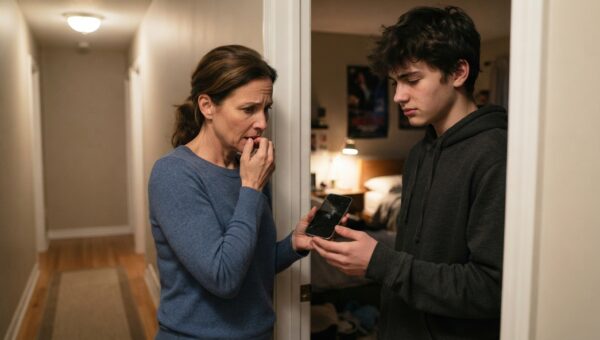
The pocket of Arthur’s wool coat had a hole in the lining near the bottom seam, which was why my fingers caught on something cold and jagged when I went to hang it up in the hall closet. It wasn’t a coin or a receipt or a stray gum wrapper. It was a small brass key, heavy for its size, with a notched bit and a little stamped metal tag dangling from a silver split ring. The numbers stamped into the brass were 38.
We had been married for sixteen years, living in the same brick house on Elm Street, keeping the same quiet routines of Sunday roast and Tuesday grocery runs. Arthur had worn that coat through six winters of bone-chilling Ohio winds, always hanging it in the exact same spot by the back door, always tossing his leather gloves into the wooden bowl on the console table. When I pulled the key out and brought it to the kitchen light, I asked him about it over dinner, figuring it was an old locker key from his masonry days or some forgotten padlock from the tool shed.
He didn’t look up from his chicken pot pie. “That’s just from my old apartment in Columbus,” he said, his voice as flat and level as a floorboard. “Before we met. Must have slipped down the lining years ago.”
I nodded and let it drop because sixteen years of marriage teaches you how to pick your battles and when to let a small lie drift away on the current of an ordinary Tuesday evening. But the math didn’t hold together in my head. Arthur hadn’t lived in Columbus since the autumn of twenty-thirteen, right after his wealthy best friend, Warren, died suddenly in that strange hunting accident up near the reservoir. A wool coat bought in twenty-seventeen couldn’t hold a key from an apartment he left four years before the tag even was manufactured.
The next morning, after Arthur left for the lumber yard with his truck idling in the gravel drive, I took the key from the ceramic dish and walked out to my station wagon. I didn’t have a plan, only a heavy, stubborn itch between my shoulder blades that wouldn’t let me breathe right. I drove to every storage facility within twenty miles of our town, starting with the big corporate lots off the interstate with their tall chain-link fences and automated gates, then working my way down to the older, cinder-block places tucked behind the auto body shops and the grain elevators.
The third place was called Tri-County Storage, a row of rust-stained green metal buildings baked under a pale November sun. The office smelled of stale coffee and damp cardboard, and the clerk was a teenager with headphones dangling around his neck who barely glanced at me when I laid the brass key on the laminate counter.
“Unit thirty-eight,” I said, my voice sounding smaller than I meant it to. “I need to check something inside.”
The kid tapped his greasy keyboard twice, squinted at the monitor, and spun a greasy clipboard around for me to sign a visitor log with a chewed-up blue Bic pen. He didn’t ask for an ID because nobody ever checked things like that in places where people kept old lawnmowers and plastic totes of Christmas decorations. He just handed me a laminated master pass and pointed a thumb toward the back row where the shadows stretched long across the gravel.
Row C was darker than the rest, tucked beneath a stand of overgrown maples that dropped wet leaves into the drainage ditches. Unit 38 had a heavy steelhasp secured with a brass Master lock that matched the key in my hand. My palm was slick with sweat as I pushed the key into the cylinder, turned it, and felt the internal tumblers click with a sharp, metallic bite.
The door rolled upward with a loud, grinding screech that made the local crows scatter from the tree branches overhead.
I stepped inside and the breath went completely out of my lungs.
It wasn’t boxes of old clothes or spare furniture. It was a room. Someone had run an extension cord under the metal door from an outlet on the exterior wall, powering a small floor lamp with a yellow parchment shade that cast a warm, sickly glow across the space. Against the back wall stood a narrow twin bed made up with a chenille spread in a pale rose pattern I recognized from my mother’s guest room. Beside the bed was a nightstand holding a glass pitcher of water that had gone cloudy with dust, and a small stack of paperback books with their spines cracked from reading.
Along the left wall, someone had hung a row of dresses on a freestanding metal clothing rack. I walked over and ran my fingers over the fabric of the dark green wool dress hanging nearest the end. It was my size. Exactly my size. I checked the tag inside the collar and saw the store name from the boutique downtown where I bought my church clothes every Easter. Further down the rack hung a winter coat that looked identical to the one Arthur wore every day, only smaller, cut for a woman’s shoulders.
I turned around slowly, my boots crunching on the dusty concrete floor, and looked at the right-hand wall.
It was covered in photographs. Dozens of them, push-pinned directly into the drywall in a grid that stretched from the floor to the ceiling beams. They weren’t family snapshots taken with a digital camera or a phone. They were candid shots, printed on heavy matte paper, captured from a distance with a telephoto lens.
There was a woman standing by the produce bins at the Piggly Wiggly, wearing a beige cardigan and holding a red mesh bag of Honeycrisp apples. There was a woman sitting on the wooden bench outside the public library, reading a thick hardcover book with her glasses perched on the tip of her nose. There was a woman standing at the edge of our own gravel driveway, looking down at her car keys with a slight frown between her eyebrows.
Every single photograph was of me.
Or at least, I thought it was me at first glance, right down to the silver streak in my brown hair and the small silver hoop earrings my sister gave me for my fortieth birthday. But as I stared at the pictures under the yellow light of the floor lamp, the small differences started to ache behind my eyes. The woman in the photos had a slightly narrower jawline than I did. Her left earlobe had a tiny notch in it where mine was smooth. Her eyes were a shade darker, brown where mine were hazel.
She looked like me the way a reflection in a muddy puddle looks like the sky. Enough to fool someone from across a room, or in the dim light of a kitchen after the sun went down.
I found the lease agreement clipped to a wooden clipboard hanging behind the door. It was dated October fourteenth, twenty-thirteen. The name written on the lessee line wasn’t Arthur’s, but the handwriting was unmistakable, right down to the way the capital letters leaned back toward the margin like wheat in a heavy wind. The monthly rent was one hundred and seventy-five dollars, paid automatically on the first of every month from an account I had never seen, totaling over twenty-three thousand dollars across eleven years of quiet maintenance.
I stood there in the center of that windowless room for nine minutes. I didn’t cry and I didn’t scream because my brain had sort of frozen up, working through the arithmetic of a life built on a foundation of sand and stolen intentions. I thought about the way Arthur kissed my cheek every morning before he left for work, the way he always remembered how I liked my coffee with two splashes of oat milk, the way he held my hand during the funeral for my father five years ago.
When the nine minutes were up, I pulled my phone from my coat pocket and dialed three numbers.
The state police investigator who met me at the storage unit twenty minutes later was a man named Miller with graying temples and a notebook that looked like it had survived a war. He didn’t ask me many questions while he walked the perimeter of Unit 38, shining a heavy black flashlight into the corners and taking pictures of the clothing rack with a department-issued camera that clicked with a dull, heavy thud.
“You recognize any of this, ma’am?” Miller asked, his pen poised over the paper.
“The clothes are mine,” I said, pointing at the green wool dress. “Or at least, they’re my size. But I’ve never seen that coat before. And I don’t know who the girl in the pictures is.”
Miller flipped back a page in his notebook and traced a calloused thumb down a typewritten list of names from an old cold case file he had pulled from the district archive. “Her name was Clara Vance,” he said quietly, not looking up from the page. “Reported missing out of Portsmouth back in November of twenty-thirteen. She walked out of her apartment to go to the pharmacy after dark and never came back. Her car was found unlocked three blocks away with the keys still in the ignition.”
My stomach gave a slow, sickening lurch. “Twenty-thirteen. That was the same year…”
“That was the same year Warren died,” Miller finished for me, nodding slowly. “Warren Higgins. Your husband’s best friend. Fell through the ice up at the north quarry during a late-night duck hunting trip. Ruled an accidental drowning, though we never did find his shotgun or his decoys. A week before that happened, Warren signed a new will leaving his entire estate, eight point nine million dollars from the family timber holdings, to his primary business partner and lifelong friend, Arthur Vance. Oh, excuse me, Arthur Miller. Your husband.”
The silence in the small metal unit felt heavier than the concrete walls. I could hear the distant hum of traffic on the highway two miles away, a steady, indifferent roar of people going about their ordinary lives while my own history dissolved into ash around me.
“Arthur said Warren killed himself with grief after his mother died,” I whispered, the words tasting like dry paper in my mouth.
“Warren wasn’t grieving,” Miller said, snapping his notebook shut with a sharp crack. “Warren was trying to back out of the land deal they set up together. He went to a lawyer’s office three days before he died to talk about amending his will. He told the attorney that Arthur was playing a very long game with people’s lives, and that he wanted no part of whatever was coming next. But he didn’t live long enough to sign the papers.”
He looked at me then, his eyes steady and tired beneath the brim of his hat. “And Clara Vance? She wasn’t a relative of his, despite the last name. She was just a girl who worked at the diner where Arthur and Warren ate breakfast every Tuesday morning. A girl who happened to have the exact same height, weight, and hair color as a quiet schoolteacher in a small town two counties away, a woman Arthur had been watching through a telescope for months before he ever introduced himself at the post office.”
Everything fell into place with a sickening, terrible clarity. The sixteen years of our marriage hadn’t been an accident of romance or a quiet blessing of middle age. It had been an audition. I was chosen because I fit the template of a ghost Arthur had created six months before he ever bought the ring on my finger, a ghost he needed to disappear so he could inherit an empire of timberland and cash without anyone asking too many questions about where the real owner had gone.
“What do you need me to do?” I asked.
“We need you to go home,” Miller said. “We need you to hang that coat back up in the closet, put the key back in the dish, and wait for him to come home for supper. My men will be parked down the road behind the grain elevator. When he walks through that front door, we’ll be right behind him.”
I drove back to Elm Street with the windows rolled down, letting the cold November air scour the smell of old dust and damp carpet out of my hair. The house looked exactly the same when I pulled into the gravel drive at five o’clock. The yellow porch light was already flickering on automatically, casting a warm, deceptive glow across the welcome mat.
I walked inside, hung my jacket on the peg by the door, and took the brass key from my pocket. I laid it squarely on the laminate counter right beside my silver wedding ring, where the afternoon sun caught the notched edges of the metal.
The front door opened a minute later with its familiar, well-oiled click, and Arthur stepped into the hallway, smelling of pine sawdust and cold autumn air, carrying his lunch pail in his left hand.
“Smells good, honey,” he said, loosening his red flannel collar as he walked toward the kitchen. “What are we having?”
I didn’t answer him. I just sat at the kitchen table, watching the way his eyes dropped instantly to the brass key sitting beside my ring, and I waited for the heavy footsteps of the men coming up the porch steps to finally put an end to the eleven-year lie.