PART 1
My brother had our father sign a new will two days after Dad came home from anesthesia. Dad was seventy-nine, and he had spent four days in the surgical unit having a bowel resection under heavy general sedation. When the hospital discharged him on a Tuesday morning, he could barely remember what year it was, let alone track legal paperwork.
He kept asking where his gray hound dog was, even though Buster had died back in 2018.
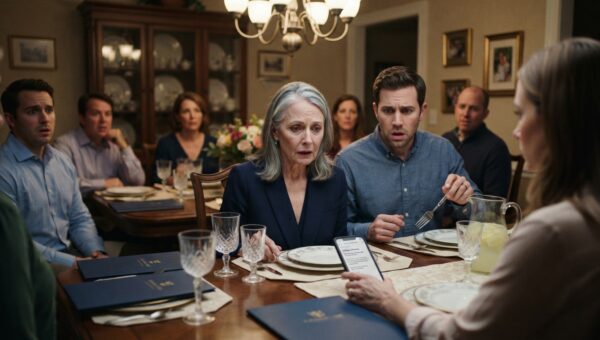
Yet on Thursday night, my younger brother Wayne called a family meeting around Dad’s dining room table. I drove over straight from my shift at the water authority, thinking we were coordinating home-care schedules and meals. Instead, Wayne had a blue legal folder resting beside Dad’s teacup.
I almost let it go. There was more history behind it than anyone at the table seemed to remember. When Mom died six years ago, she and Dad had set up mirror wills dividing their three-acre parcel, the four-bedroom house, and Dad’s union savings equally between Wayne and me. Wayne had run through two failed landscaping ventures and a messy divorce, while I had stayed on our road, mowed Dad’s lawn, and managed his prescription orders. But Wayne had a way of making any conversation about money feel like a personal insult against his character.
“I had Mr. Henderson draw up a quick revision,” Wayne told me, tapping the staple on the packet. “It’s only to update addresses since I moved out to the county line. Dad knew exactly what he was doing.”
Dad sat at the head of the table in his fleece bathrobe, picking at the fringe on his placemat. His eyes were milky and slow. When I asked him if he had read what he signed, he looked up at me with a tired, confused squint and said Wayne told him it was an insurance release for the visiting physical therapist.
The detail I kept coming back to was a witness signature on the final page. Under Dad’s shaky, wandering cursive was a neat, printed signature in purple ink: *Maria Santos, STNA*.
Maria was the home-health aide the county agency sent out for ninety minutes every morning to wash Dad and change his surgical dressing.
State regulations strictly forbid home-health aides from witnessing private testamentary documents for their active clients.
“Maria signed this?” I asked Wayne.
Wayne snatched the blue folder off the table and shoved it into his leather satchel. “She was right here when the mobile notary stopped by. Don’t start making problems, Karen. Dad’s exhausted and you’re turning a simple clerical update into an interrogation.”
I stopped arguing and checked for myself. I waited until Wayne drove away in his truck, then I went to Dad’s desk in the den. The original 2018 will was gone from the lockbox, and Wayne hadn’t left a paper copy of the new document.
I didn’t challenge him right away. For four days, I went to work, brought Dad his groceries, and watched Wayne stop by on his lunch break to check Dad’s mailbox. There was still one detail left that didn’t sit right with me: Maria only worked from eight to nine-thirty in the morning, but the notary stamp on the final page listed the signing time as four-fifteen in the afternoon.
Then, on Tuesday morning, my cell phone buzzed while I was driving down Route 6.
It was Maria calling from her agency phone. She sounded anxious, her voice hushed.
“Karen,” she said. “I am standing in your dad’s kitchen right now. Wayne left a packet of legal copies on the counter by the breadbox. I was looking for his medication sheet, and I saw my full name and state license number written on the witness page of a property deed transfer.”
My fingers tightened on the wheel. “Maria, did you sign that?”
“No,” she said, her voice shaking. “I have never signed anything for your family except my daily shift logs. I wasn’t even in this house on Thursday afternoon, and I want to know why my name is on a legal document.”
PART 2
I pulled my car onto the gravel shoulder of Route 6 and put the hazard lights on.
“Maria,” I said, keeping my voice as calm as I could. “Do not move that packet, but take clear pictures of every single page with your phone right now. Especially the signature line with your name.”
“I already did,” she whispered. “My supervisor told us during orientation that if we ever witness client legal papers, we lose our state certificate immediately. I have three kids to feed, Karen. I would never sign a patient’s will.”
“You won’t lose your license,” I told her. “Stay there. I am turning around.”
I drove the four miles back to Dad’s house. Maria met me at the side porch, holding her car keys in one hand and her agency clipboard in the other. She was twenty-eight years old, a hard worker who always took the time to trim Dad’s toenails and listen to his stories about the assembly plant.
She walked me into the kitchen. The documents Wayne had left beside the breadbox were not just a will update.
It was a complete estate restructuring package: a revocation of the 2018 joint will, a durable financial power of attorney naming Wayne as sole agent, and a transfer-on-death deed conveying Dad’s house and the entire three-acre lot directly to Wayne upon Dad’s passing, cutting me out completely.
The notary seal belonged to a woman named Brenda Lawson, an independent mobile notary who worked out of an auto title agency near the highway.
Below Brenda’s stamp were two witness signatures: one was an illegible scrawl with an address in Elyria, and the other was Maria Santos, with her home address and her state STNA registration number written in purple ballpoint ink.
“Look at that handwriting,” Maria said, holding her own agency logbook up to the page.
Her real signature was written in rounded, upright print with a distinctive loop on the letter *S*. The signature on Wayne’s document was slanted sharply to the right, written in thin, scratchy strokes.
“Where did he get your state license number, Maria?” I asked.
Maria looked toward the refrigerator. “The agency care binder. It sits right on top of the microwave so the visiting nurses can sign in. My name, phone number, and state registry ID are printed on the very first page of the intake chart.”
My stomach felt tight and heavy. Wayne hadn’t just pressured a sick old man who had come out of general anesthesia forty-eight hours earlier. He had lifted an aide’s private credentials from a medical binder to forge a legal witness line on a transfer that stripped away our mother’s wishes.
I took the papers to the dining room table, sat down, and called Robert Henderson’s law office. Robert had been my parents’ personal attorney for twenty-five years; he had handled Dad’s pension rollover and Mom’s estate probate.
When his secretary put me through, Robert sounded completely surprised.
“Karen?” he said. “How is your father doing after the surgery?”
“He’s home, Robert,” I said. “Wayne told us last Thursday that you drafted an updated will and deed for Dad to reflect Wayne’s new address.”
There was a five-second pause on the line. I heard paper shuffling on Robert’s desk.
“I haven’t drafted a document for your father since 2018, Karen,” Robert said firmly. “Wayne called my office two weeks ago while your dad was in the hospital, asking if we could prepare a quick-claim deed for the acreage. I told Wayne directly that as long as your father was on post-operative pain medication and recovering from abdominal surgery, I would not touch his estate plan without a written capacity evaluation from his primary physician.”
“Wayne used a mobile notary,” I said.
Robert let out a low whistle. “Who?”
“Brenda Lawson.”
“She’s an independent notary who stamps car titles for small lots on Route 20,” Robert said, his tone turning sharp. “Karen, if your father signed an instrument without legal counsel while impaired, and if there is a fraudulent witness attestation, that document is voidable. But you need to move before Wayne files that transfer-on-death affidavit with the county recorder.”
PART 3
I asked Maria to drive straight to her agency’s regional office in town and file a formal incident report with her supervisor, stating under penalty of perjury that her name and credentials had been used on an estate document without her knowledge or presence.
Then I called Wayne.
“Are you at your shop?” I asked when he picked up.
“I’m bidding a commercial drainage job out in Amherst,” he said, sounding busy and important. “Why? Did Dad need his prescription refilled?”
“Meet me at Dad’s house at one o’clock,” I said. “Bring your satchel.”
“I told you I’m working, Karen. We already settled the paperwork on Thursday.”
“Maria Santos called me this morning,” I said, keeping my voice level. “She has already given a statement to her agency’s compliance director about the purple ink on page four. If you aren’t in Dad’s driveway at one o’clock, Robert Henderson is filing an emergency protective petition with the county probate judge at one-fifteen.”
Wayne hung up on me.
At ten minutes to one, his black pickup truck pulled into the driveway, the tires throwing gravel against the grass. He slammed the cab door and walked through the kitchen screen door with his jaw set tight, his eyes dark with fury.
Dad was sitting in the den watching an old baseball game, half-dozing under his wool throw. I kept the pocket door to the den closed so Dad wouldn’t have to hear the noise.
Wayne threw his satchel onto the kitchen island. “You are trying to ruin this family, Karen! You’ve always been jealous because Dad trusted me with the land!”
“Dad didn’t trust you with the land, Wayne,” I said, pointing to the documents laid flat on the counter. “You brought a stranger to this house while our father was still hallucinating from Dilaudid, and you forged a home-health worker’s name to steal the house Mom worked thirty years to pay off.”
“I didn’t forge anything!” Wayne barked, stepping toward me. “The guy who came with Brenda… he had a girl in the car who said her name was Maria! I thought it was her!”
“Stop lying,” I said. “Maria’s full registration number was copied directly out of the medical binder on the microwave. You sat right on that stool, opened the county health chart, and copied her registry ID onto the witness block.”
Wayne’s face flushed dark red. His chest rose and fell, but the loud bluster suddenly died in his throat. He looked at the microwave, then looked at the blue folder on the counter.
“I’m drowning, Karen,” he muttered, dropping his hands to his sides. The arrogance went out of him like air leaving a punctured tire. “The equipment loan on the backhoe is four months behind. The bank sent a notice of repossession last Monday. If they take the rig, I lose my commercial accounts. I was going to use Dad’s equity to take out a private second mortgage for thirty-eight thousand dollars to clear the machinery, and pay it off before next summer.”
“By leaving Dad with a mortgage on a house he owns free and clear?” I asked. “At seventy-nine years old?”
“I was going to make the payments!” he yelled, his voice cracking. “I wasn’t going to let him lose the house!”
“You were going to gamble our father’s shelter on another one of your failing jobs,” I told him. “Just like you did with Mom’s car six years ago.”
Wayne sat down heavily on the kitchen chair, rubbing his forehead with both grease-stained hands. “What are you going to do?”
“You are going to take these papers out to your truck right now,” I said. “You are going to call Brenda Lawson and tell her that if she doesn’t log an immediate cancellation of that notarial acknowledgment in her official register, she will be explaining her witness verification process to the county prosecutor by tomorrow morning. And then you are going to hand me the keys to Dad’s lockbox.”
“Karen, please,” Wayne whispered, looking at the floor. “Don’t press charges. It’ll destroy my contractor’s license.”
“The only reason I’m not standing in the sheriff’s lobby right now is because Dad is in that other room,” I said. “Get out of this house.”
ENDING
Wayne walked out to his truck with his head down. Within two hours, Robert Henderson received a signed letter of withdrawal from the title office, officially nullifying the unrecorded deed transfer.
The next morning, I took the day off from the water board. Dad had a clear, quiet morning; the post-operative fog had finally lifted enough for him to sit up and eat two poached eggs without falling asleep at the table.
Robert Henderson came over to the house at eleven, bringing his legal assistant as an official witness. We sat around the oak table with the morning sun coming through the curtains.
Robert laid out Dad’s original 2018 estate documents. He took twenty minutes to explain every line in plain, simple words, ensuring Dad understood that the three acres and the house were held in equal shares for both children, protected inside a revocable family trust that requires my explicit signature on any future conveyance or encumbrance.
Dad signed the trust confirmation with a steady hand. When Robert packed up his briefcase and shook Dad’s hand, Dad looked across the table at me with tired, clear eyes.
“Wayne was having trouble again, wasn’t he?” Dad asked softly.
He didn’t know about the forged signature, and I didn’t tell him about the purple ink. At seventy-nine, recovering from major surgery, an old man doesn’t need to know his son looked at him like an easy target.
“Wayne had some business to sort out, Dad,” I said, clearing the empty cups. “It’s taken care of now.”
Maria Santos came back on Thursday morning for her regular shift. She changed Dad’s dressing, checked his blood pressure, and helped him walk thirty paces down the gravel driveway to check the morning air.
Her agency completed an internal review, confirming that her credentials had been misappropriated from the home chart. To keep her safe from any further liability, the agency assigned a formal administrative note to her file and replaced the open binder on the microwave with a secure digital check-in on her tablet.
Before she left, she stood by my car in the driveway and handed me a small plastic key tag from her pocket.
“He came by yesterday while you were at work,” Maria said quietly. “He left this under the front doormat. It’s the key to the strongbox.”
Wayne hasn’t called the house since that afternoon. A week later, a private flatbed truck came down our road and towed his orange backhoe away from his shop yard. He took a job working concrete crew for a commercial builder down in Mansfield, fifty miles south.
Dad’s incision healed clean by the middle of October.
Yesterday was Sunday. I drove over to Dad’s house after church to make a pot of beef stew for the week.
Dad was sitting on the back porch in the autumn sunshine, wearing his old work sweater, watching two blue jays fight over the seed on the feeder. The blue legal folder was gone from the counter, replaced by a stack of clean crossword puzzles and his daily pill organizer.
I set a hot mug of black tea on the wooden railing next to his elbow and pulled a chair up beside him.
Dad took a slow sip, looked out over the three acres of yellow grass stretching toward the woods, and rested his hand over mine on the armrest.
“The wind is coming out of the north today, Karen,” he said quietly.
“It is, Dad,” I told him, looking out at the trees. “We’ll get the storm windows down next weekend.”