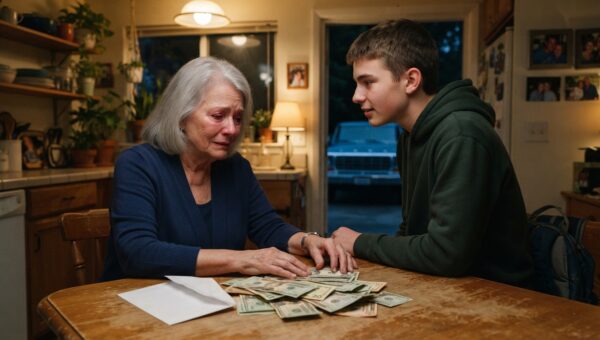
My father made me promise on his deathbed. He grabbed my wrist with a hand that felt like dry oak bark, pulled me close enough that I could smell the menthol rub on his chest, and whispered those exact words. Take care of your mother. I said I would, thinking of the quiet house we grew up in and the way my mother baked bread every Thursday morning.
I did not know then that those five words were a mortgage on the next twelve years of my life.
For the first twelve years after the funeral, my three brothers treated our mother like an optional relative they visited during the holidays if nothing better came up. Randall lived two towns over and changed his phone number every six months. Pete moved to Florida and sent greeting cards with no return address. The youngest, Toby, stayed in town but always had some excuse about cash flow whenever Mom needed her roof patched or her arthritis medicine filled. I was the one who drove her to every specialist in Columbia, paid the grocery bills, and covered the property tax when her pension fell short. Every month, without fail, I transferred the money.
By year eight, the ledger in my desk drawer had grown heavy with carbon copies and yellowed receipt slips.
I do not even know why I kept such careful track, except that a part of me always knew things were unbalanced. I spent $156,000 on rent, utilities, and routine care before the real trouble started. My brothers never asked how the bills got paid. They just showed up for Sunday pot roast, ate until they were stuffed, and complained that Mom did not keep cable television.
Then came the spring of 2018 when Mom collapsed in her kitchen and the hospital bills started piling up like cordwood. The surgery was complicated, followed by three months in a rehab facility that smelled of stale bleach and floor wax. My brothers visited once, stayed for twenty minutes, and complained about the parking fees. I liquidated the last of my mutual fund shares to cover the acute care costs, writing checks that totaled $45,000 out of my own pocket. When she came home, she was frail and scared, so I sat her down at the kitchen table with a hot cup of tea and a document I had drawn up with a local attorney.
Mom looked at the paper with trembling hands. It was a formal promissory note recognizing the two hundred thousand dollars I had poured into her care over the years, backed by her home as collateral. She cried a little bit, dabbed her eyes with a paper napkin, and signed her name in shaky blue ink right on the dotted line. I put it in the manila folder along with every bank transfer slip and receipt, tucked it into my file cabinet, and went back to my normal life of paying her electric bill.
Two months ago, Mom called an all-family meeting at the old house. I thought maybe her health had taken another turn or she wanted to talk about a new water heater. When I walked through the front door, all three of my brothers were sitting around the dining table. Randall looked heavier, wearing a zip-up fleece vest that looked brand new.
Pete had driven up from Florida in a shiny truck. Toby sat near the head of the table, tapping his fingernails against the polished wood.
Mom sat at the center, looking better than she had in years with her hair freshly permed. She smiled warmly when I walked in, though there was a strange, slippery look in her eyes that I had learned to recognize over the decades. She poured coffee from the silver pot and waited until everyone had a mug before she cleared her throat.
“I called you all here because I am getting older and I want to make sure my affairs are in order,” Mom said, her voice steady and practiced. “I have talked it over with my boys, and we have made a decision about the house and the estate.”
I took a sip of my coffee, feeling a small, cold knot form right under my ribs. I already knew what was coming, but I let her talk anyway.
“Since my passing will happen eventually, I want everything to be fair,” Mom continued, nodding toward my brothers. “I am dividing the estate into four equal shares. Twenty-five percent for Randall, twenty-five for Pete, twenty-five for Toby, and twenty-five for you.”
The silence in the room lasted for three full seconds. Randall smiled broadly and leaned back in his chair. Pete muttered something about how that made sense since family always stuck together. I just sat there, my hands wrapped around the warm ceramic mug, staring at the floral pattern on the tablecloth.
“Mom,” I said, keeping my voice very quiet. “I have spent two hundred thousand dollars taking care of you over the last twelve years. I paid your rent, your surgeries, your rehab, and your grocery bills while nobody else chipped in a single dime.”
Mom waved her hand dismissively, the way she used to when we complained about chores as kids. “I know, dear, and I appreciate everything you have done. But your brothers are family too, and blood is blood. They deserve their inheritance just as much as anyone else.”
Across the table, Toby let out a short, sharp laugh. He shook his head, leaning forward with his elbows on the table. “Fair is fair,” Toby said, smirking right at me. “You chose to spend your money on Mom. That was your choice. You do not get to bill us for being a good daughter.”
That was the exact moment the room stopped spinning. I did not yell, and I did not slam my mug down. I simply stood up, pushed my chair back an inch, and reached into the canvas tote bag I had left on the floor beside my feet.
I pulled out the thick manila folder, heavy with twelve years of proof. I laid it on the table right in front of Mom’s coffee cup.
“Let us talk about fair,” I said.
I opened the folder and flipped past the bank statements, the canceled checks, the receipts for groceries, and the pharmacy bills. I laid them out across the table until the floral tablecloth was completely covered in white paper and red ink totals. Finally, I placed the topmost document directly under Mom’s eyes. It was the 2018 promissory note, complete with her signature and the legal seal of the notary public down at the county courthouse.
Mom went completely pale, the color draining from her cheeks until she looked like old parchment paper. She stared down at the paper as if it might bite her.
“Where did you get that?” Mom whispered.
Before she could reach for it, I slid the folder across the table toward the family lawyer, Arthur Vance, whom Mom had quietly invited to make the will official. Arthur adjusted his glasses, picked up the single-page document, and read through it twice with complete professional detachment.
The room was so quiet you could hear the refrigerator humming in the kitchen down the hall. My brothers craned their necks, their earlier smugness melting into confusion as they watched the lawyer’s face tighten. Toby stopped tapping his fingers.
Arthur looked up from the paper, cleared his throat, and looked directly at Mom. “Mrs. Miller, this is a legally binding promissory note and recorded lien against the property title,” Arthur said, his voice flat and clinical. “Under state law, this debt of two hundred thousand dollars takes precedence over any estate distribution. The house must be sold or refinanced to settle this obligation before any remaining equity can be divided among heirs.”
Pete knocked his coffee spoon against his saucer, the metal clinking loudly in the dead silence. “What does that mean?” Pete demanded, looking around the table. “What is he talking about?”
“It means you are getting nothing,” I said, looking right at Toby. “There is no inheritance to split. The house covers what Mom owes me.”
Toby turned on Mom, his face flushing a bright, angry red. “You signed the house over to her? You told us the estate was clear!”
Mom began to cry then, real, wet tears that carved tracks through her powder, but nobody reached out to comfort her. My brothers started shouting over each other, arguing about lawyers and fairness and betrayal, their united front crumbling into pure panic the second they realized their free money had vanished into thin air.
I did not stick around to listen to the shouting match. I closed the heavy manila folder, slid it back into my leather bag, and zipped it shut with a crisp, final sound. I picked up my coat from the back of the chair, turned away from the table, and walked out the front door into the warm afternoon sunlight without looking back once.