PART 1
My brother Kevin told the whole family I refused to pay a single dime toward Dad’s hospital bills.
He didn’t just say it to our cousins or whisper it out on the porch during the wake. He stood near the front foyer of our church with our aunts, shaking his head and sighing while people hugged him. When our cousin Sarah brought me a paper cup of lukewarm punch, she looked at my shoes instead of my face and said, “It must be hard knowing you couldn’t be there financially, Nora. But Kevin really carried the burden.”
I didn’t answer her. I swallowed the sour punch and walked out to my car.
I had a reason for not reacting right away. I had paid those bills quietly, month after month, because Dad had literally begged me from his hospice bed not to shame my brother. Dad knew Kevin’s dry-cleaning business had been failing for three years. Dad knew Kevin had a second mortgage on his house and an ex-wife asking for back child support. Dad was old-fashioned, proud, and terrified that his only son would look like a failure in front of our small town.
“Let Kevin hold his head up, Nora,” Dad had rasped, his dry fingers gripping my wrist so hard his knuckles went white. “You got the steady state job. You got the pension coming. Kevin’s drowning. If the family thinks he handled it, let them think it. Promise your old man.”
I promised him. That was my mistake. I thought I was protecting an old man’s peace in his final weeks. I didn’t realize that in protecting Kevin’s fragile ego, I was handing him a weapon to use against me.
The night after Dad’s burial, Kevin came by my house to pick up Dad’s fishing rods. He stood in my kitchen, refusing to sit, his arms crossed over his chest. When I asked him why he let Sarah and Aunt Evelyn believe I had abandoned Dad, Kevin just scoffed.
“You always disappear when things get hard, Nora,” he said, staring right through me. “You write a check and you think you’re better than everybody. I’m the one who sat in the waiting room.”
I probably would have dropped it. I really would have let it go, swallowed the bitterness, and kept my promise to Dad just to keep the peace.
If not for one thing: $27,440 in receipts inside a manila folder.
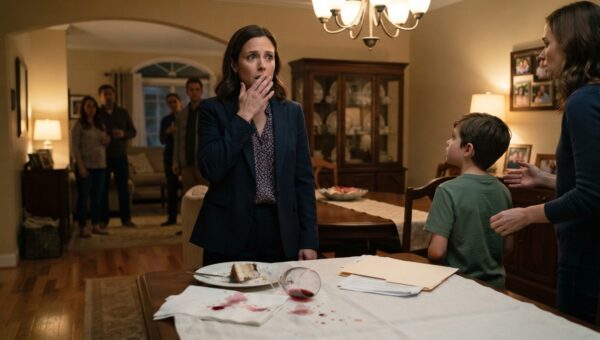
Dad had kept every single one in an accordion file under his bed. When I cleaned out his bedroom two days after the funeral, I gathered the stack of receipts and hospital billing statements, bound them with a heavy rubber band, and slipped them into a manila folder. I brought that folder to the church hall for Dad’s memorial lunch on Saturday, sliding it under my purse on the table.
I didn’t accuse anyone. At the memorial lunch, I sat at the center table and let Kevin finish his speech to sixty friends and relatives about his personal sacrifices before opening the folder. I had not even decided what to say yet.
I just slid the top document out to check the date on Dad’s final ICU invoice.
The first receipt had a second name on it, and it wasn’t mine.
PART 2
The name printed in clean blue ink on the patient account breakdown was not mine, and it was not Dad’s.
It said: *Secondary Payee / Reimbursement Claim: Kevin Vance.*
Right below that, typed in small, automated font by the hospital’s patient accounts billing software, was a line that made my throat go completely dry: *Employee Supplemental Health Plan. Dependent Parent Rider.*
I stared at the paper. I knew Kevin did not have an employee health plan. He owned a small strip-mall dry cleaners with two part-time pressers. He had complained for ten years that independent business owners got robbed on individual health premiums.
I turned the page.
Underneath was a duplicate receipt dated November 14 of the previous year. It was a formal billing invoice for $8,200 covering Dad’s first stay in the cardiac recovery wing. In the upper right corner was the copy of my cashier’s check from the State Employees Credit Union, stamped *PAID IN FULL.*
Directly stapled to the back of my payment slip was a second printout from the hospital billing portal. It showed an account credit balance created two days after my check cleared, followed by a check disbursement notice.
*Disbursement check #44091 issued to: Kevin Vance, Power of Attorney. Reason: Account overpayment / Third-party secondary settlement. Amount: $8,200.*
My hands started to tremble on the plastic tablecloth.
I began flipping through the rest of the manila folder. Every single time I had paid the hospital directly, Kevin had gone into the patient accounts office with Dad’s medical power of attorney paperwork.
When Dad had his hip surgery in January, the out-of-pocket balance was $6,400. I had wire-transferred that money from my emergency savings account directly to the hospital’s finance desk. In the folder, stapled to my transfer receipt, was another hospital ledger slip: *Refund processed to Kevin Vance: $6,400.*
Every single dollar.
All $27,440.
Dad had not known what was in those envelopes. The hospital had mailed the statements to Dad’s house, and Dad had simply stuffed them into the accordion file under his bed because he could not bear to read medical bills. He had handed me the original bills when they arrived, whispering to me not to tell Kevin so Kevin wouldn’t feel small.
Meanwhile, Kevin had been submitting claims through our mother’s old surviving teacher’s union supplemental survivor benefit, an old plan Dad had retained from Mom’s death eight years ago. The insurance had been quietly covering the balances on the back end. And whenever my private payments arrived first, the hospital refunded the surplus to the designated family representative on file.
Kevin had collected my payments as cash refunds. He had taken twenty-seven thousand dollars of my hard-earned money and pocketed it, while standing in front of our grieving family telling everyone I had refused to pay a single penny.
Around me, the memorial lunch was winding down. Aunt Evelyn was cutting slices of lemon pound cake. Across the room, Kevin was laughing with two of Dad’s old lodge brothers, leaning against the coffee urn with his hands in his pockets, soaking in their sympathy.
“Kevin’s a good boy,” one of the men said loud enough for the room to hear. “Takes a real man to shoulder that kind of debt for his father.”
Kevin lowered his head modestly. “You do what you have to do for family, Tom. Even when you’re the only one doing it.”
I stood up. I picked up the manila folder, walked across the linoleum floor, and stopped two feet from the coffee table.
PART 3
“Kevin,” I said.
My voice was not loud, but it cut right through the chatter around the urn. Aunt Evelyn stopped her knife in the middle of the cake. Cousin Sarah looked over from the punch bowl.
Kevin turned around, holding a ceramic mug. He had that tired, patient smile on his face, the one he had worn all week for the mourners. “What’s up, Nora? If you’re heading out, make sure you take some of the casserole dish.”
“I have Dad’s receipts,” I said.
Kevin’s smile twitched slightly at the corner of his mouth. “Nora, not now. We’re celebrating Dad’s life. We don’t need to get into finances today.”
“You got into them forty-five minutes ago during your toast,” I said. “And you got into them with Sarah on the front lawn.”
“I was just answering questions,” Kevin said, his tone sharpening. “People asked who took care of the hospital, and I told the truth. There’s no shame in admitting you couldn’t afford it, Nora. Nobody is judging you.”
“I didn’t fail to afford it, Kevin,” I said. I opened the folder and took out the top statement. “This is the invoice from Dad’s cardiac ward in November. It was eight thousand, two hundred dollars.”
“I remember,” Kevin said, sighing dramatically for the room. “I wrote the check from my business account. It almost broke me.”
“No, you didn’t,” I said. I held up the white slip attached to the invoice. “This is a cashier’s check drawn on my State Employees Credit Union savings account. My name is on the remitter line. It cleared on November 16.”
The room went completely quiet. The only sound was the low hum of the commercial refrigerator in the church kitchen.
Kevin looked at the paper in my hand. His face went rigid. “You don’t know what you’re looking at, Nora. That was an estimate. The hospital sends out multiple drafts.”
“I know what the next page is,” I said. I pulled the second sheet from under the paperclip. “This is a refund voucher from the hospital accounting office dated November 18. It says Dad’s secondary insurance covered the bill, creating an overpayment of eight thousand, two hundred dollars. And right here, on the distribution line, it says the check was mailed to Kevin Vance.”
Aunt Evelyn set her knife down on the counter with a dull clatter.
Kevin reached out, his hand quick, trying to snatch the paper from my fingers. I stepped back, holding the folder flat against my chest.
“Don’t touch it,” I told him. “There are four more in here. Six thousand, four hundred for the hip surgery. Five thousand, nine hundred for the intensive care unit in February. Six thousand, nine hundred and forty dollars for his medications and home oxygen equipment.”
I laid the folder down flat on the table right next to the coffee urn, spreading the papers like a deck of cards across the white paper tablecloth.
“Every single time Dad brought me a bill, he cried because he didn’t want you to know I was paying it,” I said. “He thought your business was hurting. He thought you’d be humiliated if you found out your little sister was carrying the load. So I paid every bill in cash or cashier’s checks directly to the hospital so you wouldn’t see it on Dad’s accounts.”
Kevin’s chest rose and fell rapidly. He looked around the room, but nobody was meeting his eyes now. Tom, Dad’s lodge brother, slowly took his hand off Kevin’s shoulder and backed up a step.
“I didn’t steal anything,” Kevin muttered, his voice dropping low, thick with sudden panic. “Dad owed me money. For years. I drove him to every doctor’s appointment. I mowed his lawn for five summers. That was family money. It belonged to the estate anyway.”
“It didn’t belong to the estate,” I said. “It came out of my savings account. Twenty-seven thousand, four hundred and forty dollars. You didn’t just take my money, Kevin. You took it, cashed the refund checks into your own pocket, and then stood in a church foyer telling our family I abandoned our father.”
Sarah stared at Kevin from across the table, her mouth slightly open. “Kevin, is that true?”
Kevin didn’t answer her. He looked down at the linoleum, his jaw clenched tight, the blood rushing into his neck. He didn’t look like the grieving, dutiful son anymore. He looked like an exposed stranger in a cheap suit.
ENDING
Kevin left the church hall through the side fire exit without saying another word to anyone. He didn’t take a plate of food, he didn’t pick up Dad’s remaining tackle boxes from the back room, and he didn’t say goodbye to Aunt Evelyn.
The silence he left behind wasn’t dramatic. It was just uncomfortable and heavy, the way family rooms get when a long-running lie finally collapses under its own weight.
Aunt Evelyn came over to me while I was gathering the papers back into the manila folder. She reached out and touched my forearm. She didn’t apologize out loud, and I didn’t ask her to. Older folks in our family don’t know how to say they were wrong about a character judgment. But she packed up two glass dishes of Dad’s favorite scalloped potatoes, wrapped them in foil, and carried them out to my trunk herself.
On Monday morning, I didn’t go to the police, and I didn’t hire an estate litigator. Dad was barely in the ground, and I did not have the stomach for a county courtroom spectacle.
Instead, I took the folder to our family attorney, Mr. Henderson, who had drawn up Dad’s original deed and will twenty years ago. When Mr. Henderson looked through the hospital refund slips, his face settled into a hard, grim line.
“Kevin has forty percent of the house coming to him under your father’s will,” Mr. Henderson told me, leaning over his desk. “The house will appraise around ninety thousand. If you want, Nora, I can draft an estate settlement agreement today. Kevin signs over his entire equity interest in the property to you to satisfy the unauthorized distribution of twenty-seven thousand, four hundred and forty dollars. If he refuses, we file a formal citation for estate fraud in probate court by Friday.”
I told Mr. Henderson to draft the papers.
Kevin signed them on Wednesday afternoon. He didn’t call me, and he didn’t contest a single clause. He brought the signed documents into Mr. Henderson’s office, handed over his set of keys to Dad’s house, and walked out without leaving a forwarding address.
A month later, on a cool Sunday afternoon, I unlocked Dad’s front door with my own key.
The house was completely still. The scent of Dad’s pipe tobacco and peppermint hard candy still lingered in the living room curtains. I walked into the kitchen, set my purse on the counter, and looked out the window at the garden plot Dad had kept planted every spring since I was six years old.
The house was mine now, free and clear, without Kevin’s name anywhere on the deed. It wasn’t the way I ever wanted to own it. There was no joy in winning a house by proving your only brother is a thief.
I took the manila folder out of my bag, walked down the narrow hall to Dad’s bedroom, and placed it inside the bottom drawer of his nightstand. I closed the drawer, turned off the lamp, and finally let myself sit down in the quiet.