My phone buzzed against the kitchen counter at 10:14 on a Saturday morning, a little text reminder from the bank about a low balance alert that I didn’t think twice about because Julian always handled the big investments. Ten years of marriage makes you lazy in a quiet sort of way. You stop checking the locks twice, you stop asking where the tax returns went, and you just assume that the person sleeping on the other side of the mattress is reading from the same book.
We had spent the morning drinking black coffee out of the heavy mugs we bought in Vermont, talking about planting winter onions down by the fence line. It was an ordinary morning. The kind of morning that smells like damp soil and toast crumbs before the sun burns the fog off the gravel road.
Julian had been checking his watch three times in ten minutes, which was his tell when a client was calling him on the weekend, but I didn’t think much of it. He wore his graying hair short and kept his shirts pressed without me having to ask. People in town thought we had the kind of quiet, steady life that didn’t make news. I was the one who kept the books for the hardware store downtown, and Julian ran commercial real estate loans out of the branch by the courthouse. We drove a four-year-old Subaru that we paid cash for, and we had never bought a house bigger than we could clean ourselves in an afternoon.
That was the picture, anyway. A neat little portrait in beige and gray.
We were halfway down Maple Street, right past the old brick Methodist church, when we saw her. She was struggling with something heavy. A cardboard wardrobe box, the big tall kind you use for winter coats, was wedged half out of the trunk of a battered blue sedan with primer spots on the fender. She had on high heels that were sinking straight into the soft grass by the curb, and her dark hair was stuck to her forehead with sweat. She was fighting that box like it weighed half as much as she did, her arms shaking under the cardboard. Julian stopped dead in his tracks. His sneakers squeaked once on the dry concrete, and then he just froze.
“Help her out,” I said, giving his elbow a little shove because it was ninety degrees out and the girl looked like she was about to drop the whole thing right on her toes. “What are you waiting for?”
He didn’t move for three long seconds. When he finally turned to look at me, all the color had completely drained from his face, leaving him the gray of wet cement.
His mouth opened twice before any sound came out, like a fish pulled up onto the dock. The words he whispered weren’t meant for the church bells or the passing traffic, but they hit the air between us heavier than lead.
“That’s my daughter,” he whispered, his voice shaking so hard I barely caught the syllables over the cicadas in the elms. “And everything she owns is being paid for by the money I stole from our joint accounts.”
I just stared at him. The word daughter didn’t fit into the sentence. We didn’t have children; we had agreed on that back in the second year when the clinic bills started piling up and we decided the farm mortgage and our sanity mattered more. My brain stalled out right there on the sidewalk, unable to push past the gears of what he had just admitted. Before I could ask him what the hell he meant, the girl lost her grip on the top flap of the wardrobe box.
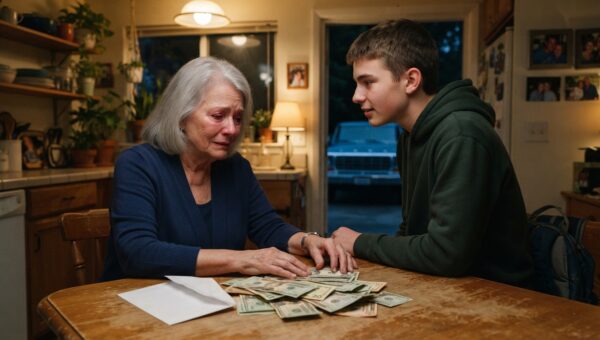
The cardboard tore down the side with a loud ripping sound that echoed off the brick wall of the church. The whole thing hit the asphalt with a sickening thud, spilling its contents across the middle of the street in a messy fan of clothes, plastic tubs, and loose paper. A thick stack of banded fifty-dollar bills slid right out of an open canvas bank bag and scattered across the white lines of the crosswalk. Right behind the cash came three framed photographs face-down on the warm pavement, and a velvet jewelry roll that I knew better than my own name. It was my grandmother’s sapphire ring and her gold locket, things I hadn’t seen since I put them in the small wall safe behind the pantry door six months ago.
The girl let out a small, choked sound and dropped to her knees in the middle of the street, grabbing at the loose bills before the wind could catch them. “Dad,” she cried out, her voice cracking as she looked up at Julian standing there like a ghost. “Dad, help me get this stuff in the car. The landlord locked the door twenty minutes ago.”
The word hung there in the September air. Dad. Not a client. Not a niece from out of state. Not some vague business obligation he forgot to mention over Sunday pot roast. The girl was twenty, maybe twenty-two, with dark eyes that looked just like the ones in the old high school yearbook picture of Julian’s first girlfriend from down in Lincoln that I found once in the back of his cedar chest and never asked about because I trusted him. I stood there on the hot concrete while the neighborhood traffic crawled past us, nobody stopping because people in Nebraska mind their own business until the shouting starts.
“Julian,” I said, and my voice didn’t sound like mine at all. It sounded thin, like paper tearing in another room. “Open your phone.”
“Lorna, please,” he stammered, taking a half-step toward me with his hands out, his palms empty and sweating. “I can explain every dime. It’s just, she had nowhere to go for the semester, and the tuition at the state college went up, and, “
“Open the app,” I repeated, louder this time, stepping around the spilled clothes and the bank bands until I was right in front of him. “Show me the savings balance.”
He fumbled in his pocket for three tries before his thumb hit the glass screen, his fingers shaking so badly he dropped the phone twice against the toe of his shoe. When the screen finally lit up, he didn’t even have to tap it twice. The balance on our primary savings account blinked back at us in plain black numbers against a white background. Forty-two dollars and sixteen cents. We had forty-two dollars left after ten years of working seventy-hour weeks at the hardware store and the loan office, while our life savings had been funneled into tuition checks and apartment deposits for a girl we supposedly never had.
The girl on the pavement stopped gathering the money and looked between the two of us, her face flushing red under the sun. “You didn’t tell her?” she whispered, her hands hovering over a stack of accounting textbooks with Julian’s neat handwriting scrawled inside the front cover. “You said she knew. You said she was helping.”
“Shut up, Chloe,” Julian muttered, his voice dropping into that low, ugly tone he only used when the loan committee turned down a bad risk.
“Don’t you tell her to shut up,” I said, and the heat finally hit my chest like someone had poured boiling water down my shirt. “You’ve been stealing from my grandmother’s estate, you’ve been draining the store dividends, and you set up a whole second life two towns over while you ate my pot roast every single night.”
I reached down and picked up one of the frames that had spilled from the box. It was a picture of Chloe in a cap and gown, smiling proudly while Julian stood behind her with his hand on her shoulder, both of them squinting against the May sun. The date stamp in the corner was from three years ago, right around the time Julian told me we needed to take out a second mortgage on the house to fix the roof. The roof was fine. The money had gone into a down payment on a rental townhouse near the campus so his daughter wouldn’t have to live in the dorms with the common folk.
“You took the pearls, too,” I said, looking right at him. I didn’t yell. People who yell haven’t figured out yet that the game is over. “You told me they were stolen during the break-in at the office last November. You even filed the police report yourself.”
“The insurance covered most of it,” he mumbled, looking down at his sneakers like he was trying to find a crack in the pavement to crawl into. “Lorna, let’s just go home and talk about this. We can sell the truck. We can figure something out.”
“There is no home to go back to, Julian,” I said, and I reached up with my left hand, sliding the heavy gold band off my finger. It came off easy, easier than it should have after ten years of sweat and cold winters. I dropped it right into the middle of the pile of clothes and banded cash at the feet of the girl who was staring up at us with wide, terrified eyes. “You can keep the money. You can keep the kid. But the house is in my name from before we married, and the locks are getting changed before the sun goes down today.”
He didn’t follow me when I turned around. I walked back up Maple Street toward the brick church and the hardware store beyond it, my footsteps steady on the hot sidewalk, not looking back once to see if he was picking up his daughter’s boxes or his own dignity.