Mr. Kessler asked me to help him die at home. I am his neighbor, not his nurse, though thirty years working the floor at Mercy Hospital tends to leave certain habits baked right into your bones. You don’t ever really forget how to check a pulse without looking at your watch, or how to read the peculiar gray tint that settles into a dying man’s skin when his kidneys finally decide to pack it in.
Arthur didn’t want strangers in white coats coming and going through his front door. He wanted his own worn-out armchair, the smell of sawdust lingering in the hallway from the workshop he hadn’t used in five years, and somebody nearby who knew how to hand him a fresh glass of ice chips without making a fuss about insurance forms.
I told him I’d help. I didn’t have any business saying no. Arthur’s wife Clara passed away back when the brick plant down on the river was still running three shifts, and after that, it was just Arthur and his workshop. His son David had packed up a battered Ford pickup a decade ago after a shouting match that the whole street could hear through open screen doors, and he never came back. Arthur told me on the very first day I moved my nursing gear into his spare bedroom, back when he could still walk to the bathroom on his own two feet with a cane, that we had a strict rule to follow.
He looked right at me with those pale, stubborn eyes and said, “Don’t call David.”
I nodded because at the time, it seemed like a straightforward promise between neighbors. You respect a dying man’s boundaries. You don’t go digging around in old family graves just because you’ve got a soft spot for prodigal sons. But Arthur didn’t account for the persistence of someone who grew up with his exact same stubborn blood. Every afternoon since Arthur took to his bed for good, my own cell phone has rung at precisely four o’clock in the afternoon. Every single day without fail. It’s David on the other end. He asks how his father is doing in a voice that is polite and desperate and trying not to cry, holding his breath between every sentence like he’s waiting for me to drop an anchor through his chest.
I always give him the short version because I promised I would, though the lying gets heavier with every passing twenty-four-hour cycle.
I tell him his father is resting. I tell him he’s comfortable. I don’t tell him about the rattling breath in Arthur’s throat or the way the hospice nurse, Brenda, pulled me aside this morning to say we were looking at forty-eight hours, maybe less. David just breathes into the receiver on the other end, thanking me like I’m doing him some massive favor by keeping him alive in exile. “Is he asking for me at all?” he asked yesterday, his voice cracking right in the middle of the word asking. I told him no, and the silence that followed on the line felt longer than the Mississippi River.
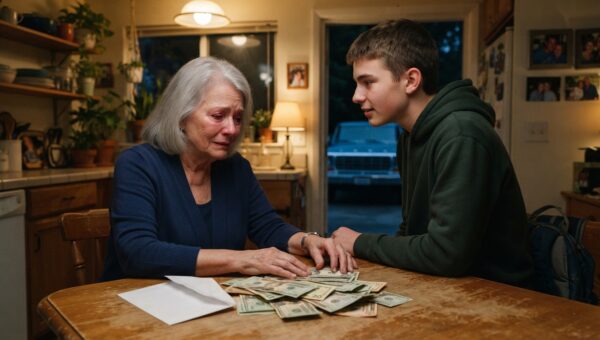
The letter arrived two days ago, dropped into my mailbox by a mail carrier who didn’t even bother ringing the bell because he knew the house was under hospice care. It sits right now on the kitchen table, resting right next to the telephone where the digital display flashes the time like a slow countdown.
The envelope is standard white with my name written across the front in blue ink, but the handwriting has that sharp, slanted tilt to it that I recognize from the old neighborhood church directories. It’s unopened. Arthur doesn’t know it’s here, and even if he did, he’d probably tell me to throw it straight into the woodstove in the corner of the den.
Brenda came by around noon to adjust his morphine drip and check his vitals. She’s a practical woman who’s seen a thousand people leave this world, and she doesn’t waste time with sugarcoating. “He’s slipping into the deep sleep now, Arlene,” she told me while we stood by the kitchen counter, washing our hands in the small porcelain basin. “If there’s anything left unsaid in this house, you better say it before tomorrow morning.” She dried her hands on a paper towel, gave my shoulder a brief, professional squeeze, and walked out to her hatchback. The front screen door gave that familiar, metallic squeak that I’ve been hearing every afternoon at four o’clock for the last three weeks.
I walked back into the bedroom to check on Arthur. He was lying flat on his back with his mouth slightly open, his chest rising in shallow, uneven waves that sounded like dry leaves scraping across a concrete driveway. The bedside lamp was casting a yellowish circle of light over his forehead, highlighting the deep grooves that thirty years of woodworking and stubborn pride had carved into his face. I reached down and pulled the thin wool blanket up over his bony shoulders, noticing how cold his skin felt even beneath the flannel. He didn’t stir. He was miles away, probably standing in that old garage with the radio playing country music low, arguing with a ghost he’d been fighting for ten whole years.
The thing is, I found out why they fell out back in the autumn of fourteen. It wasn’t because David wanted to move away or because he married the wrong girl from over in Rolla. It was because Arthur said something unforgivable at the kitchen table three days after Clara was buried, telling his boy that he didn’t have the stomach to run the family carpentry business because he spent too much time chasing books instead of honest labor. David dropped his coffee mug right there on the linoleum, watched it shatter into a hundred tiny pieces, and walked out the door without looking back. Arthur spent the next ten years convincing himself that his son was cold-hearted, while David spent ten years waiting for a single word of apology that never came.
I walked back out to the kitchen and stared down at the white envelope resting beside the telephone. My thumb hovered over the top edge of the paper for a long time while the grandfather clock in the hallway ticked away the seconds toward four o’clock. Arthur told me not to call David, but he didn’t say a single word about what might happen if David found another way in through the back door. I slid my index finger under the flap of the envelope and tore it open with a sharp little rip that sounded entirely too loud in the quiet house.
The letter inside was written on three sheets of lined yellow legal paper, folded twice and slightly yellowed at the creases like it had been carried around in a pocket for a long time before finally being mailed. I started reading under the harsh light of the kitchen fixture, my eyes tracking the hurried, uneven lines. David had written that he never stopped driving past the house on his way down to Springfield, that he sat in his truck at the end of the gravel road on his mother’s birthday every single year just to see if the kitchen light was on. He wrote that he didn’t care about the old argument anymore, that he was tired of being angry at a ghost, and that he just wanted his father to know he was sorry for walking away when Clara would have wanted them to hold each other up.
“I know he won’t answer,” David had written right near the bottom of the third page, the ink smudged where a tear must have hit the paper. “I know he’d rather die alone than admit he was wrong about me. But if you’re reading this to him, please tell him I kept the toolbox he built me for my sixteenth birthday. It’s sitting in my truck right now.”
The digital clock on the microwave changed its numbers with a soft click, flipping over to 3:58. Two minutes until four o’clock. The house was dead quiet except for the low, rattling rasp of Arthur breathing in the other room. My hand was shaking slightly as I picked up the telephone receiver and set it down on the table, keeping the line clear for a call I knew was coming down the wire. I walked over to the bedroom door and looked in at the old man lying under the quilt, wondering if ten years of silence could really be undone by a three-minute phone call from a stranger who didn’t know when to mind her own business.
The phone started ringing at exactly 4:00 PM, shrill and demanding against the quiet backdrop of the afternoon. I let it ring twice, three times, listening to the electronic chirp echo off the walls of the empty hallway. On the fourth ring, I picked up the receiver and brought it to my ear before David could hang up and lose his nerve. “David,” I said before he could start his usual polite preamble about how his father was holding up. “Listen to me very carefully. Don’t say anything yet. Just listen.”
There was a sharp intake of breath on the other end of the line, followed by dead silence except for the hum of long-distance static. “Arlene?” he whispered, his voice trembling so hard I could barely make out the syllables. “Is he… did something happen?”
“He’s still here,” I said, walking the portable phone slowly down the hallway toward the open bedroom door until I was standing right beside Arthur’s mattress. “He’s sleeping, but he’s breathing on his own. And I have a letter sitting on my kitchen table that I think he’d want to hear.” I didn’t wait for his permission. I hit the speaker button on the handset, set the little plastic box down gently on the wooden nightstand right next to Arthur’s empty water glass, and started reading David’s words out loud into the quiet room.
I read every single line in a steady, nurse’s voice, starting from the part about the truck parked at the end of the road all the way down to the mention of the sixteenth-birthday toolbox. When I got to the part about Clara, I looked down at Arthur’s face and saw something shift beneath his eyelids. The shallow, rattling breaths hitched for a second. His fingers, curled into fists over the edge of the blue wool blanket, suddenly twitched and slowly began to open, the stiff joints relaxing as if a heavy iron weight had just been lifted off his chest.
“Dad?” David’s voice came out of the small speaker on the nightstand, sounding thin and scared and impossibly young across the miles of telephone wire. “Dad, are you listening?”
Arthur didn’t sit up. He didn’t perform any miraculous recovery. But his eyes fluttered open, watery and unfocused in the yellow lamplight, staring up at the ceiling before slowly turning toward the sound of the tinny voice coming from the little plastic box. A single tear broke loose from the corner of his left eye, cutting a clean path down through the gray stubble on his cheek before disappearing into the collar of his flannel shirt. His lips parted, dry and cracked, moving once or twice before a sound finally came out of his throat, hoarse and broken with ten years of stubborn pride. “Davey,” he whispered.
The phone on the nightstand stayed active for the next twenty minutes while father and son talked across a distance that should have taken a lifetime to cross, speaking in short, clumsy sentences that left out all the bitterness and kept only the marrow. By the time David’s car tires crunched into the gravel of the driveway forty-five minutes later, slamming car doors breaking the long silence of the street, Arthur was propped up slightly against two pillows with a look on his face I hadn’t seen since the day I first moved in next door. The unopened envelope sat empty on the kitchen table beside the telephone, and the front door clicked open to let a son back into a house that had been cold for far too long.