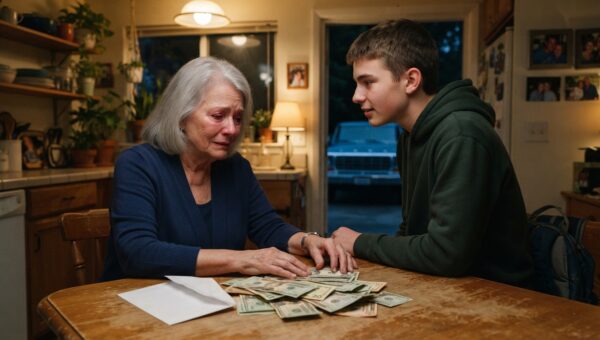
The kettle was whistling on the stove, a sharp little shriek that cut through the quiet of an empty house, but I stayed right where I was on the top step of the cellar stairs, my hand frozen against the wooden banister. I was wiping down the kitchen counter for the third time that morning, moving the same glass jar of sugar left and right, because if I stopped moving my hands, I knew the silence would catch up to me.
The paper towel was damp and bunching up in my palm. My husband Arthur had been gone three years now, and the quiet in the house had gone from a peaceful thing to something heavy and pressing, like a damp wool blanket draped over my shoulders. I kept the radio on low just to have a voice in the room, but even the midday news announcer sounded like he was talking from the bottom of a well. I didn’t expect anything out of the ordinary when I grabbed my canvas tote bag and walked three blocks down to the branch library to drop off my overdue mystery novel.
The library vestibule always smelled of floor wax and old paper, a clean, dry scent that usually settled my nerves. But when I pushed open the heavy glass door, I didn’t make it to the return drop. Pinned right to the center of the cork community board with a yellow plastic pushpin was a typed index card, stark white against a collage of church bake sales and lost cat flyers.
My eyes caught the word Fairhaven before my brain had even processed the rest of the sentence. Fairhaven. That single word hit me right behind the ribs, a sudden, cold jolt that made me drop my library book onto the linoleum floor with a sharp thud. I bent down slowly, my knees popping, and picked it up, but my feet wouldn’t move away from that board. I stood there staring at the typed lines until the black letters seemed to blur together into gray smudges.
The notice was typed on an old machine with a crooked lower-case e. It said a woman born in the spring of 1969 at the Fairhaven home was looking for any information about her birth mother. Then came the sentence that made my breath catch in my throat and stay there. She remembered only a homemade flannel bib with a crooked letter M embroidered in blue thread on the corner.
The corkboard seemed to tilt slightly, or maybe it was just the blood rushing out of my head. Fifty-six years. I had buried that memory so deep under twenty years of quiet marriage and church committees and Sunday potlucks that I sometimes wondered if 1969 had even happened to me at all, or if I had read it in some sad book. My fingers brushed the edge of the paper on the board before I caught myself. Passersby would have seen an ordinary seventy-three-year-old woman in a beige cardigan staring a little too long at a lost dog flyer, but inside my skin, I was seventeen again and terrified of my father’s heavy boots on the linoleum.
I walked home without returning the book, my grocery tote swinging against my knee, and sat down at the kitchen table with the phone right in front of me. I didn’t take off my coat.
My hands were shaking so badly I dropped the receiver twice before I managed to punch in the seven digits typed at the bottom of that index card. Each ring sounded hollow and impossibly loud in the empty kitchen, echoing off the floral wallpaper Arthur had put up back when we still thought we might have children of our own. I almost hung up on the fourth ring, telling myself it was a cruel joke or a mistake, some registrar’s office error dragging up bones I had spent a lifetime burying in the backyard. But then the line clicked open, and a woman’s voice said hello. It was a soft voice, a little raspy around the edges, and she didn’t say anything else after that single word. She just breathed into the receiver, and in that ragged intake of air, I heard the exact same pause my mother used to take before she told me hard truths.
“Is this about the board?” I asked, and my voice sounded like dry leaves scraping across concrete. “The card at the library?”
There was a long silence on the other end, so quiet I could hear the faint hum of a refrigerator miles away. “I’ve waited fifty-six years to hear someone ask me that,” she said, and her voice cracked right in the middle of the sentence. “Are you her?”
I couldn’t say yes. I couldn’t even find the breath to say no. I just sat there gripping the yellow plastic receiver until my knuckles turned white, staring out the window at the neighbor’s overgrown privet hedge. “I was seventeen,” I whispered, and the confession slipped out before I could stop it, simple and ugly. “My father drove me there in the middle of the night so nobody in the parish would see my stomach.”
“Fairhaven,” she said softly, and I could hear her crying now, quiet and restrained, the way people cry when they’ve practiced it alone in dark rooms for decades. “You were seventeen. I know. I know the rest of it. Can I come see you this Saturday? I only live four hours north. I’ll drive down first thing in the morning.”
“Saturday,” I repeated, tasting the word like it was something foreign and sharp. “Yes. Come on Saturday.”
The rest of that week passed in a blur of gray mornings and endless sweeping. I didn’t tell the ladies at the altar guild, and I didn’t call my cousin Martha, who usually knew everything about everybody before it even happened. I kept the secret inside my ribs, the way I had kept it when Arthur was alive. Arthur was a good man, steady as a fence post and kind to a fault, but he was a man of his generation who believed that what was in the past should stay in the past where the dirt wouldn’t get kicked up. When he asked me once, years ago, why I never talked about my family before we met, I told him my father and mother had died in a car crash up in Nebraska and left no papers behind. It wasn’t entirely a lie; they were as good as dead to me the moment they packed my bags in March of 1969 and dropped me off at the heavy iron gates of Fairhaven with a suitcase full of oversized dresses and a strict warning about family honor.
Fairhaven wasn’t a hospital; it was a brick-faced brick purgatory run by women who wore stiff gray uniforms and treated sin like a mildew you could scrub off with lye soap. We weren’t allowed to use our last names, and we spent our afternoons sewing baby blankets for families who could afford a proper donation to the diocese. My father had made it clear before he turned his Buick around in the gravel drive that I was not to bring shame back under his roof. When the pains started on a rainy Tuesday in May, they gave me a stiff shot of something that made the ceiling swim and wheeled me down a narrow corridor that smelled of carbolic acid and boiled cabbage. I woke up twelve hours later with flat pillows and an empty crib at the foot of the iron cot. A nurse with hair pulled back so tight her eyebrows looked permanently arched set a stack of adoption papers on my gray blanket before I could even sit up.
“Sign at the bottom of the line, Evelyn,” she had said, and her voice didn’t have any vinegar in it, which somehow made it worse. “Your father is waiting in the parlor with the car running. He paid the intake fee, and the paperwork is already filed with the county.”
I remember the pen they gave me was one of those cheap plastic ballpoints with the blue cap that always leaked ink onto your fingers. My hand shook so badly the signature looked like a spider dying on the page. Before the nurse picked the papers back up, I had reached into the pocket of my cotton housecoat and pulled out the small flannel scrap I’d been hoarding since midnight. I had stolen a square of white diaper cloth from the laundry basket down the hall and spent three hours by the dim light of the hallway sconce embroidering a crooked letter M with blue sewing thread I’d begged off the laundry girl. It was lopsided because my fingers were clumsy and my eyes were swollen from crying into my pillow, but it was the only thing in the world that belonged to both of us. I tucked it deep inside the receiving blanket right where her little chin would rest, pressing it down hard so the nurse wouldn’t see the lump before she carried her away down the corridor.
By Friday night before Saturday’s visit, I had scrubbed my kitchen floor on my hands and knees twice. I baked a lemon pound cake because my mother used to bake them whenever company came, even though I didn’t even know if Clara liked sweets. The clock on the microwave ticked toward eleven, then midnight, and I sat at the kitchen table with the overhead light off, watching the headlights of occasional cars sweep across the living room ceiling. I thought about the man my father had been, a man who measured his worth by how many people took off their hats when he walked into the feed store, and how easily he had traded his own flesh and blood for a clean name in a small town where nobody cared about anything except how straight your corn rows were. I had spent fifty-six years believing I was an accomplice to that hardness because I signed my name with that leaky blue pen.
Saturday morning broke gray and humid, the kind of heavy Midwestern morning where the air feels like wet flannel. At precisely eleven o’clock, a dusty blue sedan pulled slowly into my gravel driveway and crunched to a halt near the back porch steps. I was standing right behind the screen door with my hand resting on the wooden frame, watching through the rusted wire mesh. The car door opened, and a woman in her mid-fifties stepped out onto the gravel. She was wearing a sensible green raincoat and had short, curly brown hair that looked a little windblown from the drive. She looked up at the porch, and for a second, she didn’t move at all. She just stood there with her hands folded over her purse, her shoulders curved forward just slightly, the exact same way I stood whenever I was waiting for bad news at the doctor’s office.
I pushed the screen door open and stepped out onto the porch boards, the old wood groaning softly under my slippers. She took three steps toward the wooden stairs, stopped, and then opened her arms wide without saying a word. I walked down those three steps, my knees trembling so hard I thought I might miss the landing, and fell right into her embrace. She smelled of rain and peppermint tea, and when her arms went around my back, the fifty-six years of silence between us just evaporated into the damp morning air. We stood there holding onto each other beside the porch railing for a long time, neither of us saying anything because there weren’t words big enough to cover what had happened in the gap between our lives.
“You came,” I whispered into the shoulder of her green coat.
“I told you I waited my whole life,” she said, pulling back just enough to look at my face with eyes that were the exact shade of hazel as my mother’s used to be. “I have something to show you.”
She reached down into the large leather pocket of her handbag and pulled out a small, flat square wrapped in tissue paper. With fingers that were just as unsteady as mine, she peeled back the brittle, yellowed paper and revealed a piece of faded white flannel, washed thin by fifty years of careful laundering. She turned back the bottom corner, and there it was, the crooked little M, stitched in coarse blue thread that had frayed slightly at the edges over the decades. It had been kept in a wooden box on a shelf in her adoptive mother’s bedroom all her life, treated like holy relics are treated in cathedrals, her only tangible proof of where she came from before the world started.
“My adoptive mom kept it in her cedar chest,” Clara said, her voice catching as she traced her thumb gently over the lopsided stitches. “She told me on my sixteenth birthday that I was wanted, even if the world made it hard back then. She said whoever sewed this put a piece of her soul right into the cloth so I’d know I wasn’t forgotten.”
We went inside the kitchen together, and I poured coffee into two heavy ceramic mugs that Arthur used to use for his morning black roast. We sat at the white laminate table where I had eaten thousands of solitary meals, but the room felt different now, wider and brighter, as if the walls had finally been pushed out to let the light in. She told me about her life up in northern Iowa, about the couple who raised her with love and piano lessons and church socials, and about the children and grandchildren she had raised herself who all had her same stubborn chin. I told her about the long decades in this house, about Arthur and his vegetable garden, and about the quiet grief I had carried around like a smooth stone in my pocket until it wore a hole clean through my lining. We didn’t talk about my father once, because his name didn’t belong in the room with us, and neither did the cold brick halls of Fairhaven.
By late afternoon, the sun finally broke through the gray clouds and threw long, golden squares across the kitchen floorboards, catching the edge of the old baby bib resting right beside a modern snapshot of Clara’s grandchildren that she had propped against the sugar bowl. We were sitting close together on the vinyl bench, talking about nothing and everything all at once, the way mothers and daughters do when they’re making up for five decades of missed kitchen tables and rainy afternoons. I looked down at the crooked blue M on the flannel square, then over at Clara’s face as she laughed at some foolish thing I said about my garden tomatoes, and for the first time since 1969, my chest felt entirely empty of secrets.