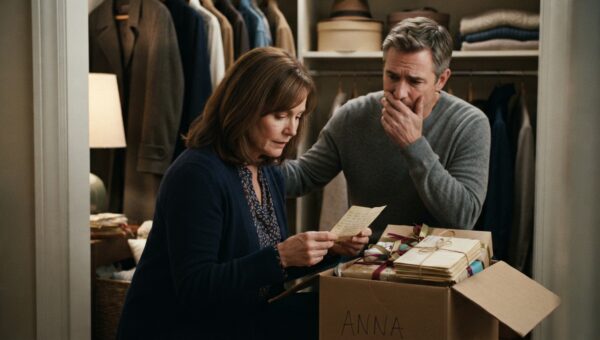
The box of letters sat on my kitchen table for three days before I finally opened the lid. It wasn’t because I didn’t care. It was because the cardboard smelled faintly of the municipal storage unit where they kept the belongings after the house was sealed, and that smell alone could make my throat tighten up until I couldn’t swallow.
My mother’s handwriting was neat, slanted slightly to the right, the kind of penmanship taught to girls in parochial schools back in the fifties. Every envelope started the same way. Sweetheart, she would write, in blue ballpoint ink that had faded to the color of a robin’s egg. I didn’t do it.
I was seventeen when the sheriff knocked on our side door at two in the morning, his flashlight beam cutting right through the kitchen window where my father was lying face down on the linoleum. My father, Arthur, had a habit of staying up late to work on his ledgers, smoking stale pipe tobacco at the kitchen table until the house smelled like burnt sugar and old wool. That night, the smell was different. It was sharp and iron-heavy, the kind of metallic stink that gets into your clothes and stays there for days. The deputies found my mother upstairs in our bedroom, fast asleep under the heavy patchwork quilt my grandmother had sewn.
Her flannel robe was stained with a dark, wet circle near the cuff where she had accidentally nicked her thumb cutting beef roast for Sunday dinner earlier that evening. They found the heavy bone-handled hunting knife tucked four inches deep beneath the mattress on her side of the bed.
The trial lasted eight days. The prosecutor, a man named Vance with slick gray hair and a voice like gravel sliding down a chute, laid the evidence out on the oak table like a row of dominoes. The blood on the robe matched my father’s type. The knife belonged to the set my father kept in his tackle box in the garage. The back door was locked from the inside. There were no signs of forced entry. Vance looked right at the jury during his closing argument and said the words that eventually sealed the vault. Who else could have walked through that bedroom door while she slept like a lamb?
I sat in the second row behind my defense-appointed lawyer, a tired man named Mr. Henderson who smelled of peppermints and damp tweed, and I watched my mother’s face. She didn’t cry. She sat with her hands folded in her lap, looking straight ahead at the walnut judge’s bench. When the foreman stood up and read the verdict of guilty, she didn’t gasp. She just turned her head slightly and looked at me, her eyes steady and terrible in their calm.
For six years, the world moved around me in a gray blur. I finished high school by sitting in the back of the library with a textbook in my lap while the other kids talked about prom dresses and state colleges. Matthew was ten when they took our mother away, a quiet, skinny boy who stopped speaking entirely for nine months. We went to live with our aunt Clara in a small house near the river where the floorboards always groaned when the wind came down from the north.
Clara was good to us in her own stern, churchgoing way, but she never said our mother’s name. To Clara, the house on Elm Street was cursed ground, and my father was a martyr who had been cut down in his prime by the woman he slept beside.
I tried to believe Clara. I tried to look at the photographs from my childhood and tell myself that the woman smiling beside the garden hose was a stranger who had simply worn my mother’s face. If you tell yourself a lie often enough, your bones adjust to it. By my twentieth birthday, I had learned to pack the doubt down deep into my chest, right behind my ribs where it couldn’t bother anyone. When the letters arrived once a month, I stacked them in the cardboard box without breaking the seals. I couldn’t look at the blue ink. I couldn’t look at the word sweetheart.
The execution date came down on a Tuesday in late October. The governor’s office denied the final clemency petition at 4:15 in the afternoon, sending a two-page fax to the warden’s desk that essentially closed the book. Clara didn’t cry when I told her. She just sat at the kitchen table, wiped a crumb off the oilcloth with her thumb, and said we should start planning for Matthew’s future because the state was finally going to balance the scales.
Matthew was sixteen now, taller than me by half a head, with the same hollow cheekbones our father had. He hadn’t been inside a prison visiting room since he was twelve. But when I told him the date had been set for midnight on Friday, he didn’t argue. He just put on his heavy canvas jacket, laced up his work boots, and walked out to the truck without saying a word.
The visiting room at the state penitentiary smelled like floor wax and wet wool. The air conditioning hummed a low, vibrating note that got inside your teeth. We sat in the small plastic chairs bolted to the floor, waiting behind the heavy green plexiglass divider while the guards brought her in. When the side door clicked open, my heart did a strange, heavy stutter against my ribs.
My mother looked smaller than she used to. Her hair was pulled back in a loose gray braid, and her orange jumpsuit hung off her shoulders like it belonged to someone else. She walked with that same steady, unhurried gait I remembered from the kitchen floor six years ago. When she sat down on the metal stool on the other side of the glass, she picked up the black telephone receiver, and I picked up mine.
“You shouldn’t have brought Matthew,” she said, her voice small and tinny through the speaker. “He shouldn’t have to see this place.”
“He wanted to come, Mom,” I said, and my voice cracked right on the middle syllable, sounding thin and small even to me.
She looked through the glass at my brother, who was sitting beside me with his hands jammed deep into his coat pockets, staring fixedly at the scuff marks on the linoleum floor. Matthew hadn’t picked up his receiver yet. He just sat there, breathing through his nose, his chest rising and falling in short, rigid jerks.
“Look at me, Mom,” Matthew whispered, though the glass blocked the sound from reaching her directly.
My mother leaned closer to the partition, her forehead nearly touching the thick plastic. “What did you say, sweetheart?”
Matthew picked up his receiver with a hand that was shaking so hard the plastic rattled against the metal hook. He didn’t look at her face. He stared right at the gray seam where the glass met the steel frame.
“I know who did it,” Matthew said.
The room seemed to shrink until the walls were pressing right against my spine. The guard standing by the back door shifted his weight, his heavy boots squeaking on the wax.
“Matthew, honey, don’t talk like that,” my mother said, and for the first time in six years, I heard something crack in her voice. It wasn’t fear. It was a terrible, heavy exhaustion. “We talked about this. You keep your head down. You finish school. You take care of your sister.”
“No,” Matthew said, and his voice didn’t sound like a kid’s anymore. It sounded hard, like dry pine snapping under a boot. “I’m not doing it anymore. I kept my mouth shut because he said he’d put you in the ground right beside Dad if I said a word. But you’re already here.”
My mother closed her eyes for a long second, her fingers tightening around the black plastic handle of the phone until her knuckles went gray. “Matthew, stop.”
“It was Uncle Ray,” Matthew said into the phone, and the words came out in a rush, fast and ugly and final. “I saw him. I woke up because I heard the back door latch, and I thought it was Dad coming up for a glass of water. I looked out my bedroom door. I saw him coming out of your room with the towel wrapped around his hand. He had the hunting knife from the garage. He dropped it on the floor by the hamper before he went down the stairs, and then he went back in and put it under your side of the bed while you were sleeping.”
The hum of the air conditioner seemed to stop. I couldn’t breathe. My lungs felt like they were full of dry sand.
“He told me if I told anybody, he’d come back for you and Sarah,” Matthew whispered, and a single tear finally broke free and tracked down his nose, dropping onto his jacket sleeve. “He said you’d take the blame because of the blood on your robe from the roast. He said nobody would ever believe a ten-year-old kid over a grown man.”
My mother didn’t scream. She didn’t slam the phone down. She just looked at my brother through the glass, her eyes wide and wet, and the last six years of cold stone inside my chest simply dissolved into nothing.
“Don’t cry for me,” my mother said, her voice dropping to a harsh, steady whisper that carried straight through the wire. “Just take care of Matthew.”
The side door flew open before I could draw another breath. The guard reached out and tapped my mother on the shoulder, his face flat and professional. ” Visiting time is over. Step away from the glass.”
“Wait,” I screamed, standing up so fast my chair scraped across the floor with a loud, metallic shriek. “Wait, you don’t understand, she didn’t do it, “
“Step back, miss,” the guard said, putting a heavy hand on my arm.
“Mom!” Matthew yelled, lunging forward until his forehead hit the plexiglass with a dull thud. “Mom, I told them! I told them!”
They were pulling her away now. Her hand stayed pressed against the glass for one long, agonizing second, her fingers spread wide against the plastic, before the heavy metal door swung shut and the latch clicked into place with a sound that felt like a gunshot.
We didn’t go back to the truck right away. We sat in the gravel parking lot under the yellow glare of the security lights, the engine of the pickup idling in the cold October air. My hands were shaking so hard I dropped my car keys twice into the dirt before Matthew picked them up for me.
“Get in the passenger seat, Sarah,” he said, and he didn’t sound like a sixteen-year-old kid anymore. He sounded like a man who had carried a mountain on his back for two thousand days and finally let it drop.
“We have four hours,” I said, staring blindly through the windshield at the razor wire glinting on top of the fence. “The execution is at midnight. We have four hours to find a judge.”
“We don’t need a judge,” Matthew said, putting the truck in gear with a hard shove of his palm. “We need Uncle Ray. And he lives three miles down the road from the church.”
Ray Vance wasn’t our uncle by blood; he was my father’s cousin, a heavy-shouldered man who ran the grain elevator down by the tracks and had spent the last six years bringing casseroles to Aunt Clara’s house while looking us dead in the eye with a face carved out of lard and Sunday-school piety. He was the one who had helped us carry the floral arrangements into the funeral home. He was the one who had patted my shoulder at the graveside and told me that the Lord works in mysterious ways.
We didn’t call the police from the truck. We drove straight to his house on the edge of town, the headlights cutting through the dark cornfields where the stalks stood like broken teeth against the starlight. When we pulled into his gravel drive, the porch light was on, throwing a sickly yellow glow over his old Ford pickup.
Matthew didn’t wait for me to kill the engine. He threw his door open, jumped down into the gravel, and marched straight up the wooden steps to the front door. He didn’t knock. He hit the wood with the flat of his hand three times, a sharp, rhythmic pounding that rattled the stained-glass transom above the lintel.
The porch light flickered. The deadbolt turned with a heavy, oiled click, and the door swung open six inches to reveal Ray in his undershirt and gray flannel trousers, his hair sticking up on one side like a nest of dry grass.
“What in God’s name, ” Ray started, his voice thick with sleep and irritation.
Matthew didn’t give him room to finish the sentence. He hit the screen door with his shoulder, sending it bouncing off the clapboards with a loud bang, and stepped right into the hallway, his face twisted in a fury that had been six years in the making.
“You told me you’d kill her if I said a word,” Matthew shouted, his voice cracking on the last syllable as he pointed a finger right at Ray’s chest. “I saw you. I saw you come out of their room with the towel. I saw you put the knife under the bed.”
Ray’s face didn’t go white. It went gray, the color of wet cement, and his eyes dropped from Matthew’s face down to the floorboards between them. He took half a step backward, his hand fumbling behind him for the brass doorknob of the coat closet.
“You’re crazy,” Ray muttered, but his voice was thin, the gravel gone out of it entirely. “The boy’s out of his mind. Grief’s addled his brain.”
“I was ten years old,” Matthew said, stepping closer until Ray had nowhere left to back into. “You had your hand wrapped in a dish towel so you wouldn’t leave prints on the bone handle. You told me if I told anyone that you took the money from the ledger and killed him when he caught you, you’d put Mom and Sarah in the ground beside him. Well, she’s still breathing, Ray. And we’re right here.”
I stood in the doorway behind my brother, watching the way Ray’s throat worked as he tried to swallow. The house smelled of stale beer and cheap cigars, the same smell that had lingered in the garage the day they found my father’s body. The evidence wasn’t hidden anymore. It was sitting right there in the way Ray’s shoulders curled inward, the way his eyes darted toward the side window like a trapped animal looking for a hole in the wire.
“I didn’t mean for her to take the fall,” Ray whispered, and the words came out so low I almost missed them over the hum of the kitchen refrigerator down the hall. “The old man found out about the grain shortage. He was going to ruin me. I just went in to talk some sense into him, and things… things got sideways.”
I didn’t scream at him. I didn’t hit him. I reached into my coat pocket, pulled out my phone, and pressed the record button that had been running since we pulled into the drive.
“Say it again,” I said, and my voice sounded like ice sliding across a tin roof. “Say it into the phone, Ray, or I swear to God I’ll let Matthew finish what you started.”
It took forty-two minutes for the state police cars to arrive with their sirens off, their blue lights painting the cornstalks in flashes of electric violet against the dark. By midnight, Ray Vance was sitting in the back of a cruiser with his hands cuffed behind his back, staring out the window at the road where the county prosecutor was already reading the emergency affidavit we had filed from the hood of the truck.
The stay of execution came through at 11:58 PM.
The fax machine in the warden’s office spat out the single sheet of heavy bond paper two minutes before the protocol was scheduled to begin, halting the lethal injection while the circuit court judge ordered an immediate evidentiary hearing based on new, coerced eyewitness testimony and a recorded confession from the primary suspect.
We didn’t wait for the formal release papers to clear the desk in the morning. We were standing outside the heavy iron gates of the penitentiary when the sun came up over the river, painting the gray concrete walls in streaks of pale gold and pink.
The side door clicked open, and my mother walked out into the cool morning air. She was wearing the same clothes she had worn in when she was sentenced six years ago, a simple navy blue skirt and a white cotton blouse that had been kept in a brown paper bag in the property room. She looked older, her hair completely silver now, but as she stepped off the curb and into the gravel parking lot, she looked up and saw us standing by the truck.
Matthew didn’t wait. He crossed the asphalt in three long strides and threw his arms around her neck, burying his face in her shoulder while she held him tight, her hands trembling against his back.
I walked up slowly, the cold autumn wind catching the hem of my coat, and stopped two feet away. My mother looked at me, her eyes bright with unshed tears, and then she looked down at the heavy cardboard box sitting on the floor of the truck bed, the box filled with six years of blue ink and unanswered letters.
She reached out, picked the box up by its frayed cardboard handles, and walked over to the large metal trash bin standing by the prison gates. With one steady, unhesitating movement, she tipped the lid back and dropped the entire stack of papers inside, letting the cardboard slide down into the dark bottom among the empty coffee cups and old newspapers.
“Let’s go home, sweetheart,” she said, and for the first time in six years, the house on Elm Street didn’t feel like a grave.