The library bulletin board always smelled faintly of stale floor wax and damp wool. I was standing there last month to check the schedule for the local historical society when the yellow paper caught my eye. It was pinned right over a flyer for a bake sale, a simple sheet of white printer paper typed with a manual typewriter. The keys had left deep impressions in the paper, especially the capital letters.
The notice spoke about a baby girl born in the spring of 1969 at the Fairhaven home for unwed mothers. It said she had been adopted into a good family in the next county, but she had spent twenty years looking for the truth. At the very bottom, beneath a phone number with an area code I knew by heart, was a single sentence that stopped my breath. She remembered only a homemade bib with a crooked letter M.
The paper blurred until the black ink smeared into gray smudges against the corkboard. I reached out and caught the edge of the wooden frame with my left hand because my knees felt hollow, the way they did back when I was seventeen and the linoleum at Fairhaven was freezing under my bare feet. My father had stood by the narrow metal bed with his coat buttoned to the top, his jaw set like a stone, telling me I had disgraced our family and that my signature was the only way to make it right.
He did not let me hold her. They took her out of the room before I could even see the color of her eyes. But before the nurse carried her away, I had slipped a small flannel bib into the folds of her yellow blanket. I had embroidered that crooked M myself during the long, lonely winter nights in that brick building, my clumsy stitches pulling the blue thread too tight so the letter leaned hard to the left. Fifty-six years I kept that secret locked behind my teeth. My husband of forty years went to his grave without knowing I had a child before we met. I told myself silence was a kindness. I told myself it was the only way to survive the memory.
My hand was shaking so badly I dropped my house keys twice on the library floor before I managed to unlock my sedan. The steering wheel felt cold under my palms as I drove home, the engine of the old Buick rattling against the gravel in the driveway.
I sat in the silent house for twenty minutes with my coat still on, staring at the little slip of paper I had torn from the board. My house was too quiet. It had been too quiet since Arthur passed away, but this was a different kind of quiet, heavy and waiting. I walked to the kitchen and looked at the wall-mounted rotary phone that had hung there since 1982. My fingers hovered over the plastic buttons for a long time. I kept thinking about my father’s voice, as if he might walk through the back door and tell me I had no right to dial those seven digits.
I picked up the receiver anyway and punched the numbers. It rang three times before a woman answered. Her voice was soft, slightly breathless, and it sounded so much like my own mother’s voice that my chest seized up.
“Hello?” she said, and I could hear the faint hum of a refrigerator in the background of her kitchen, miles away.
“I saw the paper,” I managed to say, my throat tightening until the words barely came out. “At the library.”
There was a sharp intake of breath on the other end of the line, and then a long silence where neither of us spoke. “Did you…” she started, her voice breaking slightly before she caught herself. “Did you live at Fairhaven?”
“Spring of sixty-nine,” I whispered, and for the first time in over half a century, the confession felt real instead of like a ghost story I told myself in the dark.
We talked for two hours that first afternoon. We did not talk about grand things or dramatic revelations.
We talked about small, ordinary details that somehow mattered more. She told me her adoptive parents had been kind people who gave her a good home, but she had found her adoption papers in a cedar chest after they passed away, and the missing pieces had gnawed at her ever since. She told me about her job at a florist shop in the valley, how she spent her days arranging lilies and fern leaves, and how she had spent twenty years writing letters to state archives that always ended in sealed file cabinets. I told her about my garden out back, the way the late-blight tomatoes never quite survived August, and how I spent my mornings drinking instant coffee while the local news played softly on the radio. By the time we hung up, my hand was cramped from holding the receiver, but the cold weight in my stomach had shifted into something else entirely.
“I can drive out there this Saturday,” she said right before we said goodbye. “If that’s all right with you. It’s about a four-hour drive.”
“Come,” I told her. “I’ll have the porch swept.”
The week between that phone call and Saturday dragged like a slow leak in a tire. I cleaned the kitchen counters three times, scrubbing away grease that wasn’t there. I walked out to the front porch every morning to check the railing for dust, smoothing my palm over the peeling white paint that Arthur had put on back when we still thought we had time for everything. I kept remembering the way my father had slammed the car door on the drive home from Fairhaven, the sound of the metal latch clicking shut with finality. I kept waiting for some invisible hand to reach out and stop Saturday from coming.
Saturday morning dawned gray and damp, the kind of heavy spring mist that clung to the cedar trees at the edge of the pasture. I brewed a pot of black coffee and set two ceramic mugs on the oilcloth kitchen table. At eleven o’clock, a dark blue sedan turned off the county road and crunched up my gravel driveway. The engine died with a quiet sputter.
I stood in the open doorway with my hands folded in front of my apron, my heart hammering against my ribs like a trapped bird. A woman in her fifties stepped out of the driver’s side, wearing a sensible navy jacket and a gray wool scarf. She stood by the car door for a second, looking up at the porch with the exact same tilt of the head I saw every morning in the bathroom mirror. Then she closed the door and walked up the wooden steps, her boots clicking softly against the old boards.
She stopped two feet from where I stood, her eyes wide and shining with unshed tears. Neither of us moved for a long beat, the years hanging between us like invisible wire.
“You have your grandmother’s chin,” I whispered, the words slipping out before I could stop them.
She let out a shaky laugh that sounded half like a sob, and then she opened her arms. I stepped forward, and we held onto each other on that narrow porch while the mist drifted around us.
She pulled back just enough to look into my face, her hands trembling as she reached into the canvas tote bag hanging from her shoulder. She drew out a flat package wrapped in tissue paper and set it carefully on the little white porch table between us. With fingers that moved slowly, deliberately, she folded back the yellowed edges of the cotton.
There it was.
It was faded now, the flannel thinned by fifty-six years of being folded in cedar chests and moved from house to house, but the blue thread was still unmistakably there. The stitches were uneven, pulled too tight at the top, leaning hard to the left in a stubborn, imperfect shape.
The crooked little M.
She traced the letter with the tip of her forefinger, her breath catching in her throat. “I kept it in my baby book,” she said softly, her voice barely louder than the wind in the cedars. “My mother gave it to me when I was old enough to understand. It was the only thing I had that belonged to you.”
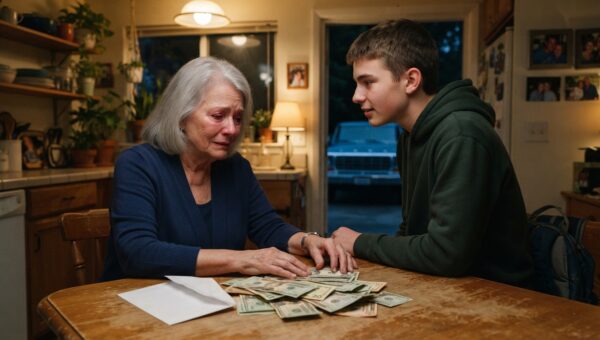
We went inside out of the damp air and sat at the kitchen table. The afternoon sun finally burned through the gray clouds, cutting a bright slant across the wood and warming the two mugs of coffee sitting between us. We didn’t talk about my father, and we didn’t talk about the cruelty of the brick building where I had wept alone fifty-six years ago. We talked about her grandchildren, about the flower shop where she worked, and about the way she always embroidered her own kitchen towels with the same uneven tension. As the afternoon wore on, the silence that had lived in this house since Arthur died began to thaw, replaced by the steady, comforting sound of another voice sharing the room. The past could not be undone, and the missing decades could never be given back, but the crooked letter sitting there on the table proved that some things survived even the coldest winters.