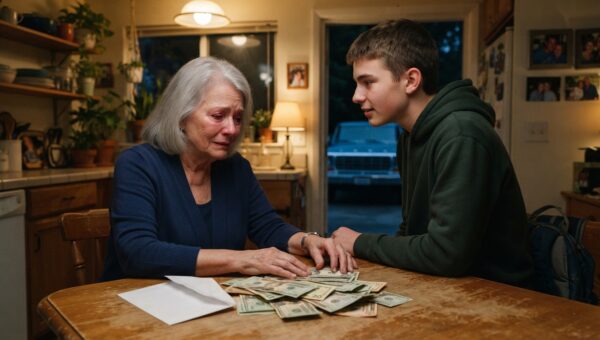
The kitchen smelled like lemon cleaner, cold gravy, and the burnt coffee Caleb had left sitting on the counter all morning. Sunlight came through the back window in a hard white square, bright enough to show every smear on the tile and every crumb his wife had watched me crawl around to collect. I was seventy-one years old, kneeling in my own kitchen, and Caleb stood behind me in polished boots that had never seen a day of real work, tapping one heel like I was taking too long.
Marissa leaned in the hallway with her red nails wrapped around a champagne flute, smiling the way people smile when they think cruelty is private. Missed a spot, Mother, Caleb said, and then his heavy boot came down squarely across my knuckles, pressing hard enough to grind my fingers against the grout.
I was scrubbing the kitchen floor on my hands and knees when my son deliberately stepped on my fingers with his heavy boots. Watch where you’re crawling, he grunted, while his wife giggled from the hallway. I slowly pulled my bruised hand away, stood up, picked up my heavy cast-iron skillet, and let the metal settle against the wood of the counter with a heavy thud that made the champagne flute in Marissa’s hand wobble. My knees throbbed where I had knelt for an hour trying to get up the grease spots Caleb left behind after his late-night frying.
Two years ago, when Arthur passed away and my joints started acting up every time the humidity rose past eighty percent, Caleb and Marissa sat at this very table and talked about safety and peace of mind. They told me a mother shouldn’t have to worry about property taxes or leaky roofs. They said sign the paper just so we can help manage things, and you’ll always have your room, your kitchen, and your quiet. I signed because I trusted the boy I raised, forgetting that people who want something for nothing will invent any story to get it.
Marissa stopped smiling when she saw the way my hand closed around the handle of that old skillet, the seasoned black iron that had cooked five thousand breakfasts in this house before she ever set foot through my front door. You’ve got grease on your hem, Marissa muttered, her voice losing that sharp little edge she usually used when she was giving me orders about the laundry.
I didn’t say a word to her. I looked past her down the dark hallway toward the master bedroom where my husband’s walnut dresser still sat against the wall, holding the metal box I hadn’t opened since the morning we went down to the county annex with the lawyer Caleb picked out. Caleb shifted his weight, his polished boots squeaking against the tile I had just finished washing. Come on, Ma, finish up the baseboards before the delivery guy gets here with the new patio chairs, he said, treating me like some hired help he could dock pay from if I moved too slow.
I walked right past him without looking down at my fingers, though the skin over my knuckles was already turning a dull, angry purple where his heel had caught me. The silence in the house changed the second I stepped onto the living room rug, the air thick with the smell of expensive laundry detergent Marissa bought with the grocery money I used to spend on good beef.
They thought I was broken because I moved slow in the mornings, because I let them take over the television after supper, because I stayed quiet when they brought their friends over and talked about me like I was a piece of antique furniture they inherited by accident. They forgot that I lived forty winters in this valley before Caleb ever learned how to drive a pickup truck. I didn’t stop until I reached the master bedroom, sliding the heavy wooden door open with a quiet click that made Caleb call out from the kitchen. What are you doing in there? We need those floors done before noon.
I didn’t answer him. I reached up to the top shelf of the closet, past the winter blankets that smelled of cedar, and pulled down the heavy steel box where Arthur kept his receipts and the original carbon copies from when we bought this lot back in nineteen-seventy-eight. My fingers were shaking just a little bit, not from fear, but from the kind of cold, steady anger that only comes when you realize you’ve been a fool for too long. Inside that box wasn’t just old tax forms. There was the supplementary agreement Caleb’s high-priced lawyer friend drafted in a hurry, the one with the specific rider about lifetime occupancy and the mandatory care stipulations that had to be met every single month to keep the transfer valid under state elder protection guidelines. They thought a quitclaim deed was the end of the story, but Arthur taught me to read every line twice before touching a pen to paper. They had missed three separate clauses regarding my medical independence and structural upkeep, and every single one of them gave me the right to void the whole transaction if my living conditions fell below standard.
When I walked back out into the living room, carrying the steel box in one hand and the heavy skillet in the other, Marissa was sitting on the sofa checking her fingernails. Caleb was standing by the kitchen island pouring himself another cup of coffee from the pot I had brewed at six o’clock this morning. You’re making a scene over nothing, Ma, Caleb said, not even turning around when my boots hit the hardwood. I set the metal box down right on the middle of the glass coffee table, right on top of a glossy magazine Marissa had left open. Sit down, Caleb, I said, and my voice didn’t shake at all. It sounded like Arthur’s voice when he had to tell the lumber yard foreman they sent a bad batch of oak. Caleb turned around, his mug halfway to his mouth, laughing that short, nervous little laugh he always used when he knew he broke something of mine and didn’t want to admit it. What’s this about? We don’t have time for your box of old junk.
Marissa stood up, her face tightening up like she smelled something burning on the stove. This is ridiculous, she said, reaching for her champagne flute again. We have people coming over for drinks at five, and the house smells like old bleach. You’re going to stay right here and listen to every word, I told her, and the look in my eye must have stopped her because her hand froze halfway to the glass. I didn’t raise my voice. When you get to be seventy-one years old, you learn that shouting just makes other people think they’re winning. I opened the steel lid and pulled out the crisp white papers with the blue county seal at the top, the ones they thought were gathering dust in some municipal drawer where nobody would ever look twice. I laid them out across the glass, right under the heavy iron skillet that I set down with a solid, resonant clang that made the coffee in Caleb’s mug splash over the rim.
You boys think you own this roof because of a piece of paper you made me sign when my head was full of grief after the funeral, I said, looking right up into Caleb’s eyes until he looked away toward the window. You thought you could put me in the small room by the laundry, feed me scraps from your dinner parties, and wait out the clock until you could ship me off to that county facility down by the interstate. Caleb set his mug down so hard the ceramic cracked, the brown liquid pooling across the laminate counter like dirty water. You signed that deed fair and square, Ma, he snapped, his face turning that blotchy red color he always got when he was cornered. It’s legally binding, and you know it as well as I do. It’s binding only as long as you maintain the care terms, Caleb, I told him, tapping my finger right on the paragraph Arthur made sure we added just in case either of us ever got too old to see the wolves at the door.
You haven’t paid my supplemental insurance since last November, and you haven’t kept the property taxes current out of your own pocket like the rider demands. I’ve been paying the insurance out of my survivor’s benefit while you two spend my grocery money on imported wine and new tires for Marissa’s car.
Marissa let out a sharp little gasp, her face going pale beneath her store-bought tan. That’s a lie, she muttered, taking a step backward toward the hallway. We’ve been more than generous letting you live here rent-free in your own home. It’s not rent-free when you’re working seventy-one-year-old fingers to the bone just to keep from being shoved down the stairs, I said, standing up straight and tall until I was looking down at both of them even without my thick-soled shoes. Here is how it’s going to go from this minute on. Either you take your boots and your clothes and whatever else you brought into my house and you are gone before the sun goes down tonight, or I walk this box down to Judge Miller’s office first thing in the morning and file the notice of breach that puts this entire property right back into my sole name.
Marissa started crying then, not real tears of someone who’s sorry, but the ugly, angry tears of someone who just realized their free ride had come to an abrupt and permanent end. You can’t do that to your own son, she hissed, her voice shaking with a mix of fury and panic as she looked at Caleb like he was supposed to fix it. Caleb didn’t say anything for a long time. He just stared at the heavy iron skillet sitting on the coffee table, then down at my hands where the purple bruise from his boot heel was starting to swell up nice and dark against my skin. He knew. He knew the whole time. He knew and he ate dinner with us every single night without a shred of shame.
I’m giving you until four o’clock to start packing your bags into that truck out in the driveway, I said, my voice dropping down to a quiet, steady whisper that filled every corner of the living room. If I see one box left in the hallway after four, I’m calling the sheriff myself and showing him the default notice I already filled out this morning before you even woke up. Marissa turned on her heel and stormed down the hall toward the guest room, her heavy perfume lingering in the air like a bad memory, and the door slammed so hard a framed picture of Arthur and me on the mantel crooked itself sideways. Caleb stood there for a minute longer, his mouth opening and closing like a fish out of water, trying to find some old authority that wasn’t there anymore. You’re making a big mistake, Ma, he muttered, his voice sounding smaller than it had in twenty years. No, Caleb, I made the big mistake two years ago on a rainy Tuesday in a lawyer’s office downtown, I told him, pointing right toward the front door. I’m just fixing it now before it gets too dark to see the path.
He didn’t say another word after that. He turned around and walked down the hall, his polished boots making a hollow, defeated sound against the floorboards that his father laid down with his own calloused hands back when this valley was still full of people who meant what they said. I stayed right there in the living room for a long time after the front door clicked shut behind him, listening to the sound of tires crunching over the gravel in the driveway as his truck backed out toward the main road. The sun shifted through the back window, moving off the dirty tile and hitting the clean, dark surface of the cast-iron skillet resting securely in the center of the kitchen counter where I had wiped it spotless with my own hand. It didn’t look like much to anyone else, just an old piece of heavy metal that had cooked a thousand simple meals, but looking at it now, I knew it was the only thing in this house that had never lied to me.